
By: Ted Dabrowski and John Klingner
President Biden is pushing for $350 billion in state and local aid as part of his $1.9 trillion COVID relief bill, but an analysis of state financials across the country shows he should scrap his plan.
The money simply isn’t needed.
The billions in reserves states had prior to the pandemic – plus their share of $150 billion in the CARES Act – more than covered the dire revenue shortfalls most states projected at the beginning of the pandemic.
Combine those emergency funds with better-than-expected 2020 revenues and the case for more state aid makes little sense.
We now know states didn’t suffer the heavy revenue blows they expected in 2020. Trillions in federal relief funds led to a surge in personal incomes, buttressing tax collections. As a result, overall state tax revenues across the country in calendar year 2020 declined less than 1 percent compared to calendar year 2019. That’s a far cry from the combined 12 percent drop in revenues originally projected for FY 2021.
When the pandemic started, California projected a $42 billion revenue shortfall over FY 2020 and FY 2021. Instead, the state has ended calendar year 2020 with a $6.2 billion increase compared to 2019.
Connecticut faced a similar scare. Officials there projected an $8.4 billion drop in tax revenues through 2024. Those predictions haven’t panned out. So far, the state’s tax revenues have ended calendar year 2020 down just $240 million vs. 2019.
Even Illinois – the nation’s fiscal basket case and the least prepared for an emergency – nearly broke even in tax collections compared to the year before.
That same story played out in many states across the country; twenty states ended up with higher tax revenues than in 2019. Another 15 had year-over-year losses of less than 5 percent.
Below, we take a state-by-state look at how rainy-day funds and CARES Act aid more than made up for most of the state’s dire revenue projections.
We then look at each state’s actual calendar year 2020 revenues, showing those negative projections never materialized for most states. That strengthens our case that more aid is unneeded.
Last, we look at the calendar year revenues of several prominent blue states, those most vocal in calls for increased federal aid. The better than expected revenue performance in those states greatly diminishes their case.
Reserve funds, CARES Act cover most state’s negative revenue predictions
Even during the early days of the pandemic in April and May – when revenue shortfall projections were at their worst – the situation for states wasn’t as negative as commonly thought.
Wirepoints added up each state’s fiscal year 2020 and 2021 projected revenue losses, as provided by the Center for Budget and Policy Priorities, and compared that sum to the combined amount of reserve funds and CARES Act funds available to each state. Based on those numbers, we found most states had more than enough emergency funds to cover their projected combined revenue losses.
Texas, for example, estimated in July it would suffer a combined $13 billion in lost revenues for fiscal years 2020 and 2021. That decline, however, was more than covered by the state’s $15 billion in reserves and $8 billion from CARES.
Similarly, Ohio predicted a two-year shortfall of $4.7 billion, but that was more than offset by nearly $8 billion in reserves and CARES funds.
On the other hand, California originally projected two-year revenue losses of nearly $42 billion. But the state’s $22 billion in reserve funds and another near $10 billion in CARES funds brought that shortfall down to $10 billion, equivalent to 5 percent of the state’s 2019 revenues.
 In all, Wirepoints’ analysis found only 12 states faced a shortfall in fiscal years 2020 and 2021 after taking their emergency funds into account. The cumulative shortfall for those 12 states totaled $47 billion.
In contrast, the remaining 38 states had a combined revenue surplus totaling $71 billion, resulting in a net surplus across all 50 states of $24 billion.
 It’s important to remember, however, that the calculations above were based on the alarming revenue predictions made early on in the pandemic. The good news regarding revenue collections for all of 2020 was yet to come.
States’ negative revenue predictions never materialized
Nine months after most states released their initial negative revenue projections, we now know most of those losses did not occur.
Actual calendar year 2020 revenues came in far stronger than expected for most states. Wirepoints estimated ten states actually achieved a net revenue increase in 2020 and another 21 states experienced revenue declines of less than 5 percent. In all, actual calendar year 2020 revenues declined by an estimated $33.5 billion. (See Appendix C.)
That’s a far cry from the $103 billion decrease states originally predicted for calendar year 2020. In the end, states lost just a third of what they expected.
Applying those revenue adjustments to the graphic above makes it clear the financial situation for states is even better – and federal aid even less necessary – than it was months ago.
The number of states still suffering a revenue shortfall drops to six – with a combined loss of just $12 billion. The other 44 states have a combined surplus of $105 billion.
 What about the few losing states?
The biggest losing states in the nation are three of the “usual suspects” when it comes to stories of financial crises: New York, Illinois and New Jersey.
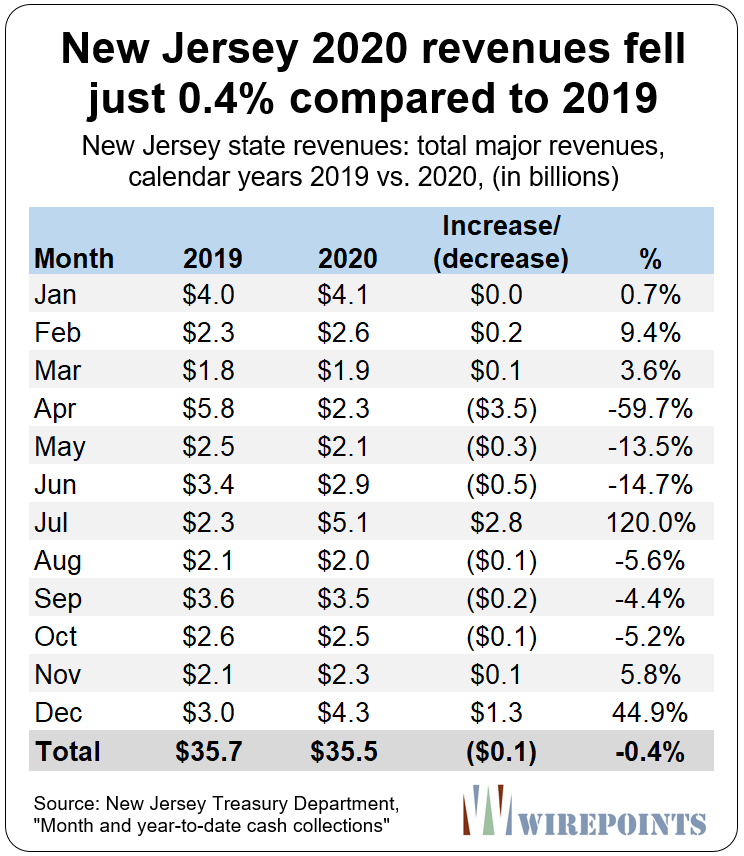 Those three states have been among the loudest calling for more aid. But all three have tax revenues that have survived COVID mostly intact. It’s their pre-pandemic financial mismanagement that’s giving them budget problems.
The Wall Street Journal warned last October that New Jersey was “expecting a more than $5 billion revenue decline for the 2021 budget year, a 13% drop from the state’s pre-Covid projection.”
That meltdown has yet to materialize. A month-by-month comparison of New Jersey tax revenue collections in calendar year 2020 shows tax collections were down just 0.4 percent, or $150 million, compared to 2019.
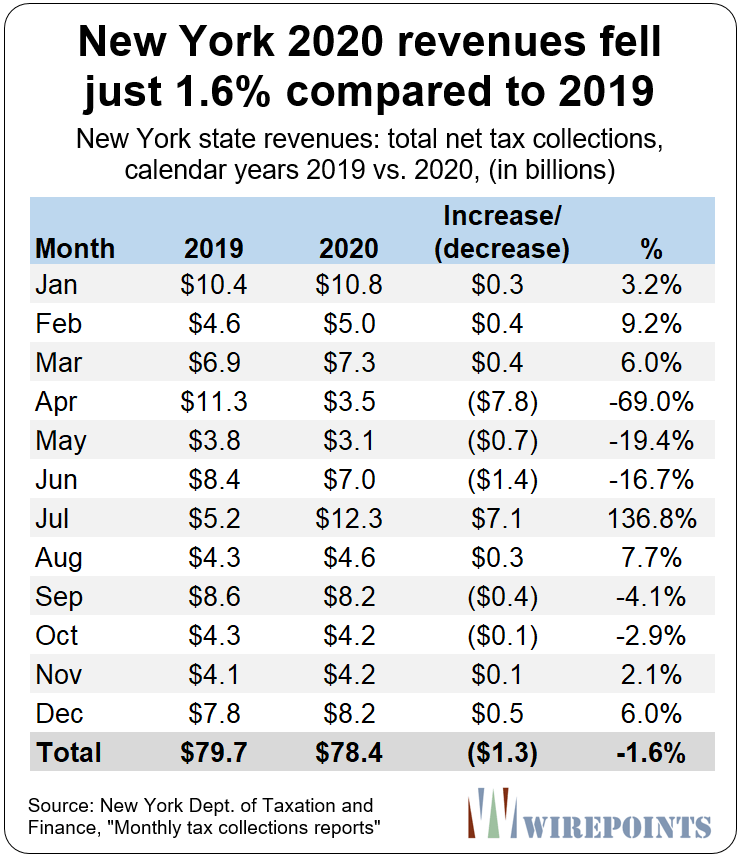 New York was arguably ground zero for the COVID-19 pandemic (though a case can be made for New Jersey – it has the nation’s highest per capita deaths). It had every reason to expect COVID to have a heavy impact on its finances. Early on in the pandemic, the state released projections of a $13.3 billion shortfall, or 14%, for its fiscal year 2021 state budget.
A look at year-over-year tax revenues for calendar 2020 shows New York actually experienced a revenue shortfall of just $1.27 billion, or 1.6 percent of its 2019 total.
Illinois is worth covering in greater detail. It’s yet another blue state where dire predictions never happened. The state ended calendar year 2020 with a shortfall of less than 1 percent compared to 2019.
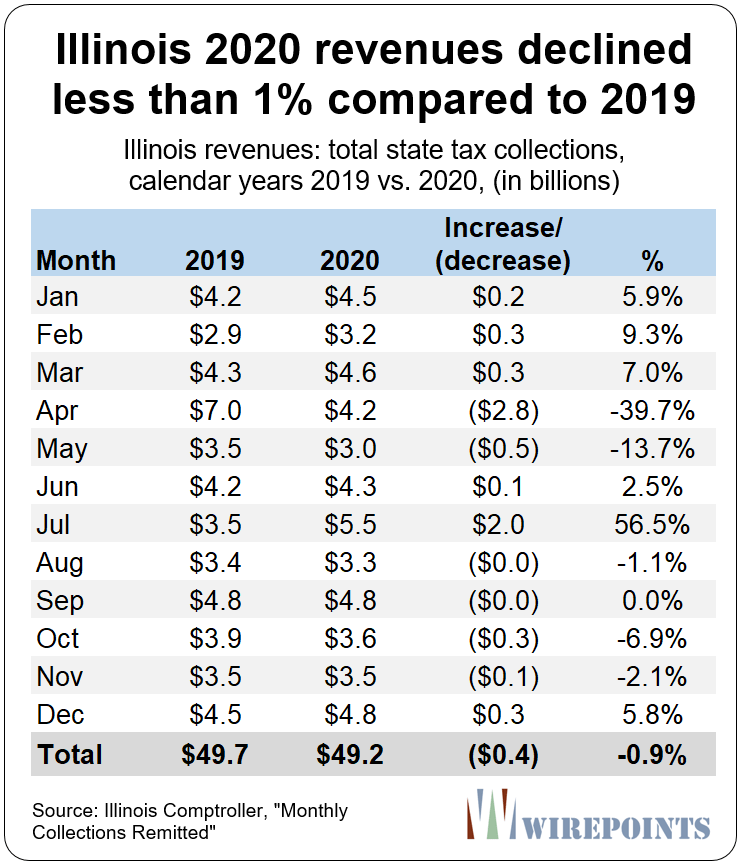 What makes Illinois special has been its loud, consistent calls for more aid. Illinois’ initial request was the most blatant example of a state asking for federal funds to fix its pre-pandemic crisis. In April, the state’s senate majority leader publicly requested from Congress bailout funds worth $42 billion – much of it for state and local pension debts.
That request was rebuffed, but Illinois politicians never adjusted to that reality. Instead of controlling costs to meet the challenge of the pandemic, Illinois politicians continued to spend.
For example, at a time when other governors were canceling or suspending raises, or even cutting pay, Gov. J.B. Pritzker instead gave state AFSCME workers a pay hike worth $260 million – never mind the fact that Illinois state workers were already some of the nation’s highest paid.
In all, Illinois grew its budget for fiscal year 2021 by $2.5 billion compared to the year before. State lawmakers then “balanced” a resulting $6 billion shortfall by assuming the federal government would provide at least $5 billion in additional federal aid. Their gamble will pay off if the new federal stimulus passes.
Years of financial negligence
Blue states like those above cannot easily blame their deficits on the pandemic considering their revenues are coming in better than expected. Nor do their deep financial issues stem solely from an inability to control costs in the face of the pandemic. If they’re suffering budget problems, it has more to do with their pre-pandemic crises than anything else.
States like Illinois, New York and California have long histories of financial negligence. California ran a budget deficit during seven of the last 16 years, according to a Wirepoints analysis of Pew Charitable Trust data. Connecticut has 10 years of deficits to its name. New York has 11. And Illinois and New Jersey have run budget deficits every year since at least 2004.
 And then there’s the problem of pensions. States like Illinois, Connecticut and New Jersey all have amassed hundreds of billions in pension debt – all self-inflicted by state lawmakers.
The pandemic had nothing to do with those past deficits and debts, but that’s exactly what more federal aid would end up paying for.
More aid makes no sense
Economists on both sides have warned that the full $1.9 trillion package might overheat the economy, with those on the left arguing for a smaller package and the right arguing that no stimulus is needed at all.
Not to mention that filling the coffers of state and local governments with $350 billion more in federal cash will likely do more harm than good.
Many states will be able to extend their lockdowns – prolonging economic damage and individual suffering. Other states with structural problems will use the money to paper over their finances and avoid reforms. That just perpetuates their bad behavior. And well-run states will be left with billions in revenues they don’t need.
As far as another state aid package goes, it’s just not necessary.
Appendices
Appendix A. Data sources
Wirepoints assembled the following data for each of the 50 states:
- FY 2019 total tax revenue: Actual 2019 revenues that serve as a base comparison between fiscal years. Data retrieved from the U.S. Census Bureau’s “2019 Annual Survey of State Government Tax Collections.”
- FY 2020 projected revenue losses and FY 2021 projected revenue losses: Losses compared to their pre-pandemic estimates. Data retrieved from the Center for Budget and Policy Priorities’ “States Grappling With Hit to Tax Collections” and individual state reports.
- State reserve funds: The amount in reserve funds each state had going into FY 2020. Total based on each state’s rainy-day fund and their FY 2019 general fund ending balance. Data retrieved from the Pew Charitable Trusts’ Fiscal 50: State Trends and Analysis.
- CARES Act funds: The amount each state received in total federal funding from the $150 billion distributed through the Coronavirus Aid, Relief, and Economic Security Act to states and local governments. Data retrieved from the U.S. Department of the Treasury’s “Payments to States and Eligible Units of Local Government.”
- Actual calendar year tax revenues: The amount each state actually collected in revenues in calendar years 2019 and 2020. Data retrieved from the Reason Foundation’s “Initial 2020 Revenue Figures In Many States Are Higher Than Expected.”
Appendix B. Actual calendar year 2019 tax revenue vs. actual calendar year 2020 tax revenue
 Appendix C. Early-pandemic projected 2020 revenue losses vs. actual 2020 revenue losses
To make the calculations in the following graphics, Wirepoints made two assumptions:
Projected calendar year 2020 losses: Each state’s fiscal year 2020 and 2021 projected revenue losses were combined and divided in half to extract an estimate of calendar year 2020 losses (calendar year 2020 straddles fiscal year 2020 and fiscal year 2021, which is true for nearly every state in the country).
Pre-pandemic calendar year 2020 revenue estimates: 2019 state tax revenues grown at 3 percent. To our knowledge, no calendar year 2020 pre-pandemic estimates exist.


 A mess of uncertainty and litigation is sure to follow.
 With $162 billion more from taxpayers, couldn’t you deliver a few bond upgrades, too
 Audio and summary
All the pricks and witches in Springfield will cry cry and they will steal all the money from taxpayers like they already do.
Even if some states don’t need a bailout you all know putzker will have his hand out faster than when he can get a free whopper at Burger King!!
Sorry friends…but nothing anyone does, says or absolutely proves related to…well, anything in government matters anymore. Tax payers and regular people are not listened to and we have absolutely no voice or visibility in this Country.. The elite/wealthy/celebrities are now in charge and don’t you forget it…not that they will let you. This spending bill will pass and it will include the $350B and it will get used for useless pension debt and other pay-back “programs”.. No doubt. I just hope they get on with it, so the state financially looks better and perhaps my home value will go up… Read more »
Great articale wp!! If and when $350 bill state and municipal fed bailout goes thru the moral conundrum for dems is your going to have an Illinois & NJ using thier bailout $bucks$ to directly or indirectly make a small dent in massive pension debt which benifits UPPER INCOME STATE WORKERS & RETIREES (many of whom are projected mult millionaires not poor folks) and maybe small crumbs to all the systemic inequality stuff dems keep championing. While largely debt free states like Texas & Florida are gooing to have more money then they know what to do with to provide… Read more »
But it looks like dems will pass bailout thru congress using reconciliation process, so then i assume they can also set the terms/ criteria on what states get what vrs simply distributing $350 billion on per capita basis. They could then funnel greater % of funds to irresponsible illinois that didn’t open up economy, based on unemployment # vrs a Florida which has done a fantastic job keeping economy open, unemployment low and debt low.
Excellent job WP! We knew it was a politicized hoax from the start – Now you proved it!
I don’t think the Fed bail-out of Illinois has anything to do with 2020 state tax revenue income. Nope. It’s payback for 2020 Election for blue states, for delivering the vote, by hook and crook. Illinois reliably demonstrates, particularly in Chicago and Cook, the dead vote Democrat. The green-card and undocumented “black and brown” immigrants vote Democrat, as Durbin knows, given his single-issue “legitimizing undocumented immigration” advocacy in all his years as senator. Pritzker is a diehard Democrat with a fat checkbook who dutifully toes the national Democratic Party platform, no matter how contrary to the interests of his voter-constituency.… Read more »
Based on history, Illinois will misuse the stimulus bailout. The death spiral may change speeds occasionally but the direction is a constant.
On the plus side the fed money will buy my remaining Illinois family and friends a little more time to close out their affairs in Illinois and get out. Some have kids graduating soon or spouses about to retire. Once that happens, they are gone.