
Citing improved state revenue projections, Gov. Pritzker recently announced the state would go through with a planned $350 million increase in funding for K-12 public education – something he originally left out of the 2022 budget.
“Parents, students and educators can breathe a sigh of relief,” Pritzker said. “As an education advocate myself, I am really all too happy that our improved economic and fiscal condition allows us to increase educational funding.”
That language rings hollow to the many Illinois low-income kids that depend on the state’s only school choice program, the Illinois’ Tax Credit Scholarship Program. Begun in 2017, the program currently provides 7,600 low-income children with the opportunity to attend schools of their choice.
Pritzker called for a weakening of the tax credit in his list of $932 million in “corporate loopholes” cuts he said was necessary to balance the FY 2022 budget. Reducing the credit which would save the state $14 million.
Nevermind the vastly improving state revenue forecasts. The latest good news comes from COGFA.
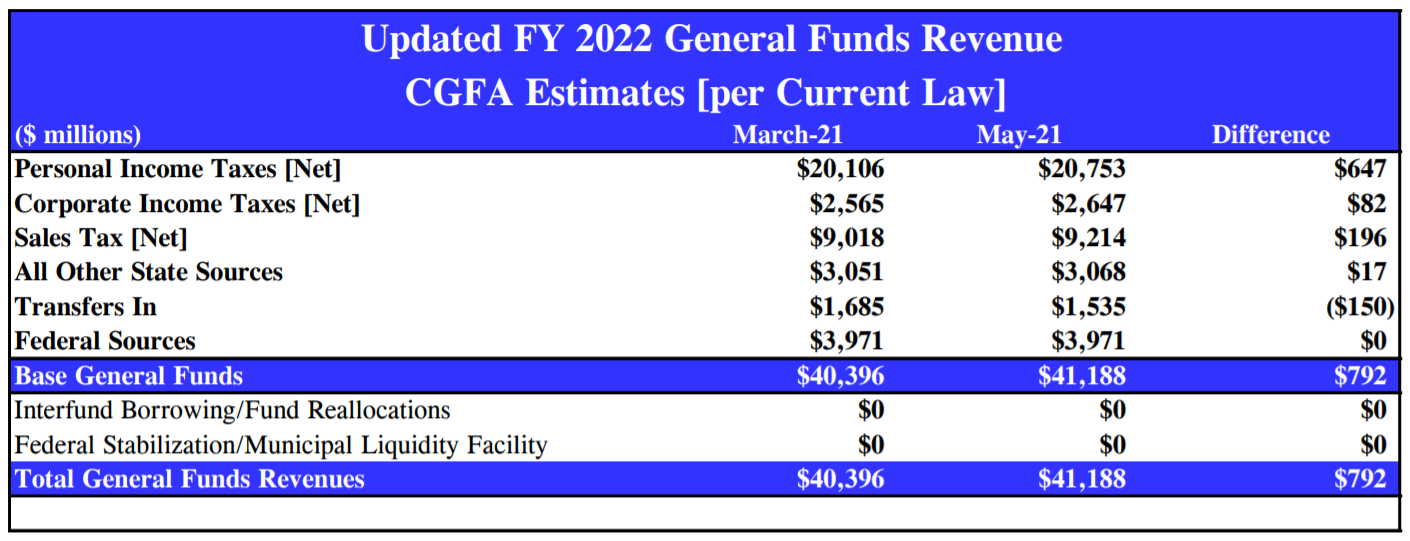
As shown, the Commission’s May revised FY 2022 base general funds estimate of $41.188 billion reflects an increase of $792 million from our March forecast. Unsurprisingly, most of the upward revision resides in the larger economically-related sources such as income and sales.
 – Ted Dabrowski and John Klingner
 New Trier High School made national headlines nine years ago as a “canary in a coal mine” for political indoctrination in public schools. The canaries lived.
 Among the consequences of economic growth that badly lags national averages are billions of lost revenue every year. Yet denial reigns in Illinois, fueling the vicious cycle of demand for higher taxes.
One way to improve anything is to have competition. School choice (which in this case is the Illinois Tax Credit Scholarship Program) is competition to the public schools. The program allows anyone, typically wealthy people, to donate money to a designated fund that is used by poor people (majority black and brown?) to attend a private school. In exchange, those donating the money receive a state income tax credit (thus the state gets less revenue but poor people get school choice). Thus Governor Pritzker is preventing the improvement of public education by reducing the school choice budget line item in… Read more »
The Illinois Tax Credit Scholarship Program is also known as the Invest in Kids Act (IIKA). Do you disagree with Governor Pritzker’s proposal to cut $14 million from the IIKA program? Here some salt for the wound. IIKA was part of Public Act 100-0465 (PA 100-0465) which is the same law that included $350 million additional annually for public education. I don’t think there were any proposed annual increases for IIKA in PA 100-0465). But flat is not good enough for Governor Rauner. Governor Pritzker proposes to cut $14 million from IIKA in the FY 2022 state budget (in other… Read more »
It seems the Governor and General Assembly did not pass laws to appropriate the $350M into some annual state budgets, as explained partially in the following article.
http://www.nprillinois.org/post/state-high-court-weighs-again-whether-education-funding-goals-are-constitutionally-required#stream/0
Thus the calculation in the above comment is erroneous.
So state funding for public education has increased since FY 2017, but less than is indicated in the calculation.
He’s an “education advocate”. Who in the world would ever come out against education? But he’s an advocate who places the education of low income kids well behind the welfare of his union and progressive buddies who see educational choice the same way vampires see a crucifix.