
By: Mark Glennon*
What will Chicago’s problems mean for it in the long run? We can’t answer that comprehensively, but let’s look closely at some recent positive headlines. Yes, there are some, though the good news is qualified and may depend on your own circumstances.
- First, and perhaps most surprising, apartment dwellers are returning to the city.
In 2020, as the pandemic, crime and work-from-home surged, the downtown apartment occupancy rate dropped to 86.5% at the end of 2020 from 93.3% a year earlier. That’s according to a Crain’s report based on data from Integra Realty Solutions.
But apartment renters returned last year, pushing occupancy up to 94.7% at year-end, which was higher than pre-pandemic 2019. Apartment absorption, which is the rate at which empty apartments are leased out, rose to a record 7,084 units in 2021, according to the Crain’s report.
The flipside on that turnaround is what you would expect. Downtown apartment rents are way up. They rose more than 30% in 2021, and Integra expects them to jump another 5% this year, said Crain’s.
• Turning to downtown office space, the story is trickier.
On the surface, official vacancy rates may seem manageable. Year-end 2021 office vacancy rates were about 18 percent in the central business district, according to NAI Hiffman research. That’s 44% percent higher than pre-pandemic 2019, but still seems like a hole that would fill with time.
The problem, however, is that official vacancy rates don’t tell the whole story because they only measure how much space is leased out. The real issue, instead, is whether that space is truly being used.
How many butts are really in the seats? If true usage won’t return because of the work-from-home trend or persistent problems, leases won’t get renewed.
For that butts-in-the-seats, the best measure seems to be data on card swipes and visitor passes for office entry. That data is published by Kastle Systems, a leading provider of security systems, and is often cited in the real estate world. They report office entries as a percentage of entries pre-pandemic.
That measure shows that a whole lot of office space is going unused — in Chicago and nationally — despite recent improvement. For the most recent week, just 35% of Chicago office space was being used, compared to a national average of 40% for big cities. Sunbelt cities are generally doing better. Here is Kastle’s chart over time for their measure of occupancy:
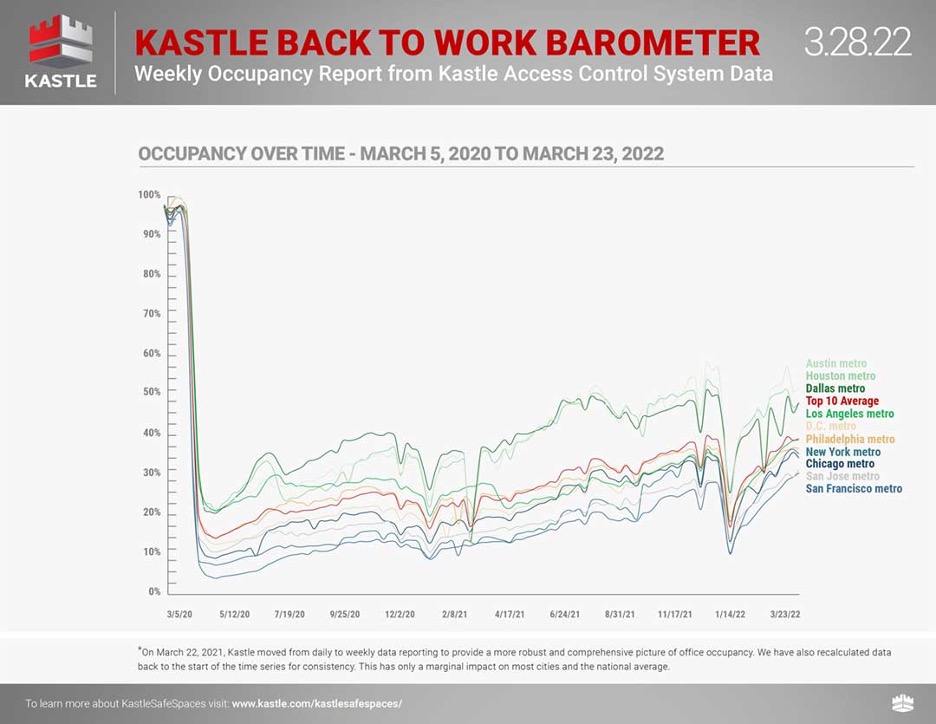 Will that measure of true occupancy return to anything comparable to pre-pandemic? The fate of major cities may turn on that question. A recent Wall Street Journal column about Midtown Manhattan put the matter bluntly. Like Chicago, Midtown has seen residential occupancy improve while offices remain mostly empty. New York planners are “imagining the unthinkable,” says the Journal, which is that Midtown’s economy “might never be the same.”
We’ve heard no such candor in Chicago.
- Chicago area home values are up by double digits for nine months straight. Cause for celebration?
The most recent Case-Shiller home price index came out this week. As of January, Chicagoland home values are up 12.5% on average compared to a year ago.
That’s nice if you already own, but not if you are a first-time buyer or hoping to take a major step up to a nicer home.
More importantly, if you think that growing value will help you afford a nice place in a different location after retirement, forget it. That’s because Chicago’s growing values haven’t nearly matched most other cities around the nation. Home prices nationally rose 19.2% year over year, according to the index. Destination cities like Phoenix, Tampa, Florida, and Miami saw the biggest annual gains at 32.6%, 30.8% and 28.1%, respectively. Of the major metros covered by the index, Washington, D.C., Minneapolis and Chicago saw the smallest annual gains. That discrepancy between Chicago and most other markets has persisted for years.
On the positive side, however, lower prices help keep Chicago more affordable. That’s perhaps the major factor offsetting at least some of Chicago’s problems. For a major, international city, it’s comparatively cheap.
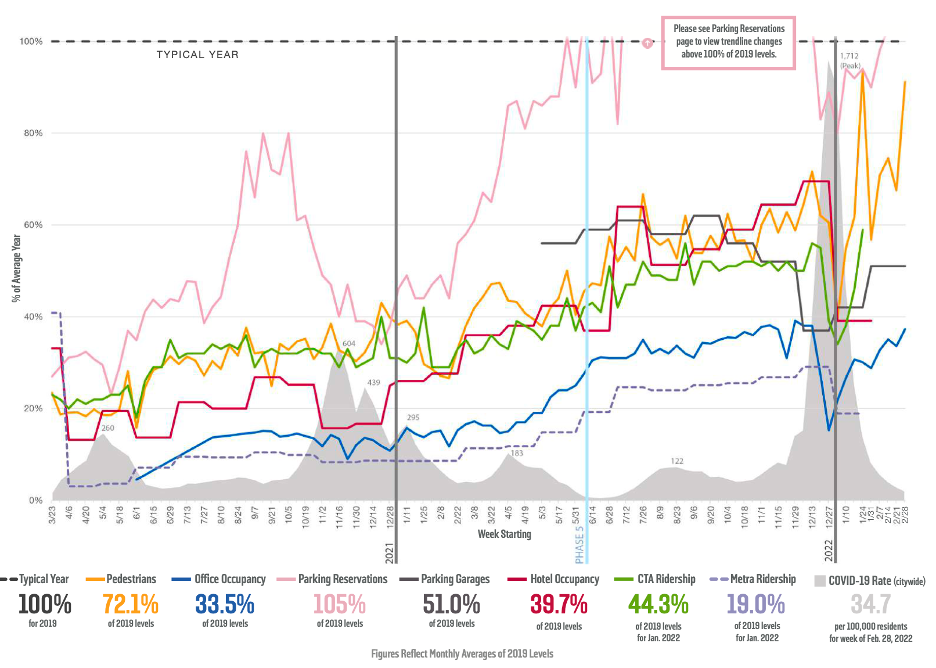
- Hotel occupancy and Metra ridership are up, but still dismal.
Tourists and convention visitors are a vital part of Chicago’s economy and tax base. Hotel occupancy provides the metric. It’s up, but still awful. Nationally, hotel occupancy is running at 56.9% of pre-pandemic levels, according the most recent reports. Chicago hotels, however, are at 43.8%.
Riders on the primary mass transit for suburban commuters to Chicago, Metra, also have improved but remain very low. Ridership varies by month, but has been running at only about 20% to 30% of pre-pandemic levels.
Here is a nice aggregation of much of the above data, and more, provided by the Chicago Loop Alliance. It is all measured as a percentage of pre-pandemic levels:
 We will continue to report whatever good news we see.
*Mark Glennon is founder of Wirepoints.
 Expect no retraction or apology. This what they do.
 The state’s existing buyout program for its own pensions is the precedent for Chicago, which should be a warning: Look out for similar exaggerated claims and shoddy analysis.
The bottom line is as the university educated young people venture out from Chicago, they discover how far behind Chicago and Illinois are from much of America, particularly the free and prosperous Red States. The gap is becoming dramatic. Chicago and Illinois will have more and more of what is not desired for a healthy society – uneducated, illiterate, unvaccinated illegal immigrants looking for handouts and menial labor.
“Chicago and Illinois will have more and more of what is not desired for a healthy society – uneducated, illiterate, unvaccinated illegal immigrants looking for handouts and menial labor.”
With a large managerial class of high upper middle income earners who mostly share the same progressive political beliefs. AKA Clownifornia.
The ‘managerial class’ is losing it’s smugness as the Wildlings have discovered the Mag Mile is theirs to loot. Chicago has declared property crimes ‘victimless’, which is a bonanza for the Wildlings. Insurance companies are the suckers.
The work from home trend started over 10 years ago. Covid just accelerated it. Companies will be forced to adapt or perish. Homeowners will want a dedicated study room where they will be isolated from the rest of the family. High tech home offices will continue to phase out corporate campuses. It’s good news for residential real estate as people desire larger homes and bad news for those owning office real estate. If you think that everything will be back to normal for students as covid concerns diminish, think again. Perhaps snow days will be virtual learning days in the… Read more »
Remote learning is going to be used to give students exposure to teachers outside their school district. Imagine a teacher with a unique specialty being able to reach 100 students and being paid a stipend for every student outside the district. Instead of a rural district spending $50K on a teacher for only a few students, they can pay $1,500 for access to that teacher and the teacher keeps 80% with the rest going to the host district to cover technology and support costs. Allows teachers to be entrepreneurial, even competitive. Win-win for everyone.
While our office is officially “back to normal” and encouraging people to com in, it is most definitely not near pre-pandemic levels. The folks that used to come in 3-4x per week are down to 1-2. I used to WFH maybe once every 2-3 weeks but it’s now once per week. My spouse has set foot in the office only a handful of times over the past YEAR and that probably won’t change. There’s a new paradigm. No $7 lunch, no $5 CTA, no $3 coffee, no 60-90 minutes of your life flushed down the toilet commuting five days per… Read more »
One group I fear may be harmed by remote working is young people. Most of us formed great friendships when we were young at the office, and learned much from others, especially senior people. From what I can tell, the young are still attracted to working in an office, though they like some flexibility. But for us older folks, I agree with you that it’s hard to imagine going back to the old commuting routine. However it shakes out, this is a major earthquake for city planning, sociology, transportation and more.
The “open concept” has been a double-edged sword for most employers. Everyone jumped on the collaboration bandwagon but forgot workers still need to concentrate. Some can do that much better from home as opposed to their wall-less cubicle. The big issue will be new employee onboarding. It’s easy to WFH after you’ve been there a couple years. Will a new employee feel isolated if most of his team is remote? It’s the employers with collaborative spaces and fringe benefits (free vitamin water or alcohol permitted) that might continue to draw the youngsters in. I worked at a software company where… Read more »
Nixit, I assume you must be high enough up at that software company that nobody hassles you about spending time putting smart comments on Wirepoints.
“The “open concept” has been a double-edged sword for most employers. Everyone jumped on the collaboration bandwagon but forgot workers still need to concentrate.” Open Concept is worse than that. Open concept means cheaper, smaller spaces for employers but it was sold as ‘collaboration’ for the employees. I’ve yet to meet an employee who enjoys working in ‘open concept’. It’s like being packed in a classroom for 8 hours a day. You smell your co-workers purfume, they sneeze on your paperwork or keyboard, you hear about their personal life in telephone calls, many just throw on headphones all day so… Read more »
It’s the employers with collaborative spaces and fringe benefits (free vitamin water or alcohol permitted) that might continue to draw the youngsters in. There is no real good answer to solving the mentoring process for employees in a work from home era. Especially when employers realize they can labor arbitrage or expand their hiring pool by hiring remotely. My spouse’s job still only wants to hire local people, and remain WFH 2-3 days a week, and they have many decent candidates who drop out of the interview process when they realize they have to move to Chicago. They don’t want… Read more »
Spot on, Mark. Pre-pandemic when I still worked a financial job downtown, our younger hires really benefited from have experienced people around. I worked in a large open air office, so even overhearing a phone call could lead to giving advice or guidance to someone. Asking a question out loud to the whole team was also a benefit. But it’s also one’s personality that determines if you’ll thrive or not in a remote environment. The value of camaraderie cannot be overstated in making a job enjoyable. I never used to like WFH because I had an easy commute to downtown… Read more »
Big Business did confront Lori about the crime. Last year, not in 2020. This was her deputy’s response: “They’re yelling at me about the crime in downtown Chicago,” he said during a July 15 meeting of the Chicago Police Board, which he previously served on. “I told them, ‘Y’all need to get in your car and go to Gresham, Austin, Lawndale, Englewood, Roseland.’ “Don’t come to me, yelling at me about the crime downtown,” he said. “I’m sorry that Suzie who lives in Lisle thinks she’s afraid to come downtown because the last 18 months she’s been working in her… Read more »
They also had access to a secret/VIP slack chatroom or something where they would get updates about security measures taking place, and property managers would email their staff and tenants with up to date information about riots, protests, police activity.
But that didn’t actually solve any crime problems because slack is nothing more than keyboard warrioring.
Business now knows it’s pointless to deal with city leaders as in the past. And whoever is mayor after Lightfoot will be the same. There is no Rudy Giuliani waiting in the wings.
The only thing that will get their attention will be firms leaving en masse. We shall see if Ken Griffin’s Citadel decides to leave.
They’ll just shrug off Citidel’s departure, when it eventually happens. Griffin is a republican so they’ll just say that they are happy to see him go because he doesn’t represent Chicago’s values. Lori watched the Bears leave Chicago and said, more or less, “Don’t let the door hit your butt on the way out!” If there’s anything we should know, it’s that ideologues don’t share your values – they have zero interest in catering to big business or private equity or keeping downtown safe. Downtown is an outward symbol of white supremacy and wealth and destruction is the point. To… Read more »
debtsor I agree 100%.
You have accurately summarized the city’s future.
With the threat of a carjacking on the highway, a mugging on the train or a flash mob on the streets, along with the Millennial generation loving the WFH phenomenon, long term prospects for butts in seats are dim. The downstream effect – lower parking revenues, fewer restaurant patrons, fewer conventions and lower tourist volume – suggests Chicago is in for a long economic downcycle.
There’s a 100+ reasons why downtown is a ghost town, but for me, it was the realization in March of 2020, that after 20 years of commuting by crowded train, or standing on a gross bus, or 70 minutes of bumper to bumper traffic – I just wasn’t going to do it any more. Being one of the 1,000,000+ rats funneling into a in a few square miles near the lake, five days a week, during a majority of my waking hours…I just lost all desire to live that lifestyle. I suspect hundreds of thousands of others feel the same.… Read more »
Situational ethics and morality of convenience. This is a recurring theme of most politicians. I’m no fan of virtue signalling, nor the globowhatever, but I have to say, if going downtown was lucrative, you’d all do it. I’m reminded of Ricky Gervais at t(e Golden Globes when he told all the liberal frauds that if Isis started a streaming service, they’d all be 8n the phone with their agents! The economy is shifting though. With the tech we have today, there’s little need to meet face to face anymore. Also, even though many of you yahoos out there think Covid… Read more »