
By: Ted Dabrowski and John Klingner
Last month Wirepoints wrote about how Illinois’ progressive and equity-focused policies – among the nation’s most extreme – have inflicted harm on the state’s minorities, particularly its black residents. Far from reducing racial gaps, a devotion to DEI policies has seemingly only amplified them.
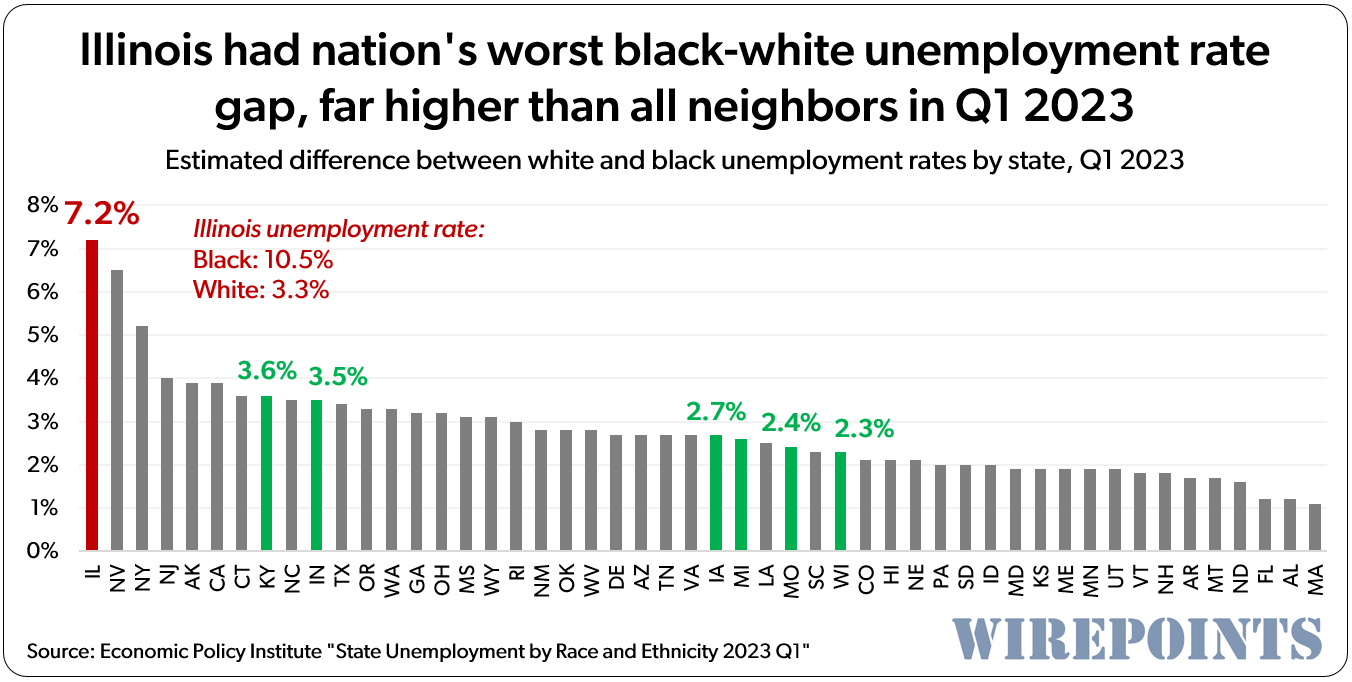
Racial employment data from the Economic Policy Institute revealed the following (see appendix):
- Illinois’ black unemployment rate was the nation’s 2nd-highest, at 10.5 percent, in Q1 2023.
- Illinois had the nation’s biggest gap between its black and white unemployment rates: 7.2 percentage points.
- The gap between Illinois’ black unemployment rate and the national average for blacks in 2022 was the worst in at least 20 years: a difference of 4.8 percentage points.
The same problem holds true for measures downstream from employment, like poverty and household incomes. Unsurprisingly, Illinois is also ranked as a national outlier.
Wirepoints found that nearly a quarter (24.7 percent) of Illinois blacks live below the poverty line according to 2021 Census data. That’s compared to just a bit over 8 percent for white residents.
That puts the black poverty rate at three times the rate for whites, making it the 6th-worse gap of any state in the nation.
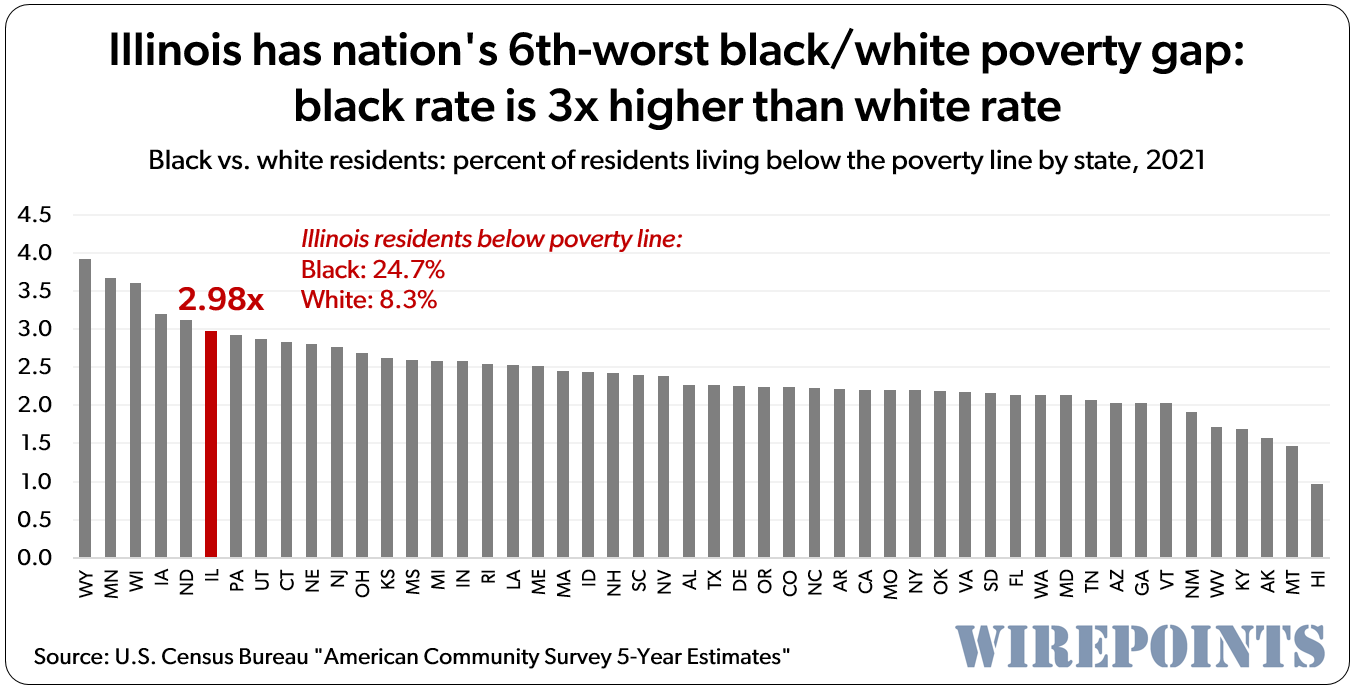
Most of Illinois’ neighbors have smaller poverty gaps. Kentucky’s black poverty rate is 1.7 times higher than its white rate, the nation’s 4th-lowest gap. And Missouri’s black rate is 2.2 times higher.
Only Wisconsin and Iowa fare worse than Illinois. In Iowa, the black poverty rate is 3.19 times higher than for whites. In Wisconsin, it’s 3.6 times higher.
Illinois has an even worse racial gap when it comes to household incomes.
The black median household income in Illinois is $43,000 a year while the median white income is $80,001. That means median black household incomes are only 54 percent of white incomes – the 3rd-worst ratio in the nation behind only Louisiana (52 percent) and Wisconsin (50 percent).
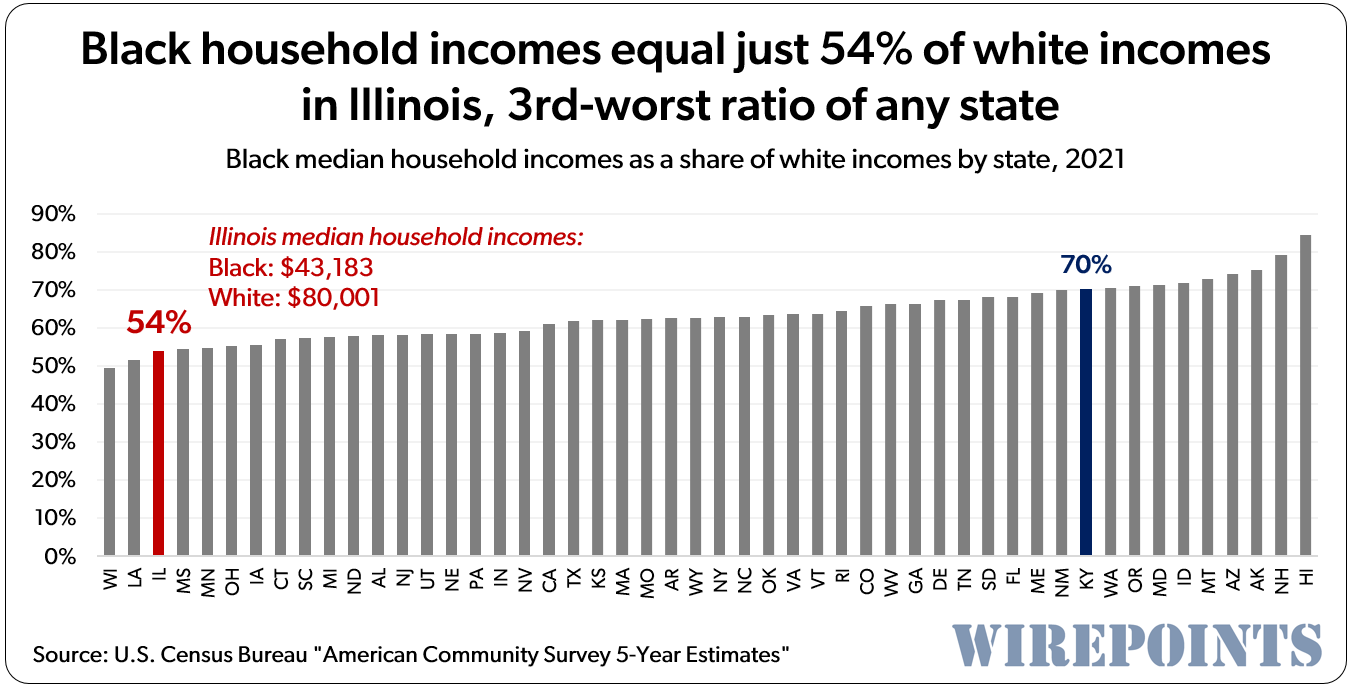 Again, the rest of Illinois’ neighbors perform far better. Kentucky has one of the nation’s smaller gaps, with black incomes ($40,335) equal to 70 percent of white incomes ($57,542). And Missouri’s black incomes are 62 percent of white incomes.
***********
Gov. Pritzker has boasted more than once that Illinois is the nation’s “most progressive state and proud of it,” as if the policies enacted by him and his fellow Democrats over the past years and decades – from affirmative action in hiring, to race-based social spending to guaranteed income programs and much more – are proof that Illinois is living up to the ideals of “equity” between whites and blacks.
The actual results on jobs, poverty and income show exactly the opposite. More handouts, programs and spending at the expense of real jobs and natural investment has only exacerbated racial gaps in Illinois.
Read more from Wirepoints:
- ‘Equity’ Fail: Illinois blacks suffer nation’s 2nd-highest unemployment rate, largest black-white gap
- 50 years of failure: Norman Lear’s ‘Good Times’ first criticized Chicago’s policy of automatically passing students in 1974. It’s still happening today.
- Chicago’s progressive agenda has been destructive for black communities
- Chicagoland has nation’s 4th-worst metro unemployment rate
- Six facts Gov. Pritzker doesn’t want you to know about Illinois’ 2022 Report Card
- The opportunity that Chicago – and Illinois – kids need is real school choice
Appendix.


 With $162 billion more from taxpayers, couldn’t you deliver a few bond upgrades, too
 Audio and summary
  A largely unasked question is becoming glaring: Is Illinois doing all it should to use artificial intelligence to make government cost less and work better? So far, the evidence says no.
Blacks have vigorously supported the Democrats in the voting booths so the referred to situation above is entirely upon themselves. They made their bed and should be happy laying in it and should stop blaming YT because, as stated, they voted for the situation.
I would love to see the median family income compared amongst 1- and 2- parent families. I’m curious if that may be a better indicator of poverty than race.
As a single mom with a good job, my 22 year old daughter is in medical school and my 20 year old son is doing well in college. We separated when my kids were one and three. My family, friends and amazing live in au pairs helped me and they attended catholic school thru 8th grade. The discipline and service work they had at private school developed character and work ethic. Our public schools no longer teach values, hard work or value academic excellence. We need more mentorship for low income black/white students
Big salute to you, Patricia, and all the single parents who have made it work. I do think that strong, extended families, as you apparently have, help make it work. In general, two-parent families work best, as all the data shows, and their breakdown is part of our problems. But that’s not to imply any criticism of folks like you.
If all blacks gain the equality that some feel that they are lacking, it would take away the livelihood of race baiters and, consequently, much of the Dems power.
The CPS and the CTU have just rapped them to death. Charged well over the market for an education and gave them ZERO. Only skills taught are criminal for a last few generations. Shameful what they got away with.
Democrat party once stood for enslaving blacks and later barring them form advancing in society — by the 1960’s their welfare state became the Democrats’ new way to keep blacks from improving their lives
Every progressive’s favorite state Minnesota 2nd worst. It’s their dirty little secret everyone ignores.