
 Illinois joined the rest of the U.S. today in applying for a piece of the $50 billion the federal government will allocate to rural health over the next five years, with a plan that seeks $1 billion. The $50 billion was a late addition to HR 1, the so-called One Big Beautiful Bill Act, following concerns that health care cuts in the GOP-led spending measure would hit rural hospitals particularly hard. CMS is set to decide on how the awards will be doled out by Dec. 31.
Wirepoints’ Mark Glennon on AM560: Why We Need to “Relentlessly” Make the Blue State-Red State Case
Glennon raised the stakes of the moment in broader civilizational terms: “This election in Illinois is not about the usual pedestrian issues… it’s about nothing less than whether Western civilization survives in our democratic republic of America because [the left], just on the open border alone, will destroy the country, and now they’re bringing in the jihadists, frankly, into the party.” Audio and summary linked here.Audio and summary linked here.
 New Trier High School made national headlines nine years ago as a “canary in a coal mine” for political indoctrination in public schools. The canaries lived.
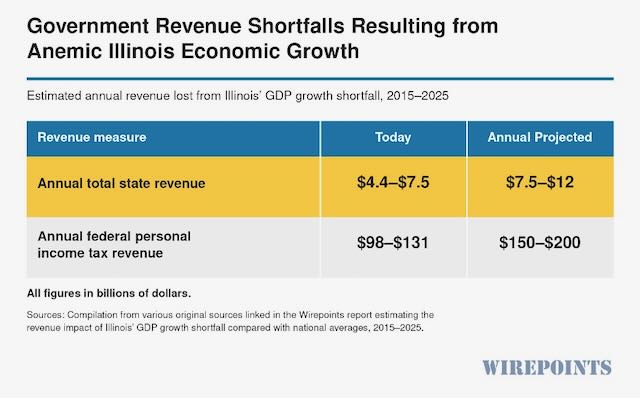 Among the consequences of economic growth that badly lags national averages are billions of lost revenue every year. Yet denial reigns in Illinois, fueling the vicious cycle of demand for higher taxes.
Any bets that Loretto and other hospitals north of Kankakee are suddenly rural? We know that a penny of Fed money can’t enter the state without the pigs in CHI, Cook County and the collar counties getting some.
That $50 billion to help rural hospitals was badly underreported amid all the concerns about impact of the Big Beautiful Bill on rural hospitals.
You’re right that the RHTP in the OBBBA was under reported. The KFF (Kaiser Family Foundation) estimates that the slowing the increase in Medicaid spending in the OBBBA will negatively affect rural hospitals by $137 billion over 10 years. Other estimates show the reduction in Medicaid spending may only negatively affect rural hospitals by $58 billion over 10 years. Either way, if these estimates of the reduction in Medicaid spending are correct, many rural hospitals are going to be in big trouble.