
By: Ted Dabrowski and John Klingner
Illinois lawmakers’ decision to end school choice last year is making Illinois look increasingly extreme as more and more states across the country embrace educational freedom.
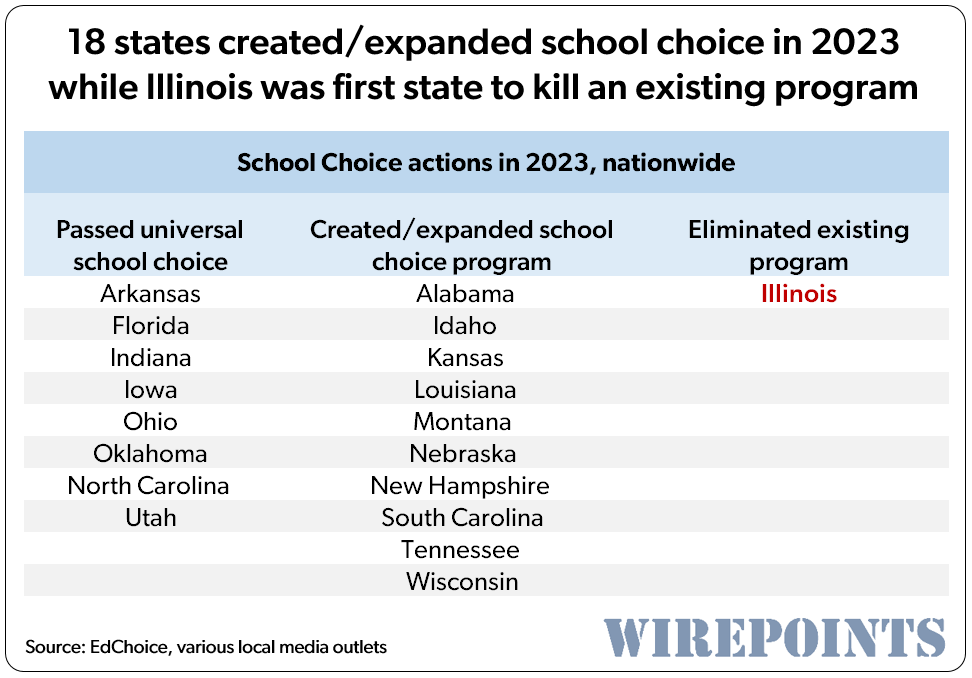
Gov. J.B. Pritzker and other legislative leaders, with the support of the teachers unions, allowed the state’s only choice program to sunset in December even as a wave of new choice programs were being implemented in multiple states. 2024 looks to continue that wave.
In just the last few days:
- Alabama Gov. Kay Ivey signed a new universal school choice program, offering education savings accounts (ESAs) worth $7,000 to every student in the state. The plan will be universal by 2027.
- Tennessee has several universal school choice expansion proposals teed up in its General Assembly.
- Texas’ Gov. Greg Abbott helped defeat several anti-choice Republicans in the state’s primary elections last week, setting up Texas for a second run at passing a school choice program.
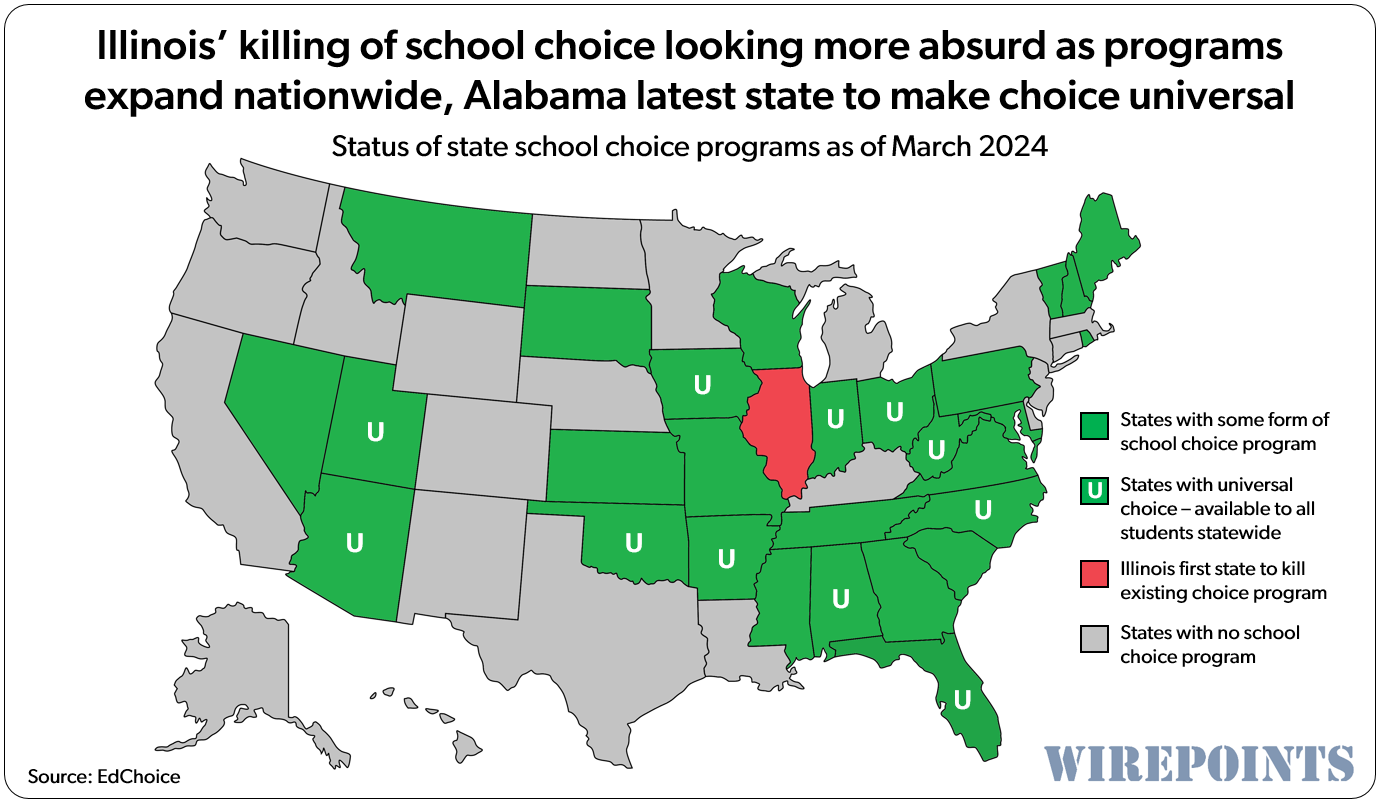
Those states are following up on the many choice expansions of 2023, known as the “year of school choice.” Eight states passed some kind of universal or virtually-universal school choice program, while another ten states expanded their choice programs last year.
Universal programs allow every student in a state, regardless of race or income, access to a voucher or education savings account to attend the school of their choice.
Expect Illinois politicians and union leaders to scoff at Alabama’s reforms. But the state and Chicago’s education systems have just as much need for improvement as Alabama does, though our politicians continue to deny that obvious fact.
Wirepoints just wrote about the state’s latest denier, State Rep. Kam Buckner, last week. His response to being told the vast majority of Chicago’s black students can’t read or do math at grade level was to dismiss the reality of those outcomes. He, a former student of CPS, said he reads “very well.” So what’s the problem?
What’s worse, the system is designed to back up Rep. Buckner’s denial. CPS graduates more than 80% of its students – and touts that as a great success – despite a vast percentage of students failing to reach reading and math proficiency standards on the SAT.
And any problems that officials do admit exist in education can only be solved with one thing, they say: more money.
Chicago Teachers Union President Stacey Davis-Gates, for example, recently warned the union’s contract demands could top $50 billion in an attempt to spur a “cultural transformation” across CPS and the city. Never mind that the district already spends more than $29,000 per student, all-in, and that overall spending was up more than 40% from 2019 to 2023.
********
As we’ve proven time and again, Illinois and Chicago’s student outcomes are beyond dismal. But as Illinois’ education policies become increasingly extreme, count on Illinois parents to notice what’s happening across the rest of the country.
Read more from Wirepoints:
- What literacy crisis at Chicago Public Schools? Illinois State Rep. Buckner says he can read ‘very well.’
- Get ready for the Chicago Teachers Union’s radical, expensive agenda in its upcoming contract negotiations
- Cost? ‘Stop asking that question,’ says Chicago Teachers Union president Stacy Davis Gates in strident speech about contract demands
- Chicago Public Schools’ twisted goal: End selective enrollment schools while keeping nearly empty, failing schools open
- 5 facts they don’t want you to know about Illinois’ 2023 student test results
 With $162 billion more from taxpayers, couldn’t you deliver a few bond upgrades, too
 Audio and summary
  A largely unasked question is becoming glaring: Is Illinois doing all it should to use artificial intelligence to make government cost less and work better? So far, the evidence says no.
This state has many private schools that offer a choice , but only to the wealthy.And the Chicago teachers must be wealthy, because 44% of them choose private schools for their kids .