
I got tired of always seeing government financial statements start with a Certificate of Excellence in Financial Reporting, so I finally decided to check them out.
We read lots “CAFRs” here at Wirepoints — the annual financial statements published by state and local governments. That’s where the certificates appear.
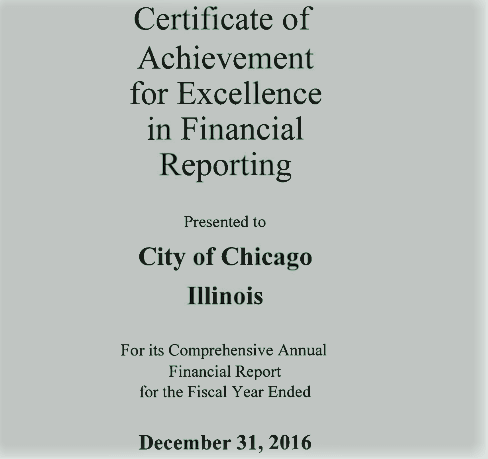 An example is on the right from Chicago’s new CAFR published yesterday. You’ll find the same thing on CAFRs for Cook County, the State of Illinois and seemingly every town and city in the state.
Sure enough, according to the folks giving the certificate, 338 of them were awarded just in Illinois in a year.
Isn’t this kinda like Lake Wobegon? You know, where “all the kids are above average,” except here maybe some performance enhancing drugs make them all excellent?
And who is giving the awards? The Government Finance Officers Association. Hmm. Maybe we should bestow Certificates of Excellence on everything we publish here.
For CAFRs, instead of those certificates, I’d say the cover pages should include something like this:
WARNING AND DISCLAIMER
THE MATERIALS PRESENTED HEREIN ARE DELIBERATELY OBSCURE AND MISLEADING. ANYTHING USEFUL HEREIN CAN BE IDENTIFIED ONLY BY FINANCIAL PROFESSIONALS FAMILIAR WITH GOVERNMENT ACCOUNTING, WHICH BEARS LITTLE RESEMBLANCE TO REALITY OR PRIVATE SECTOR ACCOUNTING.
-Mark Glennon is founder and executive editor of Wirepoints.
 Expect no retraction or apology. This what they do.
 The state’s existing buyout program for its own pensions is the precedent for Chicago, which should be a warning: Look out for similar exaggerated claims and shoddy analysis.
Who came up with Lake Wobegon headline? Your daughter? It’s rather creative and still true.
Country Club Hills has a wall full of them!
6963 governments in IL. 338 receive Cartificates of Excellence in Financial Reporting. The Certificate of Excellence is awarded for “going beyond the minimum requirements of generally accepted accounting principles.” This highlights the difference between government work and private sector work. In the private sector, no Certificate of Excellence would be awarded for achieving or even exceeding a minimum requirement. In fact, this level of performance would likely get you fired. In government work, 95% of the government financial reporting groups are satisfied with achieving or even not achieving minimum requirements in their job. Why does government cost so much for… Read more »
This article is pretty snarky, and short on explaining how the awards came about or what they signify. Below is an explanation of the awards from the GFOA website. Certificate of Achievement for Excellence in Financial Reporting Program (CAFR Program) The GFOA established the Certificate of Achievement for Excellence in Financial Reporting Program (CAFR Program) in 1945 to encourage and assist state and local governments to go beyond the minimum requirements of generally accepted accounting principles to prepare comprehensive annual financial reports that evidence the spirit of transparency and full disclosure and then to recognize individual governments that succeed in… Read more »
I read that, recently, there were 6,963 government entities in Illinois. So according to the article above, 338 were awarded this certificate. One might question, investigate, and report on what the non-awarded entities are doing or not doing. That might actually be interesting and useful to people.
Five percent of Illinois governmental bodies won the award. Sounds exclusive. But how many governments submitted for the award? And didn’t get it? Is there an application fee for the award? What percentage of GFOA members won the award? How many governments won the award in one year and didn’t receive it the following year? Answers to these questions might also actually be interesting and useful to people.
I agree. It’s a shame this author didn’t pursue those. Too deep, I guess…
Too busy writing specific articles about the monumental, consistent distortions in particular reports on municipal financials. Government financial reporting is a farce, particularly on pensions, which are a calamity. I haven’t seen a single CAFR on a major IL unit of government that should bear an award of any kind. Coming soon, an article on Chicago’s latest award bearing CAFR.
I’ve read now that Chicago’s CAFR, to get its award, has been judged by an impartial panel to meet the high standards of the program, which includes demonstrating a constructive “spirit of full disclosure” to clearly communicate its financial story and motivate potential users and user groups to read the CAFR.
Well, read our new article about that CAFR and tell me what you think about “the spirit of full disclosure.” https://wirepoints.org/why-chicagos-reported-progress-on-pensions-and-finances-isnt-real/
My town boasts of receiving this award every year, even as General Fund balances decline and police and fire pension funding deficits increase. The award is little more than adhering to a prescribed budget format-fonts, margins and the like, and has nothing to do with using sound financial policies.
And even those simple things like format and margin are crap for the award winners. Try, for example, to look at just at the bottom line on the Chicago CAFR for 2017. That’s changes in net position, on page 181. https://www.cityofchicago.org/content/dam/city/depts/fin/supp_info/CAFR/2017/CAFR_2017.pdf And it’s no surprise they would try to obscure that whole section because it shows billions in actual losses each year. For 2017, by the way, the result would have been massively worse except for some phony changes the made in pension assumptions, which we will write about shortly.
The format deserves a bad grade. On page 181 you referenced, it lists the “CHANGES IN NET POSITION” for the “Last Ten Fiscal Years” but starts with the oldest year and doesn’t carryover the line item descriptions, making it hard to follow. They repeat this practice in different sections. Proper financial reporting lists the years in descending order with the most recent first.
Excellent. And milk is good food (Paid for by the American Diary Association)