
We called it Illinois’ stupidest law of the year when we wrote about it last week because it so blatantly attempts to suppress free speech protected by the First Amendment. And they had the nerve to label it a “freedom of speech” law.
The so-called “Worker Freedom of Speech Act” passed both houses of The Illinois General Assembly this year along strict party lines, with only Democrats in support, and was signed into law by Gov. JB Pritzker on July 31. If enforceable, it would fine companies that discuss political or religious issues in meetings with workers where attendance is mandatory.
On Thursday, the predictable lawsuit was filed to declare the Act unconstitutional and enjoin its enforcement. The full complaint by the Illinois Policy Institute is here. The Liberty Justice Center is representing the institute and their press release is reproduced below. The Illinois Policy Institute is directly impacted since the law purports to cover even nonprofit 501(c)(3) organizations like them — and like Wirepoints — that focus on political matters.
Illinois has established itself as a leader in efforts to squelch free speech, as we wrote in our earlier piece, and this is the latest example. The complaint is filed in the same federal court and division where Judge Iain D. Johnston issued a blistering opinion last year, ridiculing a state attempt to ban pro-lifers from distributing information near abortion clinics.
Let’s hope Judge Johnston gets this case as well and humiliates our lawmakers once again.
-Mark Glennon
Press Release:
FOR IMMEDIATE RELEASE
August 8, 2024
Illinois “Worker Freedom of Speech Act” Is Actually an Employer Speech Ban: The Liberty Justice Center Challenges Employer Censorship Law
Chicago, IL—On August 8, the Liberty Justice Center filed a First Amendment lawsuit to challenge a recently enacted Illinois law that would prohibit companies from holding mandatory meetings where “religious or political matters” are discussed—effectively revoking free speech rights across the state.
On July 31, Illinois enacted Senate Bill 3649 (SB 3649), misleadingly titled the “Worker Freedom of Speech Act,” even though it does not actually protect workers’ freedom of speech, but rather infringes on employers’ free speech rights. Supporters touted the legislation as a defense against “captive audience meetings”—where employers inform employees that they have the right to opt out of union membership as well as the right to join a union, and which have been allowed by the National Labor Relations Act and the U.S. Supreme Court for over 75 years. However, SB 3649’s vague, broad language goes much further and will effectively criminalize mandatory staff meetings that have nothing to do with unions, including prohibiting the meetings of organizations that address issues of public policy.
The legislation would make it illegal for organizations to discuss any political or religious matters with employees if listening to or attending a meeting in which such matters are communicated is a condition of their employment, even when those topics are relevant to the organization’s business and operations. Discussing these topics in a mandatory meeting would result in fines of $1,000 per person, meaning any single violation could cost an employer thousands of dollars.
SB 3649’s broad definition of “political matters”—which includes changes to legislation, regulation, and policy—means that certain topics that may be important for organizations to discuss could suddenly be deemed illegal. For example, a company might be accused of violating SB 3649 and fined thousands of dollars just for holding an all-hands meeting to discuss the impact that a new law or regulation could have on their business.
While SB 3649 exempts political parties, government entities, candidate committees, political committees, and unions from the prohibition on mandatory meetings regarding political matters, 501(c)3 not-for-profit organizations—including organizations that exist to research and comment on public policy and legislative and regulation proposals—are still subject to that prohibition. And while “religious organizations” are exempt from the prohibition on mandatory discussion of religious matters, SB 3649 fails to define “religious organizations.”
SB 3649 will also cause problems for employers simply accused of violations. The legislation allows an “aggrieved employee” to bring a civil lawsuit against an employer alleged to have violated SB 3649 and allows any “interested party” to “assert that a violation of this Act has occurred” and submit a complaint to prompt an investigation by the Department of Labor. The Department of Labor can also institute its own action against an employer.
Unless a court intervenes to halt the legislation, SB 3649 will take effect on January 1, 2025.
On August 8, the Liberty Justice Center filed a lawsuit to challenge SB 3649, arguing that the legislation violates the First Amendment and should therefore be enjoined. Similar laws recently enacted in Minnesota and Connecticut are also facing legal challenges.
The Liberty Justice Center is representing the Illinois Policy Institute, an Illinois-based nonpartisan research organization that publishes information on Illinois public policy and will be affected by the legislation. Due to the nature of its work, the Illinois Policy Institute regularly holds mandatory meetings to discuss issues of public policy, which are included in the new law’s definition of political matters—making those meetings now illegal under SB 3649.
“The First Amendment protects an employer’s right to speak to employees about matters of importance,” said Jeffrey Schwab, Senior Counsel at the Liberty Justice Center. “Illinois has enacted a law that prohibits speech based solely on its content, political or religious. The Supreme Court has held that such content-based prohibitions are presumptively invalid. For that reason, SB 3649 should be held unconstitutional.”
“Government unions can still hold mandatory meetings with captive audiences under SB 3649. This means government unions and politicians are once again playing games with Illinoisans’ rights so that they can silence competition and advance their own political agendas,” said Mailee Smith, Senior Director of Labor Policy at the Illinois Policy Institute, a plaintiff in the lawsuit. “SB 3649 stacks the deck against ordinary organizations while allowing more power to special interest groups.”
Illinois Policy Institute v. Illinois Department of Labor was filed in the United States District Court for the Northern District of Illinois, Eastern Division, on August 8, 2024.
The Liberty Justice Center’s legal filings in Illinois Policy Institute v. Illinois Department of Labor are available here.
# # #
The Liberty Justice Center is a nonprofit, public-interest litigation center that fights to protect fundamental constitutional rights. The Liberty Justice Center is best known for its 2018 U.S. Supreme Court victory in Janus v. AFSCME. Learn more about the Liberty Justice Center at LibertyJusticeCenter.org
 Expect no retraction or apology. This what they do.
 The state’s existing buyout program for its own pensions is the precedent for Chicago, which should be a warning: Look out for similar exaggerated claims and shoddy analysis.
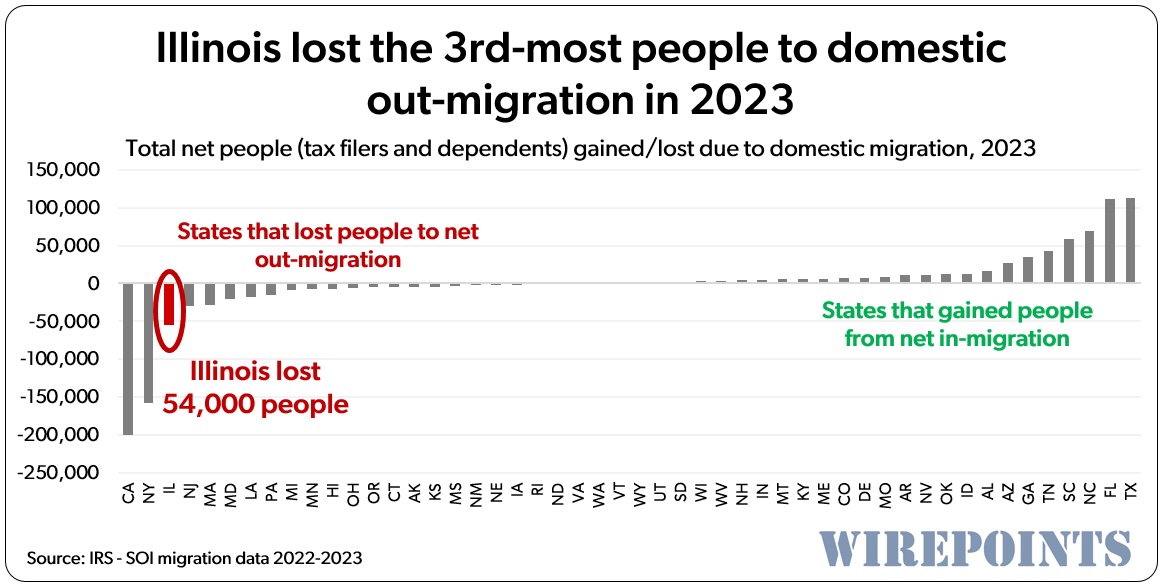 Illinois lost another 54,000 tax filers and dependents, net, according to the IRS. Since 2000, fleeing taxpayers have taken $94 billion of annual adjusted gross income with them.
The state will pay the legal fees to defend, probably millions. Just one more thing to add to the taxpayers tab. The good news is, I don’t really care. I live in a red state.