Hospitality industry losses cost Illinois $636 million in state, local tax revenue – Illinois Business Daily
About 44 percent of hotel workers in each state are expected to lose their jobs due to plummeting tourism during the coronavirus pandemic.

-- Connecting the dots between our economy, government and business --
About 44 percent of hotel workers in each state are expected to lose their jobs due to plummeting tourism during the coronavirus pandemic.
The FAA alleges that the Department violated aircraft rescue and firefighting regulations, and that it failed to ensure that the Fire Department maintained required training records.
The city’s reopening plan is very similar to Pritzker’s, but there is an ability to move between phases every 14 days instead of every 28 days. Unlike the state plan — which dictates when salons, restaurants and other businesses can reopen — the city plan is more focused on public gatherings.
According to the industry website oilmonster.com, Illinois crude oil was trading at $21.25 per barrel on April 3, well below the roughly $35 per barrel most producers need to turn a profit. But as most states have asked their residents to limit nonessential travel, demand for oil in the United States has plummeted, and on May 7, Illinois crude was down to $10.50 per barrel.
The violations the Board wants citizens to report include: a non-essential business that is open; a business not maintaining separation in lines or store; a gathering of people in a private place; a gathering of people in a public place; and a restaurant serving sit-down diners.
Gov. J.B. Pritzker’s executive orders do not allow worship services that include more than 10 people, regardless if participants meet or exceed the appropriate social distancing and hygiene guidelines. This 10-person limit applies to all churches, including large churches that have multiple meeting venues, like these two churches.
Before the pandemic hit, city officials had already projected budget shortfalls beyond 2020’s historic budget gap. Assuming a stable economy and little to no changes in revenues and expenses, budget documents predicted a $1.187 billion deficit for 2021 — one of the largest in city history.
She would only say, “The reality is that, when you have to have revenue, it’s going to impact someone — and probably someones plural. But we’re looking at efficiencies that we save internally first. I still believe that you can’t go out and talk to the taxpayers about sacrifice if you’re not making commonsense sacrifices within city government.”
“Gov. J.B. Pritzker’s office last week allowed Illinois courses to open under ‘strict safety guidelines’ that include 15-minute intervals between tee times, no access to driving ranges, no groups larger than twosomes and no carts without a doctor’s note or handicap placard. Why the disconnect between the mayor’s office and the governor’s office?”
The Chicago Teachers Union’s collection of union dues from workers who’ve disassociated from the union is an infringement on employees’ First Amendment rights, a new federal lawsuit claims.
Chicago Mayor Lori Lightfoot on Friday unveiled city-specific guidelines for reopening during the coronavirus pandemic. Lightfoot’s plan includes five phases, similar to the roadmap unveiled by Illinois’ governor earlier this week.
Comment: But in Illinois, all state workers are paid in full with full pension accruals, regardless of whether they are working, and many have a pay raise coming July 1.
The letter from the state’s congressional delegation follows a similar request from Pritzker to President Donald Trump last Sunday.
They are discussing ways that West Central Illinois should be handled differently than Chicago when it comes to reopening the state.
The church was under fire in late March for refusing to close its school during the first stay at home order. They now plan to resume in-person worship on May 17.
“The governor’s plan would not allow restaurants to reopen until at least June 26. Frankly, most of our small, family-owned restaurants will not survive that long,” Mayor Pekau said. The village said that it may lose $2.7 million this year in sales tax revenue because of COVID-19 restrictions.
For the 10 states ranking with the most COVID restrictions (including the likes of Illinois, New York, New Jersey and Connecticut), Truth in Accounting calculates an average “Taxpayer Burden” of $31,700.
No regrets over his widely ridiculed letter requesting federal money for Illinois.
The Dearborn, Michigan-based automaker plans to recall 12,000 auto workers who can’t work remotely as it takes a phased approach to reopening.
The impact of the coronavirus-induced economic shutdown tore through the U.S. labor market in April at historic levels, slashing 20.5 million workers from nonfarm payrolls and sending the unemployment rate skyrocketing to 14.7%, the Labor Department reported Friday.
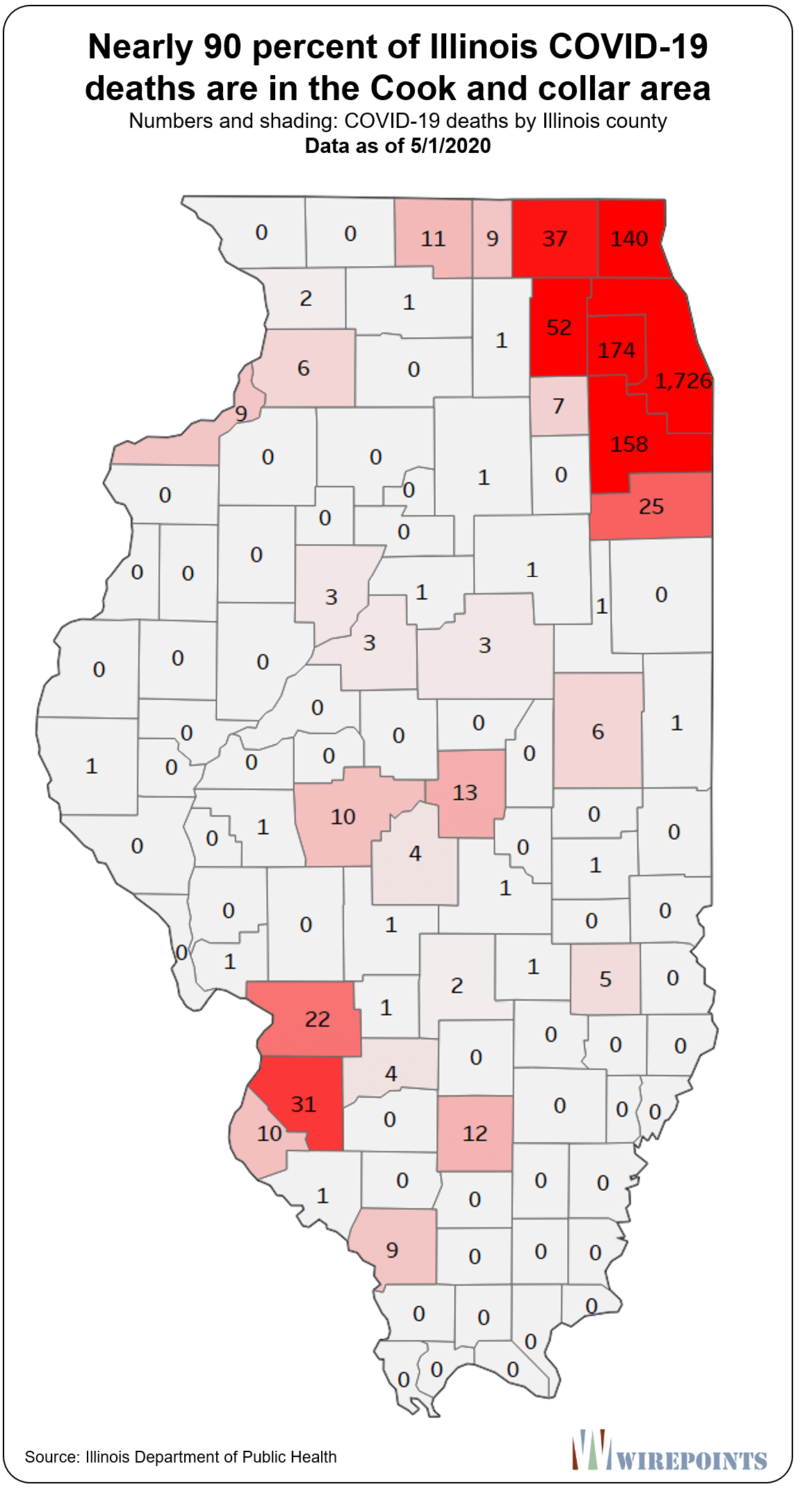
It only takes a glance at Illinois’ statewide COVID-19 data to realize what a big difference there is between Chicagoland and the rest of the state.
“They could,” the governor said. “The state often licenses some of these businesses, so they absolutely could, and we will be looking at each of those businesses to determine whether we have the ability to do that and when we could do that.”
The company has “mostly” abandoned its Chicago and New York offices.
“Look out, America: Illinois, New Jersey and New York are coming for your wallet.”

Imagine if somebody said, “I will translate for the English deficient audience.”
Ssaid Rich Guidice, executive director of the city’s Office of Emergency Management and Communications, who’s helping to spearhead the pandemic response, “We have all 32 city agencies that have been involved with the emergency operation center in some capacity.” Hundreds of city workers have been redeployed; An exact number wasn’t available.
On Thursday, Pritzker focused on the issue of unemployment claims during his daily briefing. IDES had processed more than 1 million claims for jobless benefits from the start of March to May 2. The first-term Democratic governor also suggested that he inherited some of the problems at the unemployment agency, saying IDES has suffered from a lack of funding and now has 500 fewer employees than it did during the Great Recession a decade ago.
Of Illinois’ coronavirus patients, 4,862 people are currently hospitalized, with 1,253 in intensive care units around the state. There are 766 people on ventilators.
“What’s amazing is nearly 1 million Illinoisans have lost their jobs and yet their government has yet to cut any costs,” says Ted Dabrowski, the savvy budget and fiscal analyst at wirepoints.org.
SIGN UP HERE FOR OUR FREE WIREPOINTS DAILY NEWSLETTER