
By: Ted Dabrowski and Nick Binotti
Illinois’ individual income tax – flat and relatively low since its inception in 1969 – has had a moderating effect on Illinois’ otherwise overall high tax burden. It’s been one of the few tax “advantages” Illinoisans have had over residents in other states.
But that advantage has been gradually worn down over the years. While 27 states cut their individual income tax rates over the last 14 years, Illinois was one of just nine states across the country to hike them (see appendix).
The 2021-2023 period, in particular, saw nearly two dozen states enact income tax cuts – many of them significant. Many progressive tax states cut their top marginal rates, some flat tax states lowered their rates and yet others abandoned their progressive tax schemes altogether in favor of lower, flat income tax structures. Illinois, meanwhile, did nothing.
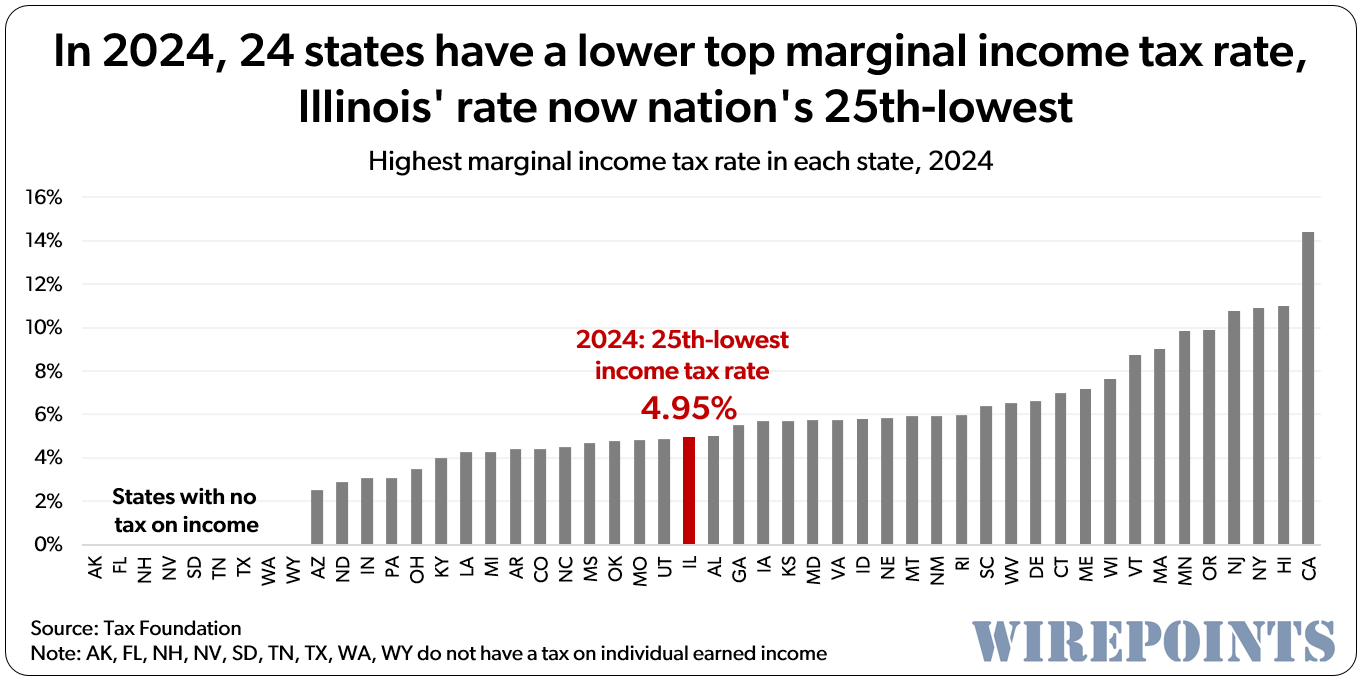
Wirepoints ranked the 50 states from lowest to highest based on each state’s highest marginal tax rate – the highest rate for progressive tax states and the flat rate for flat tax states. Comparing how each state’s rank has changed between 2010 and 2024 serves as a rough proxy for which states have become more/less competitive on income taxes.
By that simple measure, Illinois’ drop in rank across the 50 states has been significant.
- In 2010, Illinois’ 3 percent income tax rate was the 10th-lowest in the country.
- By 2020, Illinois’ rate had risen to 4.95 percent and its position had fallen to 18th.
- Now, after three years of rate cuts by other states, Illinois’ ranking is 25th.
- That drop in rank from 10th- to 25th is the 3rd-worst decline in the nation.
 Only Massachusetts and New Mexico, which enacted tax hikes of their own, dropped more in rank than Illinois between 2010 and 2024. Massachusetts enacted a 9 percent surcharge on millionaires in 2023, and New Mexico created a new top marginal tax rate of 5.9 percent on earned income above $210,000 in 2021.
In contrast, states like Arkansas and North Carolina improved their ranks by significantly cutting their income taxes. Arkansas cut its top marginal rate over time to 4.4 percent from 7 percent. And North Carolina moved to a flat rate of 4.5 percent from a top progressive tax rate of 7.75 percent.
Losing ground
In 2010, Illinois’ flat tax rate of 3.0 percent was the lowest rate of any state in the nation that levied an income tax. Overall, it was the 10th-lowest because nine states – Alaska, Florida, New Hampshire, Nevada, South Dakota, Tennessee, Texas, Washington, Wyoming – didn’t (and still don’t) tax earned income.
 By 2020, however, eight states had a lower top marginal rate than Illinois after Illinois hiked its rate to 4.95 percent in 2017 and other states lowered theirs. For example, progressive-tax North Dakota and Ohio dropped their top rates to 4.9 percent and 4.8 percent, respectively. And flat tax states like Indiana and Michigan dropped their rates to 3.05 percent and 4.25 percent, respectively.
All that dropped the state’s rank to 18th.
Today, Illinois’ marginal tax rate ranks a middling 25th. There are now 15 income-taxing states with lower top marginal rates than Illinois – all due to a flurry of tax-rate changes over the 2020-2023 period:
- Two states not only adopted flat income tax rates, but also dropped their rate lower than Illinois’ 4.95 percent: Arizona dropped to 2.5 percent and Mississippi to 4.7 percent.
- Many flat tax states continued to lower their rates: Indiana to 3.05 percent, Kentucky to 4 percent, Colorado to 4.4 percent, and Utah to 4.85 percent.
- Four progressive tax states also beat Illinois by lowering their top tax rates below Illinois’: Louisiana to 4.25 percent, Arkansas to 4.4 percent, Oklahoma to 4.75 percent and Missouri to 4.8 percent.
- Other progressive tax states – with top tax rates already lower than Illinois – lowered their rates further: North Dakota to 2.9 percent, Ohio to 3.5 percent.
 High tax state
Illinois has been a high-tax state for a long time. A Chicago Fed analyst calculated Illinois’ total combined state/local tax revenue per capita has consistently remained among or near the top 10 states for the past 60 years.
Illinoisans are feeling the pinch of all those taxes more than ever today. Residents pay some of the nation’s highest property taxes and sales tax rates, the nation’s 2nd-highest gas taxes and highest cell phone taxes.
Unfortunately, Illinois’ income tax no longer provides taxpayers with the respite it used to.
Appendix

Readers: You can sort the data table below by clicking on a column header.
Read more from Wirepoints:
- Illinois tax rates out-of-sync with those in neighboring states, most of the nation
- New ranking shows worsened business tax climate for Illinois
- Illinois’ coming drop in Medicaid enrollment should be good news, not a lament
- States across the country are cutting taxes…but not Illinois. Not even with “highest on record” budget revenues.
 With $162 billion more from taxpayers, couldn’t you deliver a few bond upgrades, too
 Audio and summary
  A largely unasked question is becoming glaring: Is Illinois doing all it should to use artificial intelligence to make government cost less and work better? So far, the evidence says no.


The North Carolina Republicans made it their long term plan in 2010 to lower the state income tax in graduated steps. From a high of 7.75% in 2010, the rate is now 4.5% in 2024, and will drop further to 3.99% in 2026. If further state budgetary goals are met, the rate will continue to drop to 2.49%. This is what effective state governance and long term planning looks like. Even better, NC is dropping the state business tax to zero percent, which will be a draw for all businesses to move or expand in NC. Illinois can never compete… Read more »
Quite telling that 6 of the 9 states without taxes on income are red, while the seven highest states are blue. But the Dems have your best interests at heart. Yeah, right. They are proponents of politics being a lucrative career, which is why they dig their heels in and cry “ deploables “ at the slightest mention of term limits, voter IDs, verification of ballots, etc. That an uneducated, former cocktail waitress such as AOC now has a net worth of millions of dollars should tell us something about taxation and representation.
“ The usual gang of idiots “, in Springfield and Chicago keep going to the well, the taxpayers, And take bucket full of our cash. Slowly but surely the well is getting lower as taxpayers leave and are replaced by lower earners. Trying to tax your way out is like trying to pick up a bucket while standing in it. “ The usual gang of idiots “ keep going like everything is ippy pippy, at some point the light will come on and the reality will hit them like a ton of bricks we don’t have enough money. People will… Read more »
As an ex- middle school teacher once advised us “ First we get da monay!”.