
By: Ted Dabrowski and John Klingner
Quaker Oats just announced it’s closing its factory in Danville, Illinois, putting more than 500 workers out of a job.
It’s the latest of four major factory closures that have occurred in Illinois this year. Blommer Chocolate Company, Rivian and Monterey Mushrooms are also enacting layoffs this year.
 While every closure is disappointing and another black mark on Illinois’ dismal manufacturing performance, the loss of the Danville plant is particularly meaningful to us.
One of the first articles we wrote at Wirepoints in 2017 was about Danville’s struggle to attract and maintain jobs in a state that imposes crippling costs and regulations on both businesses and cities.
It’s a must read if you want to understand the struggle of virtually every single downstate city in Illinois and why jobs are leaving. The top-down mandates are relentless. Binding arbitration. Prevailing wages. Workers comp. Pension costs. Overwhelming public union powers. Collectively, all those things are worse today than they were back then.
Below is the story we told through the experiences of Danville’s then-Mayor Scott Eisenhauer. What becomes obvious is that until Illinois returns to the principle of real local control, our cities will continue to atrophy.
***************
Springfield fiddles while Illinois cities burn – Wirepoints Special Report
December 17, 2017
The City of Danville’s struggles aren’t all that different from those of downstate communities across Illinois. Danville has seen its population drop by more than 20 percent from its peak last century. Residents’ earnings, adjusted for inflation, have fallen by more than 9 percent since the year 2000.
And manufacturing, once a staple of the community, has declined significantly. Gone are the General Electric, General Motors and Hyster factories and the 7,000 manufacturing jobs they provided.
But unlike so many other unfortunate downstate communities, Danville has found a way to persevere. It has diversified its economy and fought to attract new development.
Today, the city is host to many smaller industrial companies that alone provide 5,200 jobs. And companies like WatchFire, a maker of LED electronic signs and billboards, provide a solid jobs base for the city.
Those changes have been necessary to keep people and businesses from moving right next door. Danville is just three miles away from the Indiana border, where sales and property taxes are much lower and where the state is friendlier to businesses.
But Danville’s ability to stay competitive is in jeopardy. Decades of state mandates from Springfield politicians have bloated the cost of local governments to the point where cities like Danville are heading toward insolvency.
Illinois cities simply have no power to control the costs that state lawmakers pile on. Instead, they are forced to build budgets and economies under rules far more burdensome than cities in neighboring states have to deal with.
For example, lawmakers grant most Illinois government unions the power to strike against the very residents they serve. And for those that can’t strike, the unions can demand an independent arbitrator whenever negotiations don’t go their way.
State lawmakers also make communities pay inflated public works wages and workers comp rates that drive up the cost of infrastructure and improvements.
And worst of all, lawmakers impose one-size-fits-all government worker retirement benefits that are no longer affordable to the residents that pay for them.
The situation deeply frustrates Danville mayor Scott Eisenhauer: “Springfield makes the rules but localities have to pay for them.”
 The budget cuts he’s had to make over the years to manage mandates have negatively affected Danville: “It has really started to impact simple capital purchases. It has impacted our staffing levels to pay the pensions. All those cuts hurt everything.”
Mayor Eisenhauer is far from the only local official that’s had to make hard choices. The General Assembly’s failures have put city officials across the state between a rock and hard place.
Many cities are facing ruin, no matter what their choices have been. They’re either at the brink of bankruptcy through unfunded pensions or have lost people and businesses due to high taxes and fewer services. The most unfortunate cities are suffering both.
In fact, over 30% of downstate pension funds have less than half the money they need on hand today to pay out future benefits, according to Illinois’ Department of Insurance.
And more than 25 pension funds are less than 25% funded. Danville has one of them – its firefighter fund.
Pensions in Danville have deteriorated to the point where the city’s credit rating has been dropped to just two notches above junk by Moody’s Investors Services.
Faced with the above scenario, Danville may have damaged itself irreparably by doing something no other city has done anywhere in the state.
The city has created a dedicated pension fee, dubbed a public safety pension fee, so everybody can know where their tax dollars are going. The plan includes a multi-year increase to the city’s property taxes and a 176 percent increase in the pension fee to $267 for residents and $1,020 for commercial buildings bigger than 5,000 square feet.
And Danville’s trying to pay off its $113 million pension debt in 20 years, instead of the usual 30 years.
To many, a dedicated public safety pension fee is a bold and transparent move. The Chicago Tribune’s editorial board called Danville’s plan: “An honest way to address a gigantic problem – one that Illinois has found no way to resolve.”
But while it may be honest, Danville’s tax hikes don’t address the real problems faced by every city in Illinois: “All I get to do is treat the symptoms, I don’t get to treat the illness” said Mayor Eisenhauer.
By attempting to “fix” its crisis without being able to change any of its drivers – retirement costs, binding arbitration, prevailing wages – Danville may have just committed economic suicide.
State rules that drive up the cost of government and drive people away
Across Illinois, local government costs and debts are growing far faster than residents can afford.
Much of the problem is due to politicians in Springfield, who have enacted statewide rules that make a mockery of local control. Danville and other cities are stuck. They are forced to build budgets and economies under the one-size-fits-all rules the state imposes on them.
Cities are unable to change their services and government costs in a way locals want and that can best take advantage of a city’s comparative advantage.
The legislature’s preservation of ultra-restrictive labor rules – even as every other neighboring state passes major reforms – has done significant damage to Illinois’ business climate and municipalities’ budgets.
 In fact, a 2016 study by the Heritage Foundation calculated that Illinois ranked 47th-worst in the nation when it comes to restrictive and expensive labor laws. That study measured each state’s collective bargaining regime, its dispute-resolution mechanism, the legality of strikes, the proportion of government employees covered by a union contract, and each state’s right-to-work status.
Not surprisingly, Illinois’ ranking was one of the nation’s lowest and far worse than all of its neighbors. And those results were released last year even before several neighboring states passed additional major reforms (i.e. Kentucky’s right-to-work laws).
Of all its neighbors, Illinois is the only state that enshrines the right for most of its public-sector workers to strike. And for those unions prohibited from striking, Illinois forces local governments into binding arbitration.
Illinois also has the highest percentage of government employees covered by a union contract. It’s the only state among its neighbors to exceed 50 percent. And when it comes to right to work, Illinois is the only state that has not taken that step (Missouri’s right-to-work law is currently held up in the courts).

Binding arbitration
Public safety workers in Illinois are not allowed to strike. Instead, city and public safety unions begin a process called “binding arbitration” when they reach an impasse in negotiations.
In binding arbitration, a five-member panel hears the city’s offer and the union’s demands and crafts a contract. Two members of the panel are appointed by the union and two by the municipality. So the fifth member, an independent arbitrator, usually has the deciding vote on what the contract contains.
The city and the union are then bound by whatever the panel decides. The problem with binding arbitration is that the process is still biased against the taxpayers’ interests.
The independent arbitrator doesn’t have to face the consequences of increased taxes or service cutbacks from the contract he or she imposes. And because they’re selected by both cities and unions, the arbitrator has an incentive to split the difference between each side – no matter how bad cities’ financials are.
As a result, city officials are forced to consider the risks of arbitration with every negotiation – and they inflate their offers accordingly in the hopes of avoiding it.
Mayor Eisenhauer explained the difficulty he and other officials have trying to get a good deal for taxpayers: “All the onus of reasonableness is on us. I can argue all day long about the fiscal condition of the city…” but if a city can significantly raise taxes simply because it’s a home-rule jurisdiction, like Danville, then taxes are considered reasonable, no matter the circumstance.
The entire process makes it hard for a community in financial distress to get relief from unaffordable wages or restrictive work rules.
In addition, “minimum manning” rules – which typically require a city to keep a certain number of firefighters on duty at all times – also affect a city’s ability to manage costs. Municipalities can cut active firefighters to save on salaries, but the cost of paying overtime to their remaining workers to fulfill those requirements wipe out any potential savings.
The state’s one-size-fits-all restrictive labor rules shouldn’t be allowed to hamstring local governments. Instead, individual local governments should have the right to reform their collective bargaining processes to match their unique economic and budgetary situations.
The state must pass collective bargaining reforms that empower local communities to negotiate more affordable contracts.
Heritage calculated that if Illinois unions did not have the power to strike or to benefit from binding arbitration, but still enjoyed the power of compulsory bargaining, state and local government spending in 2014 could have been about $1.8 billion to $3.9 billion lower.
Prevailing wages
State-imposed prevailing wage rules drive local governments’ costs higher when communities work on public construction and maintenance projects.
Prevailing wages are hourly minimum wages placed on government contracts for public work. This means if a city finances a new construction project, repairs roads or fixes water pipes, or funds any part of a private project, the project’s contractors are required to pay the (most often union-level) wages the Illinois Department of Labor sets.
Under current law, counties have the power to research their own prevailing wage and reconcile it with the (often higher) Department of Labor’s determined wage, but most don’t. Most local governments don’t have the time and resources to argue with the DOL and their local unions over what their prevailing wages should be.
High hourly prevailing wages and additional benefits result in total compensation for laborers which often surpass six figures when considered on a full-time equivalency (FTE) basis
In Danville, the city pays laborers the prevailing wage rates set for Vermilion County. The average total FTE compensation for a prevailing wage worker in the county is over $100,000. That compensation is far larger than the median wages of the private sector workers who pay for the public sector.
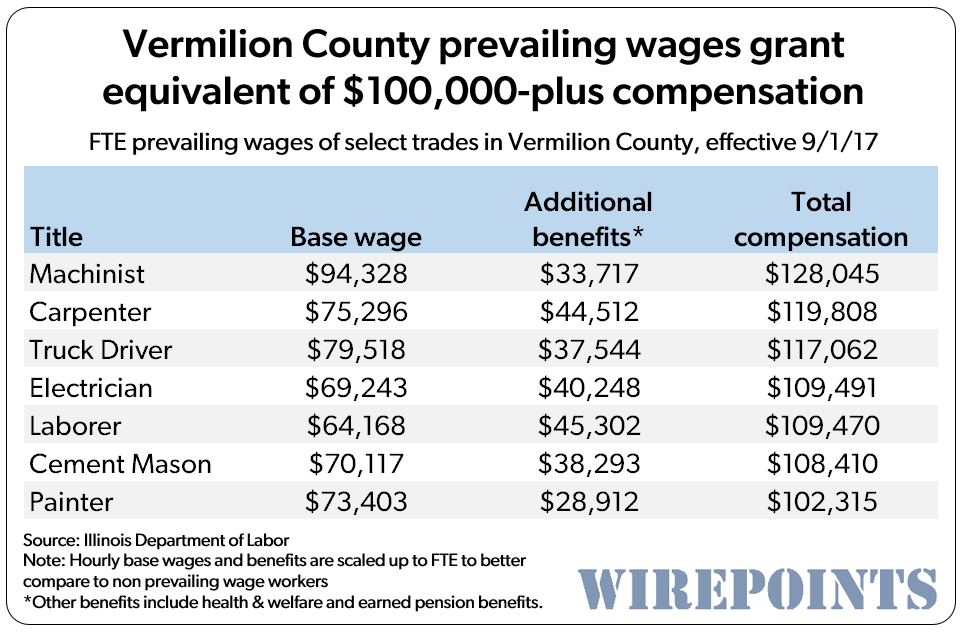 For example, prevailing-wage carpenters in Danville receive hourly compensation that, when converted to a full-year equivalent, is worth nearly $120,000. And prevailing-wage electricians receive the equivalent of nearly $110,000.
Beyond increasing construction costs for cities, the state’s prevailing wage rates also negatively affect public-private partnerships.
In Danville, the increased cost of prevailing wages has seriously handicapped partnerships between the city and local businesses to improve the community.
For example, the city has façade and sidewalk improvement programs that are now hardly used.
Businesses used to partner with the city to repair the sidewalks on their block. A business would hire workers and the city would subsidize 50 percent of the cost.
But as prevailing wages have grown, it’s simply become too expensive for businesses to shoulder the costs, even if they receive the help of city funds. And the city can’t afford to pay for the improvements itself.
As Mayor Eisenhauer noted, “What that does is it discourages municipalities from being able to offer programs that would help their communities. Danville is losing investment opportunities in our downtown because nobody does it and workers lose out on work.”
So nothing gets done. Sidewalks remain broken, façades remain faded. And workers who could have repaired them are left without a paycheck.
Prevailing wage laws also mean unions don’t have to market themselves or compete against lower-cost non-union workers. But they shouldn’t be given so much protection from competition.
“We shouldn’t have to guarantee that they are going to get work over anyone else, and in the process significantly escalate the price of doing projects to the point where, at the end of the day, those projects don’t get done,” said Eisenhauer.
Illinois’ prevailing wage laws have to change if localities across Illinois are to be economically competitive. The state should pass reforms that allow local governments to determine their own adequate rates of compensation for construction and other contract work.
Workers comp
Illinois’ high workers comp costs are often cited by businesses as a primary reason for avoiding the state.
Illinois has the 7th-highest workers compensation costs in the nation, higher than any of its neighbors. In fact, both private and public-sector employers in Illinois often pay as much as three times more in workers’ compensation costs than comparable businesses in Indiana.
Workers comp costs are especially problematic for Danville. It has to try and convince companies that the city’s advantages outweigh its labor costs, especially when Indiana is just a few miles away. Unfortunately, its efforts sometimes fail.
Vicki Haugen is the President of Vermilion Advantage, the County’s economic development corporation.
 She’s been working to improve Danville’s job climate for the past 35 years and has seen Indiana snatch opportunities from the city. “Danville was in the final round for a Honda plant and a distribution center but we lost both to Indiana. We can’t compete for labor-intensive industrial businesses. Workers comp, lack of state incentives, the cost of living and the cost of doing business, all have a big impact.”
In response, Haugen shifted Danville’s sales pitch to attract more capital-intensive and less labor-intensive companies. Businesses like LED sign-maker Watchfire can take advantage of the community’s better educated and skilled workforce while providing jobs, economic activity and much-needed tax revenue for the city.
Danville has had the good fortune to find an economic niche that plays to its competitive advantages. But many other cities across Illinois aren’t so lucky. They remain hamstrung by the state’s costly workers comp system.
 Illinois lawmakers should help reduce costs for local governments by adopting the federal definition of catastrophic injuries and eliminating the effective bump in take-home pay given to some injured government workers.
Changes should also be made to the state’s Workers’ Compensation Act. Illinois’ wage-replacement rates should be put in line with those in surrounding states, increases in take-home pay for some injured workers should be eliminated, and medical reimbursement rates should be tied to Medicare or group health rates.
Danville’s pension crisis
When Mayor Eisenhauer focused his discussion on the struggles of keeping and attracting businesses, he said Illinoisans don’t talk enough about pensions being an impediment to business:
“When we say pensions are impactful, they’re not just impactful because they cost us more and it costs the taxpayer more, but we also have to divert so much of our financial resources to that problem…My level of frustration is we’ve not been able to grow because we’re putting so much resources into pensions.”
Danville, like so many cities across the state, has put in more and more resources into pensions only to watch its pension shortfalls grow uncontrollably.
In the last decade alone, Danville has increased its city contributions to more than $5.4 million from $3.2 million, and yet the city’s total shortfall has jumped by 100 percent during that same time.

Pension costs now consume nearly a quarter of the city’s general budget and the total shortfall is $99 million, according to data from the Illinois Department of Insurance and the IMRF.
A big reason for that fiscal squeeze is Danville pensions look more and more like Ponzi schemes each year.
Danville has many more beneficiaries drawing pensions from its public safety plans than it has active workers contributing to it. In 2016, Danville had 1.5 inactive members for every 1 active member.

Unfortunately, for local government workers and taxpayers alike, the situation has only worsened each year. The funding ratios for the three local pension funds have all dropped dramatically, putting both the police and fire plans at the risk of insolvency.
At 30 percent and 17 percent funded, respectively, they are both among the worst-funded pensions in the state.
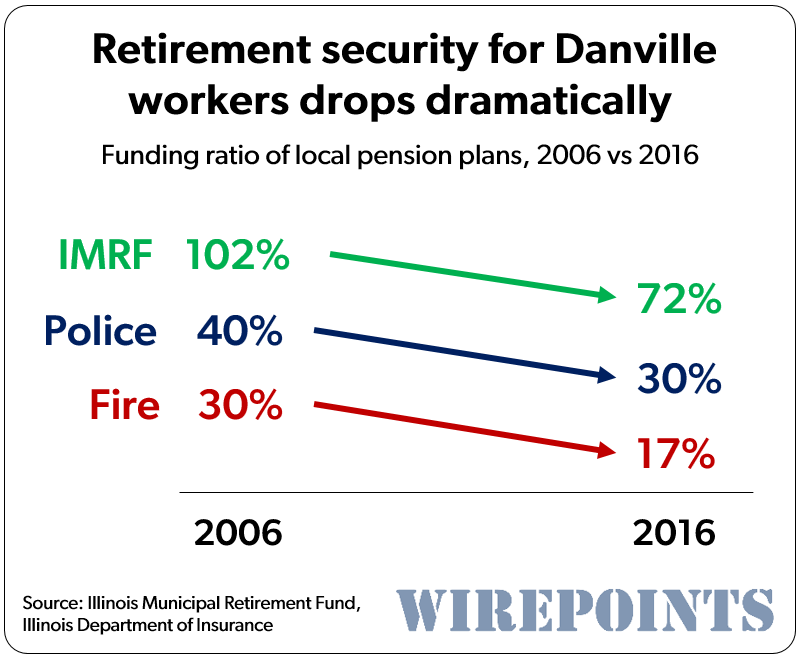 Eisenhauer is quick to tell you why cities like Danville are in such a mess.
Of the five major components that impact an employee pension – the number of actives, the number of inactives and beneficiaries, salaries, rate of returns and benefit levels – he argues he has control over maybe just one: the number of active workers employed by the city.
But even then, minimum manning laws prevent the mayor from having full control over headcounts.
Of the other four, binding arbitration overrides his control of salaries. He has zero control over the funds’ investment rates of return. Springfield sets workers’ pension benefit levels, not him. And he has little to no influence over the number of inactives and beneficiaries currently in the pension funds.
For Eisenhauer, the solution is easy. “I already compete with other cities on many factors, so let me compete on retirement benefits. Get the state out of it. They are not helping us pay for them anyway, so we won’t lose anything financially.”
And he took a dig at state legislators and their failed General Assembly pension plan, which is funded at just 15 percent, even worse than Danville’s fire fund. “The state legislators should say ‘we can’t handle our own pension programs, why are we telling local governments what theirs should be.’”
Eisenhauer wants local governments to offer their own local retirement plans to their workers, whether a pension, a 401(k)-style plan or even nothing, in exchange for higher salaries.
The bottom line is, Illinois can’t have a system where one entity of government establishes all the rules and benefits and another unit of government has to pay for it.
Treat the illness, not just the symptoms
Mayor Eisenhauer and Danville residents have taken on an impossible task with the recent pension solution they’ve enacted.
Danville’s pension crisis won’t be solved by simply raising tax burdens on residents. The city can’t easily endure the out-migration of people and business that may occur as it nearly triples its pension fee and aggressively hikes property taxes year after year.
That’s a hard pill for the residents and businesses of Danville to swallow. The area’s sales taxes are already just one point away from being as high as in Chicago. And if the local school district gets its way – it wants a one percent hike for capital needs – the city’s sales tax will hit 10.25 percent.
Higher property taxes and an even larger pension fee will only make Indiana even more attractive to both current and potential residents. And that doesn’t even take the burden of the state’s 32 percent income tax increase into account.
Mayor Eisenhauer recognizes many of the reforms Illinois and cities like Danville desperately need to become economically competitive again. He champions those reforms well.
But for many cities, the days for structural reforms have probably passed them by. For those communities, bankruptcy might be the only option that can both protect retirees and allow cities to reorganize their debts.
In the meantime, Mayor Eisenhauer is only buying time against a relentless crisis. And his solution may cost Danville dearly: “My big concern is, do we die from the illness before we can cure it?”
Unfortunately for Danville and all other struggling cities across Illinois, the answer to the mayor’s question is a foregone conclusion – unless politicians in Springfield act to fix the crises they created.
 A mess of uncertainty and litigation is sure to follow.
 With $162 billion more from taxpayers, couldn’t you deliver a few bond upgrades, too
I have an empty lot I bought 26 years ago. The taxes on it I’ve paid over that time are nearly the same as I paid for it. No way would I ever ‘profit’ from it. I can’t even sell it as it was listed for 4 years at the rate original cost and taxes paid. Never even got an offer.
These many problems that plague our cities are, as was stated, symptoms of a much larger problem. I never once heard the analysis, in this article, come to he conclusion that we must look at these problems from a different view if they are to be solved . There has been a pendulum shift happening for decades now & those who do not wake up to that fact, are screwed. I would like to comment on 4issues & how improvement can be made if we look at the problems head on. These 4 issues are Profits of owners, guaranteed pensions,… Read more »
You should start looking for a successful socialist country in which to live. Let us all know when you find one.
In my book these businesses are leaving the same a residents, High Illinois taxes, high cost of living and ridiculous regulations, corrupt democratic government. I left Illinois for a red state 40 years ago. Best move of my life!
Eisenhower isn’t the mayor of Danville anymore. Rather it’s Ricky Williams.
That’s why he’s described as “Danville’s then-Mayor Scott Eisenhauer.”
Did you read? It said the “then ” mayor.
I would think a valid question to Mayor Eisenhauer would be “Mr Mayor each and every year you contribute some funding towards the pensions. Will your new tax be in addition to said funding or will that stop as you have the new funding?” So often, as with the lottery and education, a targeted tax really amounts to a new funding of slush funds for the existing status quo. Don’t forget this is Illinois where politicians, regardless of party affiliation, are not to be trusted and so often it seems something is always happening in the smoke filled back rooms.… Read more »
Dude.
Eisenhauer hasn’t been Danville mayor for 4 years. Rickey Williams is mayor. And Vickie Haugen passed away last year. Why are you stoll quoting them?
Dude. Read the beginning of the article again. This is a reprint of an article done in 2017. Geez.
The icing on the cake is that government pensioners get to say one last “F you” to the taxpayers when they retire to Florida and the taxpayers have to then mail their pension checks into the Florida economy. Where those Illinois taxpayer funded checks only benefit Florida where the pensioner who rabidly hated Republicans all their working life, chooses in the end to head to a red state because they like how it is run. So not only do the companies leave, the very pensioners who benefitted from the taxpayer abuse head out of Dodge too. Great article on all… Read more »
Spot on, so many retired cops, teachers, and firemen at young ages live on the southwest coast.
House prices have gone up only a retiree with a huge pension can afford them.
You have facts on that? Probably true, but we like facts here.
1. Naples, Florida Population growth from 2010 to 2020: 53.7% Average home value in 2020: $359,706 Average home value in 2023: $594,043 Increase in home value from 2020 to 2023: 65% 2. Estero, Florida Population growth from 2010 to 2020: 63.2% Average home value in 2020: $321,867 Average home value in 2023: $527,221 Increase in home value from 2020 to 2023: 64% 3. West Palm Beach, Florida Population growth from 2010 to 2020: 17% Average home value in 2020: $245,472 Average home value in 2023: $389,511 Increase in home value from 2020 to 2023: 59% 4. Jupiter, Florida Population growth from 2010 to 2020: 11% Average home value in 2020: $437,570 Average home value… Read more »
Yeah, Leaving, we know about Florida home growth. The point was about the number of our retired public workers living there.
You should have better access to that information than I do.
I hope you own a second home in Florida, at least one of your homes will be going up in value.
Florida isn’t all what it is cracked up to be, try and get homeowners insurance, hurricane insurance and if you do be prepared to pay pay pay.
This is ridiculous how people can say ignorant Democrat or stuck up republican only look out for the rich.its 2024 people why don’t you all get a clue and realize it’s not about choosing sides of the fence and blaming one another. We as people are responsible everyday for all of this. Danville is a crime ridden town, dilapidated buildings and homes, and just down right economically failing because all we have done as a country is out source all of our work to countries who will do it for less. It’s the big business failing our country and failing… Read more »
Taxes in Illinois has gotten ridiculous. As well as many other things in this state has been raised over n over again to the point that people just can’t afford things they could afford in recent years. Pensions and all the things mentioned in the article, plus look at the stupidity of the sec of state did to the fees to register, title, and the tax to drive back n forth to work. We are taxed to death on wages that are taxed before we even get the check. The rich pays less n less, the poor n middle class… Read more »
That’s what happens when you have career politicians, term limits period.
Wow, great article. Thank you for explaining this.
The mayor knows what should be done but the politicians in Springfield have tied his hands. Illinois is one frustrating state for a taxpayer.
Rauner’s incredibly modest pension proposal would have helped to al least lower the curve. Yet the IL Supremes essentially decided the state has an unbridled ability to tax, so just keep raising taxes no matter the economic damage done.
What modest Rauner plan did the supremes decide against? You pointy wire wackos love to just make up stuff.
Rauner was a fraud. But, anything he would have proposed remotely fiscally conservative, would have been DOA. This state and country doesn’t have the courage to make responsible financial decisions. All they know is tax and spend, lather, rinse, repeat.
? Rauner’s office released a 50+ page document of business-friendly proposals early in his term. He said he wanted to turn around the state with the legislation. It was DOA because, for those with short term memories, Mike Madigan said, This is dead on arrival. And it was dead. Rauner did an interview not too long ago, said that he was unable to get anything done because the progressive legislature refused to work with him on anything, he was actively undermined by the bureaucrats within the state and because of the unions, he was unable to terminate or fire any… Read more »
It was DOA or it was stopped by the Supremes? How did the Supremes stop anything if it was DOA? Just more pointy wire liars twisting and turning logic.
Sit down, son.
Pretty much what they did to Trump in Washington
But Trump has set them all up for failure by forcing the Dem issues out front and letting even the Dems (most or soon to be) see the ill effects of their policies. There is no possible way to reform the state and it’s corruption. It needs to be burnt down and if you are relying on state pension you will be out of luck.
The one the Democrats went along with. You have a PC look it up if you aren’t just a lazy Democrat.
There wasn’t any Rauner plan that the Democrats went along with. Typical pointy wire ignorance. Lazy and ignorant.
LOL you don’t know the answer and you refuse to look it up yourself; yet, you call JackBolly ignorant and lazy! Typical low iq democrat
You can’t look up something that never happened. Rauner didn’t have any plan struck down by the Supremes. You pointy wire wackos will never learn anything if people provide you the answers. Teaching the ignorant pointy wire cult to learn for the future will benefit mankind. Maybe think of a different governor on your quest for knowledge.
Go grab a cup of coffee, reread JackBolly’s comments, and then come back. It’s Monday morning and you have a reading comprehension problem. I understood what he wrote, JackBolly understood what he wrote, and what is wrote is not what you are saying.
My guess is Bill is a teacher.
Why the insults? They are either wrong or they are not. I find the arguments silly because no Governor could have any salutary impact on the pension situation in any material way. The numbers don’t work. The real point of pain is Chicago. The State’s finances matter because they are in no position to help Chicago. I am of the view that the City won’t see a cataclysmic event but will rather suffer a slow decline with a per capita gdp akin to West Virginia. Not easy to get anyone excited over that. Query what your education level? As hominem… Read more »
Do you think saying pointy wire is creative? Fat Rich is the first one that said it, and since you kiss his fat ass at every chance, it’s no wonder you repeat it over and over again like the follower dope you are.
Bill got kicked off of Cap Fax for being dumb spam on every single post, and now he is spamming here because he has no life at all.
Bill ought to answer my question about his education. This is not an inquiry over credentialism, but rather matters because he gives such large opinions cobbled together with ad hominem attacks.
Pritzker conveniently forgets to talk about companies deciding to abandon Illinois or reduce their presence. He’s too busy bribing companies to come to Illinois through the use of tax credits. It’s a strategy doomed to fail.
Companies have been leaving long before Pritzker. Owen’s Illinois left in the 80s for SC. My mom was told she could keep her job by moving there for half the pay.
Companies don’t care about their workers.
The Oreo factory moved to Mexico. Have you seen an oreo lately?