
By: Ted Dabrowski and John Klingner
Illinois lawmakers continue to complain about the lack of housing across the state, in particular affordable housing. “We must build more housing in every Illinois community from Cairo to Chicago,” Gov. Pritzker said last year. But lawmakers have no one but themselves to blame for the shortage.
Their very own policies limit the growth of multi-family housing. Restrictive zoning laws mean fewer opportunities for more housing. And burdensome building regulations and permits – not to mention the country’s highest property taxes – make Illinois a national outlier in home building.
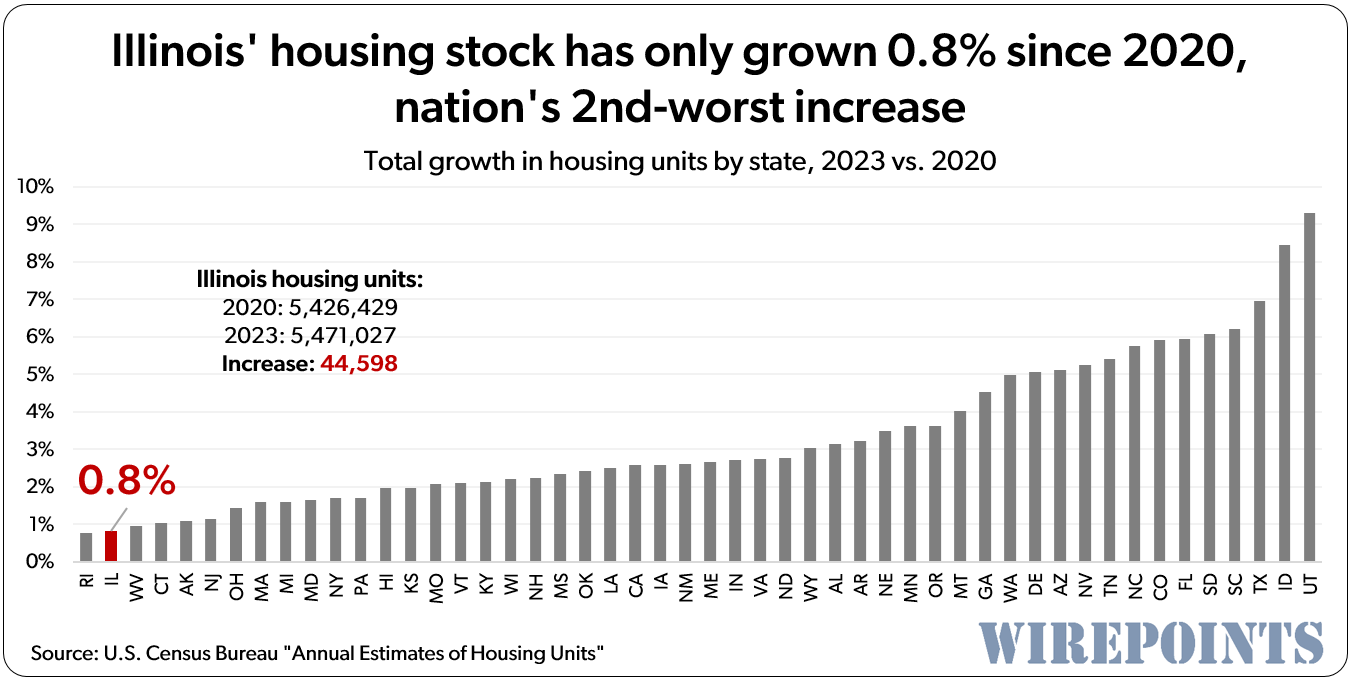
A Wirepoints analysis of U.S. Census Bureau data shows just how far behind Illinois has fallen. Just 44,600 net housing units have been added in the state since 2020 – an increase in the housing stock of less than 1%. That makes Illinois 49th in the nation when it comes to increasing its supply of homes.
Lawmakers have reacted to the lack of market-built housing not by opening up more zones for multi-family housing or by reducing property taxes or by easing regulations – like getting rid of silly rules that impose restrictions on how landlords must handle security deposits – but by passing more affordable housing programs subsidized by the government.
These subsidized homes end up incredibly expensive because the projects must comply with increasingly more demanding regulations and zoning rules, including green energy, environmental rules and diversity requirements.
That’s led to eye-watering costs to build affordable housing in places like Chicago. The Chicago Tribune, the Sun-Times and Crains have all complained about the massive per unit cost to build affordable housing in the Windy City.
The Sun-Times points out: “that’s much higher than market-rate developments and more than double the cost of new affordable units in Houston” and the Tribune noted: “a $38 million project cost amounted to an eye-popping $884,000 per taxpayer-subsidized rental unit, [compare that to] an existing 21-unit building nearby on the market now for $150,000 per unit.”
The Tribune and Sun-Times are right to call out the government’s excessive spending, but they unfortunately still call for the wrong solution: that Illinois and Chicago government officials intervene more.
The right solution? Reduce the government’s role in the real estate market by cutting restrictive zoning, permitting, taxes and regulations. Move out of the way and let the market build more housing affordably. That way there won’t be the need for more government-subsidized programs that drive up costs.
Cutting back on housing restrictions is supported by both sides of the aisle, with think tanks like the libertarian Cato Institute arguing that “relaxing land-use regulations is the most effective way to expand housing supply and increase affordability” and the left-leaning Brookings Institution saying “zoning reforms that open up neighborhoods to townhomes, duplexes, and small apartment buildings would substantially increase the supply of housing.”
Illinois’ housing crunch will continue without such reforms. And residents will continue to leave to states where costs are lower and building is booming. Like Tennessee, where housing units are up 5% since 2020. Or Texas, which has seen its housing stock grow by over 800,000 units, or 7%. Florida has had over 586,000 homes built. And then there’s Utah, the nation’s most impressive state by far. Its housing stock has grown 9% in just three years, by over 100,000 units.
Housing stagflation
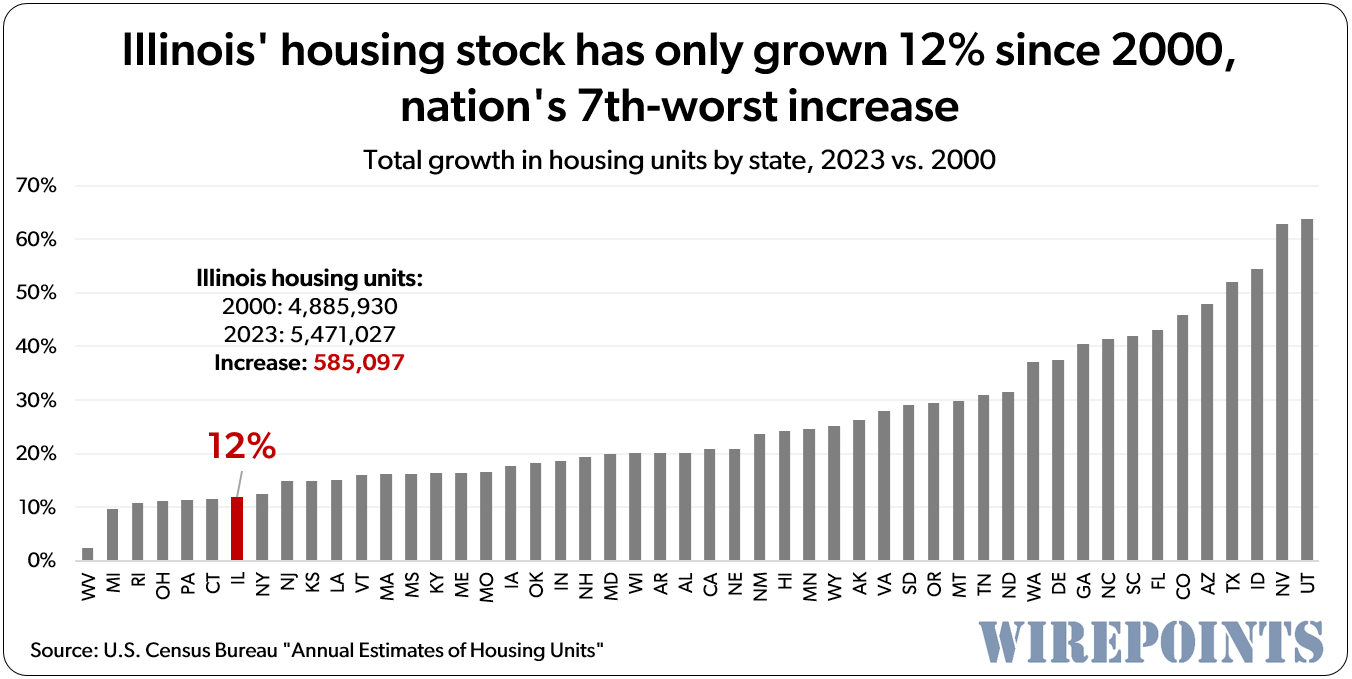
Illinois has been suffering a housing shortage for a long time. Over the past 23 years Illinois’ housing stock has only grown about 12%, the 7th-worst increase in the nation.
Compare that to Utah, where available homes have boomed by nearly 65%. And Texas homes have grown by over 50% since 2000 – with over 4.2 million more units available today.
What’s worse for Illinois homeowners is that the state appears to be suffering a housing version of “stagflation.” Fewer new homes available should, theoretically, mean demand pushes up prices for existing properties. But that’s not what the Census Bureau data shows.
The median home value in Illinois since 2000 has only grown 14% when adjusted for inflation – the worst growth of any state in the nation. Illinoisans who counted on their homes to be their retirement nest-eggs have seen almost no return on their investment for nearly 25 years.
Meanwhile, home values in many popular destination states have exploded, with Texas and Florida both having real values grow more than 100%. Long-term Idaho homeowners are the nation’s biggest winners, with the median value of their homes up nearly 130% since 2000.
 *********
Illinois officials, both state and local, created this state’s housing crisis by imposing excessive regulations and high property taxes on builders and homeowners. And that problem will not be solved with more government via more building programs, more subsidies, and more carve-outs for favored groups.
Like so many other issues in Illinois, the answer is for lawmakers to stop making a mess.
Read more from Wirepoints:
- ‘Record’ number of Illinois jobs: Don’t be a chump.
- Illinois metro areas take the top four spots for nation’s highest property taxes. Rockford takes the crown.
- Illinois lawmakers ignore where the real transit savings are
- More than $1 billion in market losses is a reminder of how close Chicago pensions are to the brink
 Audio and summary
  If this bill passes, say goodbye to local control over all Illinois parks and expect to see open drug and alcohol use, needles, no sanitation and fire hazards, but no ordinary park users.
Apartments, townhouses and condos is what’s going on in lake county. And slot more than I’m comfortable with.
Same in Rockford. Multi-family housing complex and a few homes here and there at most. Many builders from years ago are now in the remodeling business. No more building spec homes for an entire area.
Tax rate went down in Rockford and Belvidere and values went up but taxes are still higher than last year thanks to Ptell.
In Lockport and many other towns the trend is apartment construction, rentals. In the late 90’s you had many small builders making homes, good ones, where they worked closely with the buyer throughout construction. Now it’s apartments or corporate builders, neither of which would interest me if I were to be so stupid as to want to build something in Illinois.
Many homes are somewhat affordable but the property taxes attached to them is not.
It won’t help build “affordable housing” but I believe one of the few things broke blue state dems are hoping to get out of the DT admin is boost in $10g SALT cap, (to $20g, $30g???) as part of Trumps “one big beautiful bill” where he needs even the few blue state republicans votes to pass. Which if increased or eliminated could boost housing demand to some degree even in bankrupt Illinois. Or maybe just an excuse for Illinois dems to raise taxes further, especially on upper-income (millionaires tax).
Southern states with low taxes are building like crazy. If you are a tradesman and want work, look to Texas and Florida.
Gosh, this seems like a perennial problem in blue states like Cali for example.
Home construction is the best indicator of economic growth in America – strong correlation for decades. In IL Pritzker has told us that government jobs are the best indicator.
Its the enormous property tax and the general government behavior in this state. Chasing people away. No demand for homes…the mortgage rate is one thing and qualifying for the loan is another, but when the property tax doubles your house payment…people say nope.
If the proposed tax on services is enacted, and includes maintenance and construction services such as plumbers, electricians, etc., then the cost of housing will further increase and its physical condition will decline.