
-- Connecting the dots between our economy, government and business --
-- Connecting the dots between our economy, government and business --
 Much of the routine trade and investment between China and America is entirely appropriate and in America’s interest. But inserting the Chinese Communist Party into America’s pay-to-play system and its economic development strategy isn’t just crossing a line. It’s a leap into an abyss of stupidity.
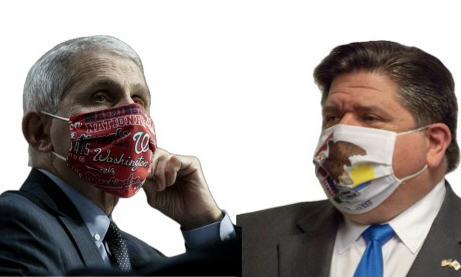 Illinois paid the price for embracing Fauci’s “science.” Here’s the retrospective.
 Summary and audio
“A partner at Chicago’s Chapman & Cutler, James Spiotto, charged clients for more than 5,471 hours in a single year – about 15 hours a day, every day. Called “possibly the hardest-working lawyer in America” by his colleagues, Spiotto claimed to have pulled 52 all-nighters in a row in 1993, working on bankruptcy matters. Spiotto is still a partner in good standing at Chapman & Cutler. Firm managing partner John M. Dixon would not explain how Spiotto could have spent virtually every waking hour of his life doing billable work, adding that “No clients were hurt and no clients complained.”… Read more »
You are familiar with the term “ad hominem argument,” correct?
I heard Spiotto would blast “Whoomp! There It Is” over and over during those all-nighters while wearing a Montreal Expos cap.
I have just one question regarding this article. Why are the “police powers” that are supposedly reserved for sovereign governments only to be invoked for breaking pension contracts? Why can’t they be used to unilaterally break other contracts such as for payments owed to bondholders, suppliers or current employees? Even more broadly, If we allow governments to be all-powerful and do whatever they want, regardless of explicit constitutional prohibitions, provided that they claim it is for the public good, what is to prevent a future Democrat-run federal government from taking away people’s guns, for example? This sounds to me like… Read more »
Your first question is a good one respecting equitable treatment of all creditors. Your other questions are spurious: The police power does not allow governments to be all-powerful; the limitations on the doctrine are strict and have been laid out by the courts.
In Puerto Rico, the bondholders, who notionally proceeded under the belief that they were secured, are going to take quite a haircut, with the latest in time investors facing a 40 percent or so recovery. Most pensioners are slated to receive 91 percent, with some at a full recovery. As regards Puerto Rico, Mr Szakmary’s concerns over the abuse of dictatorial power would be in support of the bondholders – a curious position i would think for him. (I feel no sympathy for bondholders as they chased yield and ignored obvious risks, just as with Illinois creditors). I am not… Read more »
Bondholder haircuts involve a loss of principal and [if they are not simply cashed out] possible loss of future principal and interest. However, this type of haircut has the virtue of being fairly predictable in cost to the municipality. In Detroit and perhaps in P.R., pension haircuts were provided by cutting back monthly retirement income benefits and health benefits. This type of haircut comes with the peril of actuarial assumptions. In Detroit, outdated actuarial tables were used and the city already faces a pension funding deficit with the possibility that another bankruptcy will be needed down the road … where… Read more »
Cass – great points, and food for thought. I am skeptical that a court (or a court approved settlement) will see a cram down to cash lump sums on pensions. That is the best concept for taxpayers, as it relieves them of the risks of future mismanagement.
And ironically, most pensioners might take the lump sum; and most of those will likely blow all of it in a few years.