
By: Ted Dabrowski and John Klingner
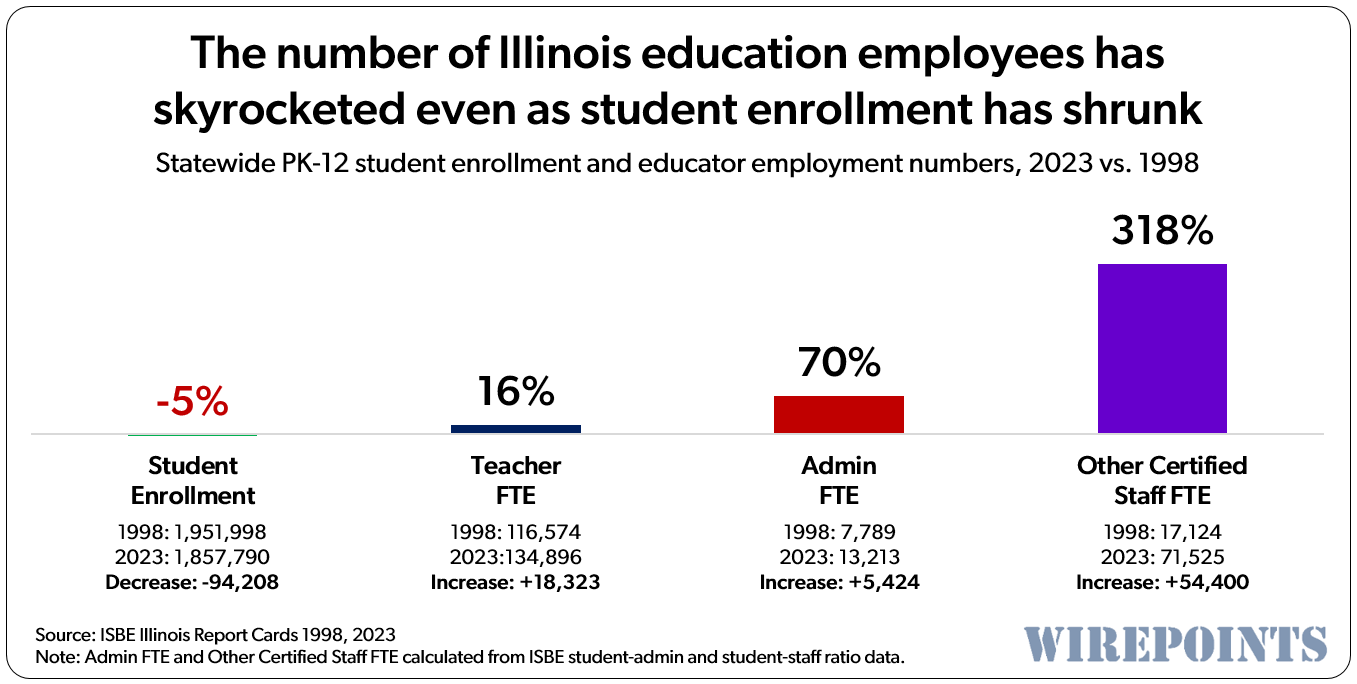
The number of administrators in Illinois schools has jumped by 70% in the last 15 years, while student enrollment has fallen by 5 percent (see appendix). That bloat has contributed to the nation-high property taxes Illinoisans pay and it also sucks up resources that could go directly to classrooms.
What does that bloat look like? When we ranked the number of students per administrator for Chicagoland-area unit school districts – those with both elementary and high schools – Lisle CUSD 202 was the worst (least efficient) with a student-to-admin ratio of just 77. That’s half the statewide ratio of 141 students per administrator.
By comparison, the best third of Illinois’ 300 Chicago-area school districts average 170 students per administrator. And the top 20 most efficient districts have more than 200 students per admin. The data all comes straight from the Illinois State Board of Education’s Illinois Report Card.
UPDATE: Four districts in this chart had incorrect enrollment/administrator count data due to pulling individual school info rather than district data. This chart has been updated to reflect the proper enrollment/admin numbers.
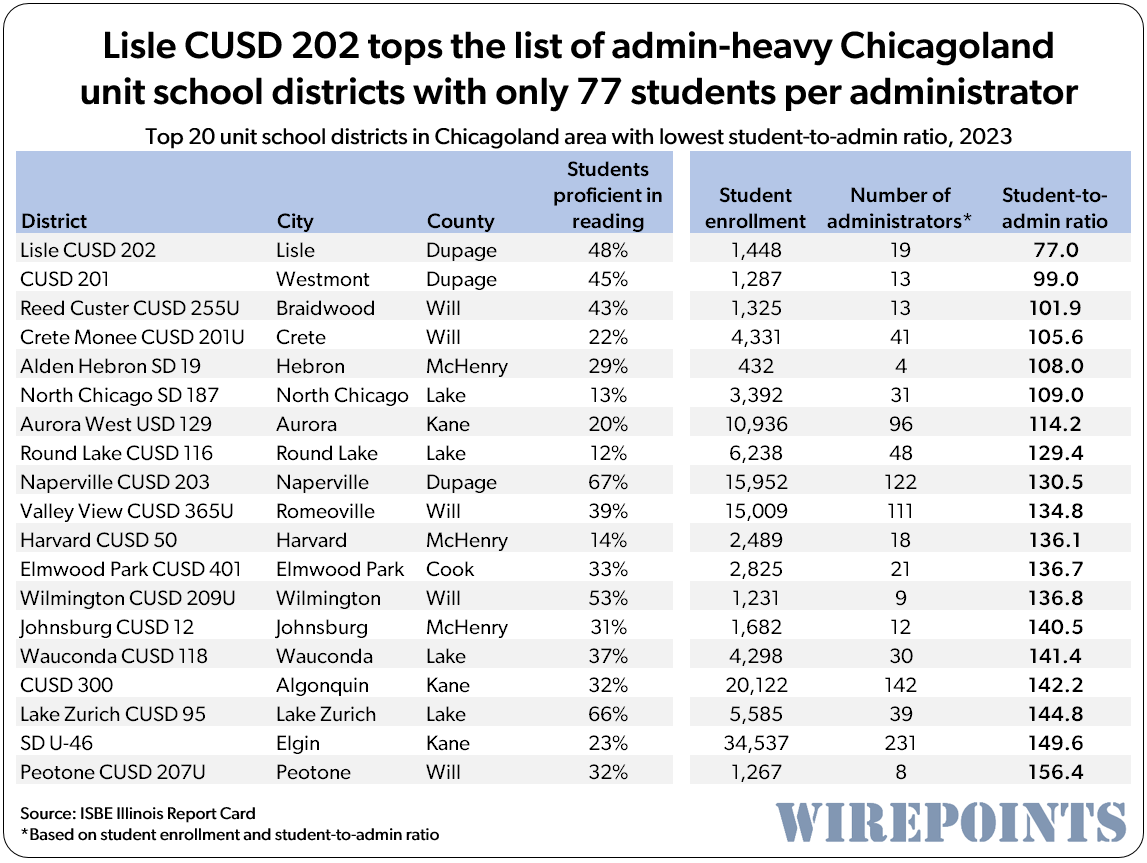 Lisle CUSD 202 has 19 full-time equivalent (FTE) admins to manage a total enrollment of less than 1,500 students. Those positions cost the city’s taxpayers $2.4 million a year just for base salaries alone.
The situation is not just bad in Lisle. Administrative bloat has been growing across the state for decades.
In 1998, Illinois had 1.95 million students and 7,800 admins for a ratio of 251 students per admin. Since then, the number of students has declined by nearly 100,000 while the number of admins has nearly doubled to 13,000, leading to a ratio of just 141 students per administrator in 2023.

The growth in administrators is happening in districts across Illinois, but often the most extreme examples of bureaucrat-bloat can be found in the Chicagoland area.
The worst (least efficient) 20 Chicago-area districts by student-to-admin ratio all have 78 of fewer students per administrator (the list includes all three types of school districts: Unit, Elementary, and High School). Harvey-Dixmoor in the south suburbs, for example, has 11 education administrators that manage a district with just 720 students, a ratio of 66.1. And the average admin there is paid over $100,000, all in a district where just 9% of students can read at grade level.
Township HSD 113 is yet another extreme. The taxpayers of Highland Park are paying 41 administrators an average of $170,000 each in a district with 3,145 students – a student-to-admin ratio of 76.5.

***********
Illinois’ administrative bloat is yet another symptom of the state’s failed education system. Big pay, big jobs and big pensions, as we recently wrote about in “New Trier School District set to produce next $8 million superintendent pensioner,” in a state where 1.2 million kids can’t read at grade level.
Add to that the nation’s highest property taxes, most of it for schools, and you have to wonder why Illinoisans aren’t clamoring to be part of the school choice wave that’s overtaking the rest of the country.
Appendix
Read more from Wirepoints:
- Illinois lawmakers’ decision to kill school choice looks increasingly absurd
- Here’s what Chicago voters will need now: School report cards by district
- The evidence so far on Illinois’ ‘Evidence-Based Funding’ for K-12 schools: It’s a flop – Wirepoints Special Report
- New Trier School District set to produce next $8 million superintendent pensioner
- Illinois has more educators, less students than ever, yet officials complain about a ‘teacher shortage’
 Expect no retraction or apology. This what they do.
 The state’s existing buyout program for its own pensions is the precedent for Chicago, which should be a warning: Look out for similar exaggerated claims and shoddy analysis.
WP could expand this topic to higher education in Illinois public universities and arrive at a similar conclusion.
yup, and I’m sure the same for all of Illinois CRAZY 7,000 units of gov (600+ police & fire depts, a zillion townships mosquito abatement dist, etc, etc) stacked with overpaid administrators and their relatives.
Fantastic work WP!!! 1.) A ton of work, but it would be great to know what other states are spending, or ratios are for administrators/ per student? I tried to comment earlier that 8 yrs ago there where a lot of articles stating that Illinois was #1 nationally for school administrative spending (https://www.chicagobusiness.com/article/20170331/ISSUE07/170339970/illinois-schools-overspend-on-administrative-expenses-study). 2) From previous WP piece comments (https://wirepoints.org/new-research-on-big-pensions-shows-need-for-cost-shift-wirepoints/), Nick Binnote replied to my comment stating that administrators are mostly non-unionized and have separate individual contracts (non-collectively bargained) from teachers with all CRAZY 852 school districts. And my question is, therefore, could these administrator individual non-collectively bargained contract positions… Read more »
These positions could be easily cut if the taxpayers in these mentioned school districts would stand up and be heard, but as usual they talk among themselves and that’s were it dies.
Are you sure the 2,511 enrollment number for Naperville School Dist. 203 is right? The school district serves about half of a town that has 150,000 people in it. It has two high schools (Naperville North and Naperville Central), the combined enrollment of which should be at least this much. In 1973, I graduated in a class of about 700 from Naperville Central High School. Has enrollment declined that much?
Jefferson, in four cases we accidentally showed school enrollment rather than district enrollment. The numbers have been properly updated.
The actual student-to-admin ratios were all correct so there were no needed changes. Thanks for pointing out the error.
Yes, Illinois public schools put incredible pressure on the taxpayers. Consider the property taxes on comparable middle class homes in Illinois and Tennessee with 4% annual inflation (compounded). Illinois: 2023 = $8,000 2028 = $9,700 2033 = $11,800 Tennessee: 2023 = $2,000 2028 = $2,400 2033 = $ 3,000 In 10 years, property taxes increase $1,000 for the Tennessee home and $3,800 for the comparable Illinois home. Next, consider the fact that Illinois has a massive debt problem, which will likely raise taxes even further while Tennessee does not have this problem. Finally, consider the fact that Illinois has an… Read more »
While I’m not surprised at this, I have a very hard time believing that Naperville District 203 only has 2,511 students. The town is 140,000+ people, and while there’s another district (204) that the town is part of, 203 has two high schools, three middle schools, and many more primary schools. I think you need to recheck your numbers.
203 has around 16k students.
Please see comment above. Naperville and three other enrollments were showing school, not district, enrollments. They have been properly updated. Thanks.
D113 also includes Deerfield. Sad to see the administrative bloat. When I attended the money went to teachers.
It isn’t about the students, it’s about the adults. Governmental and NGO organizations never account for their actions, their results, or consider disbanding when it’s clear that the only beneficiaries of their actions are their staffs who have well-paid jobs, great benefits and lots of time off. Follow the money and it rarely benefits the putative beneficiaries. It’s more likely to create real benefits if you throw rolls of quarters from drones (modern spin on WKRP’s turkeys) over their service areas.
“With God as my witness, I thought turkeys could fly.”