
By: Ted Dabrowski, John Klingner and Nick Binotti
In 2017, Illinois politicians passed a new education funding formula that they said would “transform” Illinois K-12 education. Seven years and $8.5 billion in dedicated funding later, the only evidence so far is that Evidence-Based Funding (EBF) has been a flop.
The EBF formula was sold as a way to close the funding gaps between the state’s wealthiest and poorest school districts. The “evidence” part of the formula specified those gaps would be closed by spending more on a long list of specific inputs – like the number of teachers, textbooks, computers, and librarians per student. The goal was for each of the state’s 851 school districts to reach by 2027 a target level of education spending – it’s “adequacy target” – which would then “enhance student achievement over time.”
But for all the money Illinoisans have poured into education in the name of EBF, it hasn’t “enhanced” student outcomes at all. A number of districts have since reached and exceeded 100% of their funding targets, and yet their student proficiency scores are still dismal, many of them worse-off than before.
And, in complete contradiction to the justification for EBF, some of the school districts still furthest from adequacy are achieving some of the best reading scores in the state. Germantown Hills SD 69 in Woodford County is at only 69% of its adequacy target, yet 71% of its students read at grade level, the 22nd-highest reading score in the state.
The evidence of EBF’s failure isn’t found only in Illinois. A look at other states that previously adopted “evidence-based” model as Illinois – Ohio, Arkansas, Wyoming and North Dakota – show the same results: stagnant student achievement over many years. Take Ohio, which began EBF in 2009. Just prior to implementation, 39% of the state’s students were proficient in reading and math on national standardized tests. A decade later, just before covid hit, proficiency still stood at 39%. Today, it’s down to 36%.*
It’s facts like that that led education experts like Professor Eric Hanushek of Stanford University to declare those selling EBF as “Confidence Men: Selling Adequacy, Making Millions.” As Hanushek told us in 2017 when Illinois’ formula was originally passed: “We know that focusing on input requirements for schools is a bad idea. If we want efficient and productive schools, we have to focus on the outcomes of schools and students.”
Cairo Unit SD 1, one of the poorest school districts in Illinois, provides a good example of how EBF has failed. So far, the EBF formula has done exactly what it was supposed to do for Cairo – in terms of funding. The district jumped from just 70% of its adequacy funding target in 2018 to 115% in 2023. It’s one of the biggest jumps in the state.
That increase, however, has done nothing for student outcomes. In fact, the share of district students able to read at grade level has fallen to less than 2%, lower than in 2018 when 5% of students were reading at grade level.
Defenders of the EBF formula will counter that Cairo is an outlier, that students in such a small, low-income, minority district cannot be expected to perform well. But that’s exactly how “evidence-based” funding was sold to the public: as a way to improve results in struggling districts.
Cairo has more money than ever – the district now reports total, all-in revenues (local, state and federal) of $9.8 million, equal to $32,000 per student – yet its student outcomes remain beyond dismal.
The table below shows the biggest gainers in funding adequacy for districts that were below 80% of their funding targets in 2018 and are now above 100%. These are some of the districts that were among the most in-need according to EBF, and received the most financial support, yet student performance has either fallen or shown meager gains.
 Ford Heights is now at 104% of its adequacy target, yet student reading proficiency has collapsed by 13 percentage points – to where just 8% of its students read at grade level. Ditto for Richmond-Burton, which is down nearly 20 percentage points in reading.
What’s equally alarming is, despite all these districts now exceeding 100% adequacy, only two have 50% or more of their students reading at grade level.
More evidence that “evidence-based” doesn’t work
Even districts that are very well funded according to EBF standards are failing to perform. The table below shows 15 districts that exceed 150% of their funding targets – some over 200% – and yet have reading proficiencies below 50%.
Venice CUSD 3 in Madison County is at 235% of its adequacy target, and yet just 11% of students can read at grade level. Operating spending at the district hit $42,000 per student in 2023. Seneca Township HS 160 is at 235% of adequacy, spending more than $30,000 per student, and there just 28% of students read proficiently.

Overall, the weighted average of student reading proficiency for the 38 Illinois districts above 150% of their adequacy level is just 62%.
For even more evidence of EBF’s failures, in the appendix below we list the 113 districts with adequacy funding above 100% and where less than 50% of students are proficient in reading.
Chicago Public Schools
CPS deserves mention given it’s the largest school district in the state. The district was at 63% of its adequacy target in 2018 and by 2023 it was at nearly 75%. In dollar terms, it’s the biggest recipient of state funding and in 2024 the district will receive $1.7 billion in EBF funding, or 21.2% of the state’s total EBF disbursement. CPS makes up about 17% of all student enrollment statewide.
Unfortunately, all that money hasn’t helped Chicago’s reading proficiency results. CPS has yet to recover to its pre-covid levels. In 2018, 27% of all CPS students were reading proficient. Proficiency fell to 20% in 2022 and since then, it’s recovered to just 25%.
CPS also benefits from a hold harmless provision in the EBF formula which says no district will be impacted by a falling enrollment – EBF funding is effectively protected at the previous year’s level. That’s good news for CPS given its enrollment has dropped by 60,000 students since 2017, when EBF was originally passed. (In 2017, enrollment was 381,000. It’s now at 323,000.)
It also can’t be ignored that CPS has also benefited from all sorts of additional funding – TIF surpluses, federal covid aid, higher property taxes – and that’s helped push up district spending to record levels. All-in per student spending (local, state and federal) has jumped from $17,265 in 2018 to more than $29,000 in 2023, an increase of almost 70% in five years.
Low funding, top results
Another blow to EBF: Illinois has many districts that are far from reaching their “adequate” funding targets, which, according to EBF’s logic, should mean they’re all struggling with low student proficiency.
But that’s not always the case. In fact, some of these districts rank among the highest-performing in Illinois. Prairie Hill is at just 70% of its funding target, yet at 76% reading proficiency, it ranks 9th-highest among all districts in the state.
Ditto for North Palos. At 61%, it’s the 7th-worst funded district in the state based on EBF standards, yet 73% of its students are able to read at grade level, the 14th-highest proficiency in the state.
The same goes for Germantown Hills, Aviston, and Tazewell’s Central School District. They are all top performers in reading proficiency despite their low funding levels. In all, we found 42 districts that are far from reaching their target funding level and yet achieve reading proficiency levels above 50%.

Moving towards adequacy, but not better results
The biggest problem with EBF is that it lets education officials make “adequacy” spending targets the primary focus in education – not educational achievement.
That gives officials an easy excuse for dismal outcomes. If districts with failed results aren’t at 100% of funding adequacy, they blame the lack of funding. And even if those districts exceed 100% adequacy, they say student improvements take time.
Illinois has already spent billions to move hundreds of districts toward adequacy. The 2017 EBF law promised $350 million in new EBF funding yearly, all of which has been provided except in 2021. That means $8.5 billion in additional spending over and above the base amount spent in 2017 has gone into education, overwhelmingly to the state’s poorest districts (those with less than 80% adequacy).
Those billions have helped move districts up along the adequacy ladder, which the table below shows. There are now only 2 districts still below 60% adequacy, and 42% of all districts are now above 80% adequacy, a big improvement based on education officials’ goal of closing the rich-poor district funding gap.
Despite all that, student reading proficiency is down across the board. All those improvements in adequacy targets have failed to lead to improvements in reading.

It’s important to note that all-in revenues for education in Illinois, including all local, state and federal sources, totaled more than $42.5 billion in 2023, up from $34.1 billion in 2018. In per student terms, that was $22,900 in 2023 vs. $17,000 in 2018, a 34% increase.
The evidence in other states? Not good
The education consulting group Picus Odden & Associates was the original developer of the Evidence-Based Funding model that Illinois’ own EBF is based on. Several other states have adopted Picus Odden & Associates’ model for funding education, among them Wyoming (2006), Arkansas (2006), Ohio (2009) and North Dakota (2009). In none of those four states has there been any real evidence of an improvement in outcomes based on student reading and math proficiencies from the National Association of Educational Progress, or NAEP.*
In 2019, ten years after the implementation of EBF – and before the impacts of covid – Ohio and North Dakota’s combined average of 4th- and 8th-grade reading and math results were essentially flat compared to 2009. Student outcomes have fallen further post-covid. The results are effectively the same for Arkansas, which implemented EBF in 2006, giving the state an even longer opportunity to create success.
North Dakota’s failure to improve is noteworthy given the sky-high results Picus Odden & Associates promised EBF would accomplish: “The goal of adequacy North Dakota is to identify the resources needed to ensure that all students are taught the state’s curriculum standards and that strategies are deployed using those resources in ways that will lead to a doubling of student performance on state tests over the next 4-6 years.”
Wyoming is the only state where average student proficiencies did experience some limited improvement. But even there, proficiencies began to stagnate and fall during the pre-covid 2017-2019 period. And today, Wyoming students are back to where they started 16 years ago.
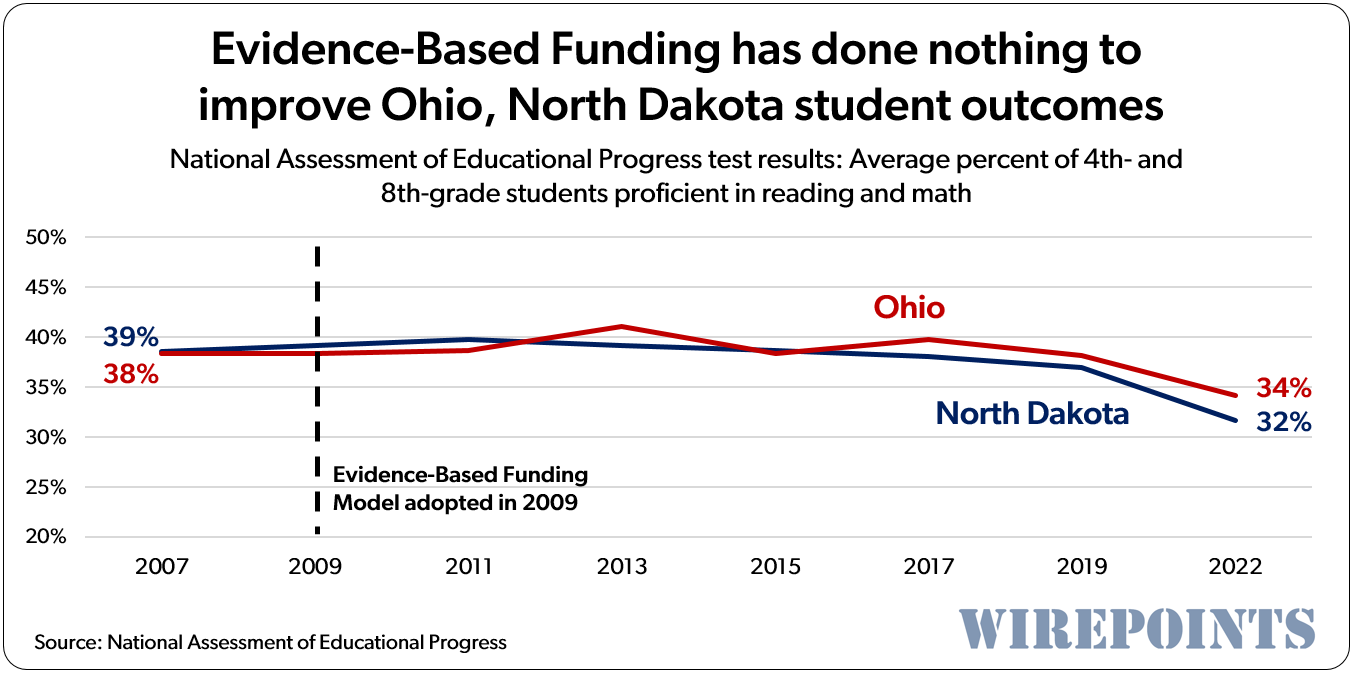

In Illinois, EBF has been implemented for less time than in the other states, but after seven years, there’s no evidence of success when looking at state reading and math proficiency tests. Yes, covid had a negative impact, but that’s little solace for the Illinoisans who’ve put in $8.5 billion in fresh EBF funding.
Investing in a flop
What’s entirely ignored in the EBF discussion is Illinois’ already high level of spending in education, and the high level of taxation that goes with it. We recently reported this in “The big myth that needs debunking: Illinois needs more money for education.”
Also frustrating is that Illinois spends all that money – far more than any other state in the Midwest – and yet student outcomes are at the same dismal level as our Midwestern neighbors. Below we show how
Illinois spends, based on US Census Bureau data, $3,000 to $7,500 more than the other states and yet it has nothing to show for it.

The evidence against the Evidence Based Funding formula is clear. It doesn’t work.
EBF and its convoluted formula should be eliminated. The real focus should be literary and numeracy. Take the money we already spend, and obsess about outputs, not inputs. Because with student outcomes this low throughout the state, it’s clear that money is not the problem.

*For ease of comparison and analysis, we averaged the 4th and 8th-grade reading and math scores to obtain one single NAEP proficiency number.
Appendix


Read more from Wirepoints:
- The big myth that needs debunking: Illinois needs more money for education – Wirepoints Special Report
- New 2023 School Report Cards reveal to parents Illinois’ dismal student outcomes
- Illinois has more educators, less students than ever, yet officials complain about a ‘teacher shortage’
- Poor student achievement and near-zero accountability: An indictment of Illinois’ public education system
 A mess of uncertainty and litigation is sure to follow.
 With $162 billion more from taxpayers, couldn’t you deliver a few bond upgrades, too
A report such as this provides a poorly balanced perspective when it fails to perform a comparable analysis of the successful schools in Illinois. It’s difficult not to conclude that its data was cherry-picked.
The operating expense per student is really an amazing number. Private schools would be less expensive and better as they don’t need to put up with disruptive students and can throw them out. It is just ridiculous that this continues and continues. It is not getting better, just more expensive. Offer parents a choice with vouchers and let them choose where their education tax dollars are spent and perhaps let the rest of us choose also.
Over 12% of K-12 students in IL attend private school – just imagine if one day they showed up to their local failing public school? Those families are doing the teachers union a great service.
There’s a better argument that private schools are a primary contributor to dominished public school performance. Take the best students from the most successful families out and the leave the least motivated students from poor and dysfunctional families, and it not surprising public schools would decline. I fail to see how following your formula, removing even more of the better students would do those students left behind a bit of good. BTW, studies have shown most of the charter schools and many private schools do no or little better than the public schools.
So much effort goes into articles like this one, including deep research and various graphs/charts, yet I could summarize all of the WP info with 2 words, “ILLINOIS SU …”
All the Illinois holdouts, refusing to leave and clinging to hope, where exactly do you see improvement coming from? It sure won’t come from the graduates of its public schools. It’s also unlikely many professors are included in the bus shipments from Texas, courtesy of their governor.
People have different ‘breaking points’, and there is ‘Stockholm Syndrome’. Also, those that remain are more and more beholden to the ‘abusive system’ Democrats have put into place in IL. I think that so many young people leave IL for college and careers pretty much sums it up.
well obviously it failed because the funding formula wasn’t big enough or bold enough. We need give two or three times as much month to these failing districts, in perpetuity, and I promise that there will be results…
Vouchers is the only answer to schools in Illinois and let the chips fall where they will.
EBF has been a huge success in IL – A huge, permanent money grab, which is what Democrats are all about.
what is the history nationally of who dreamt up up EBF for big $pay-offs$? AFT?
Illinois politicians making disastrous decisions. Who’s surprised?
This legislation was strongly supported by the education establishment and teacher unions. Now that it is a clear failure, we will hear all the same voices telling us that the voters are at fault. Maybe they are. We need to stop following the galactically stupid advice of the education establishment.
Remember Kansas City? A federal judge bought the argument in the 90’s that Missouri needed to pour billions into the KC schools – even ordering a tax increase. The school system then received everything under the sun. What happened? The schools became considerably worse, and the anticipated flux of good students never came into the system, notwithstanding the Olympic size pools and new buildings. The money at times had a perverse impact. Teaching jobs are vital to that community, and the additional funds only entrenched mediocre teachers and administrators more than before. I do believe good teachers should be compensated… Read more »
Checkout John Stossel “Stupid in America” He had many shows/videos on the public school system from around the country. He has videos on private vs public schools.
Dynamite article Ted & John.
I think you mean $1.7 billion not million?:
Good catch, Where’s Mine?? Thank you. But then again, millions, billions, trillions. What’s the difference anymore?
You said it all Ted, billions or trillions the outcomes are the same the kids
Cannot read or do basic math, the future is terrible for them. On the flip side all the union CPS teachers will be driving Rolls Royce Wraiths, Black Badge.
Does anyone know who is credited with being the architect of the EBF in Illinois? Are they connected to Illinois politicians and/or do they receive any state funding as part of their “advocacy” work? When taxpayer funded programs, which don’t work for the people, are allowed to continue, there usually is a reason and that reason is some sort of money flow that can be tracked.
Ralph Martire and Bruce Rauner’s wife were key architects. (Rauner’s wife is far left).
Ralph was right again. Oh…wait…
The man is a menace to the taxpayers.