
Two new pieces, one from Pew and one from Illinois’ official number crunchers, provide more evidence that the federal government’s $350 billion bailout to state and local governments earlier this year was entirely unnecessary.
Far from lacking cash, most states had billions of extra dollars to draw on to cover pandemic costs. From Pew: States’ Total Rainy Day Funds Fall for First Time Since Great Recession:
The total amount set aside in state rainy day funds fell for the first time since the Great Recession as lawmakers in fiscal year 2020 filled budget gaps driven by the pandemic’s early fiscal and economic fallout. Nearly a third of states reported declines in the total dollar amounts of their savings—the most since 2010. Still, remaining balances hovered near record highs.
Despite the start of a recession, rainy day funds in the rest of states were unchanged or even grew somewhat in the fiscal year that ended for most states in June 2020. Overall, rainy day funds nationwide were left with $71.6 billion—second only to the pre-pandemic record-setting total of $78.7 billion—to deal with budget shortfalls or other emergencies as the pandemic continued into this fiscal year.
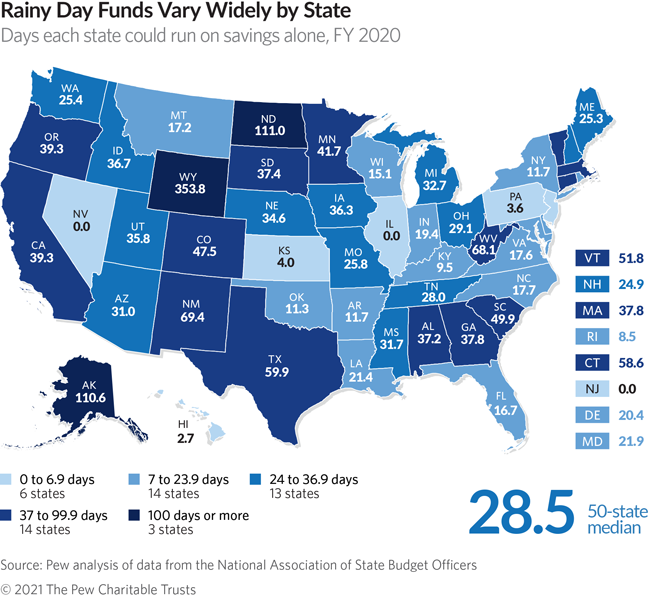 That was for fiscal year 2020, meaning most states still had billions to draw on going into fiscal year 2021 (July 1, 2020 – June 30, 2021). The numbers have only gotten better since, especially in recent months.
It is still unclear how much states may draw on their reserves to balance budgets this fiscal year, which ends June 30 in 46 states. Eleven states expected their rainy day fund totals to fall by the close of fiscal 2021, according to NASBO data. But fiscal and economic outlooks have improved considerably since most states’ budget plans were passed last year.
The threat of big year-end budget gaps lessened as the national economy began bouncing back and state tax revenue began recovering. As of February 2021, tax collections in 29 states had grown enough to offset initial losses since the start of the pandemic, though in at least 18 states—often those heavily reliant on tourism or energy production—receipts still were running behind pre-pandemic levels… A few states that recently withdrew from their rainy day funds were already considering making sizeable deposits in fiscal 2022, including California, Michigan, and Oklahoma.
Even Illinois, which started the pandemic with zero reserves, will likely come out ahead. We wrote about that here: The states’ 2020 financials are in: Biden’s billions in new federal aid aren’t needed.
Illinois is one of the states that’s seen its revenues continually improve – all in the face of the dire predictions made early in the pandemic. From the The Commission on Government Forecasting and Accountability’s new Revised FY 2022 Economic Forecast and Revenue Estimate and Updated FY 2021 Revenue Update:
…Since then, actual receipts for both March and April have been booked, and despite final payment deadlines for personal income tax being slightly delayed, revenues have been interpreted to continue to significantly outpace expectations. As a result, as discussed in the following revenue update, the Commission is making a revision for FY 2021, as revenues are expected to total $45.616 billion, or $2.025 billion above the March projection.
After adjusting the $45.6 billion down for the $2 billion in Federal loans and the $1 billion in 2020 income tax payments that were pushed into 2021, Illinois expects total 2021 revenues at about $43 billion.
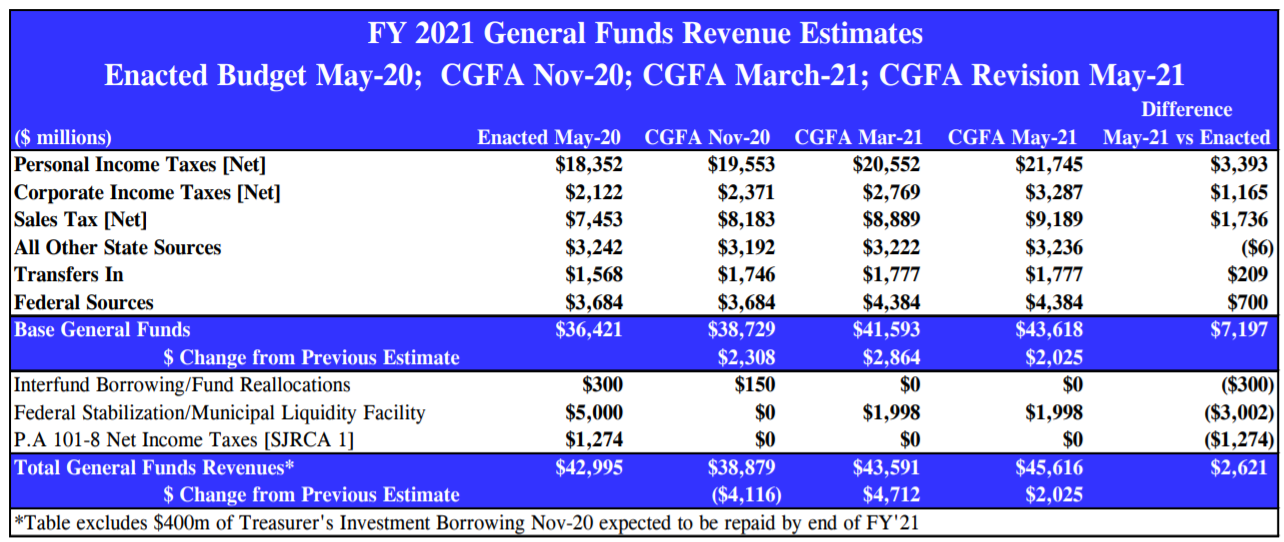 That compares to 2020 revenues of $41.1 billion (adjusted up by $1 billion for the tax revenues pushed into 2021) and 2019’s $40.12 billion.
— Ted Dabrowski and John Klingner
 Expect no retraction or apology. This what they do.
 The state’s existing buyout program for its own pensions is the precedent for Chicago, which should be a warning: Look out for similar exaggerated claims and shoddy analysis.
Are they [those who represent the collective us]: 1) giving the masses bread and circuses to pacify their otherwise chaotic disposition? 2) giving the spoiled brats an extra piece of whatever knowing that they may be enabling useless teenagers? 3) stimulating short-term economic activity that will result in a well-disposed electorate at re-election time? 4) distracting the electorate from climate, covid and corruption? We are pretty sure it won’t end well. We are equally sure that those who are making it happen have nothing really to lose. With today’s values, the little pig who used bricks is likely to get… Read more »
With all the states seemingly in great financial shape and now receiving mountains of free fed cash, is it ONLY broke-ass illinois that’s a standout,
looken to raise taxes (thru jbs proposed $1b in new business taxes)?
When I said this at the start of the pandemic I was demonized. Why give billions to the restaurant industry when 85% go out of business in the first few years. Many small businesses collected more money than they would make in 2-3 years so they shut their doors while the getting was good. Thank you for all you do.