
By: Mark Glennon*
Heralded as a renewable energy triumph, electric transit buses made by Proterra attracted major public investments in the Chicago area, Bloomington-Normal and many other metros around the country.
Calamity resulted from many of those purchases, with stories now common about disastrous performance, cost overruns and buses sitting unused. No problems are being identified, however, by PACE, Chicago’s regional transit authority that has ordered Proterra buses, or by the Chicago Transit Authority, which has Proterra buses in operation. But for Connect Transit in the Bloomington-Normal region of Illinois, Proterra buses are a fiasco.
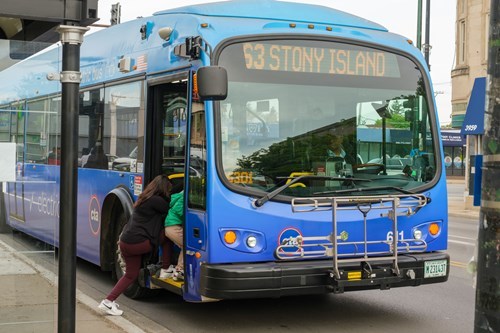
Proterra was widely regarded by green energy enthusiasts as a darling of the transportation sector. President Biden “all but endorsed Proterra,” the Washington Examiner wrote, “at one point taking a virtual tour of a Proterra manufacturing facility in South Carolina in 2021, where he revealed he used to be a bus driver.”
But problems plagued the company’s electric buses from the outset. “There were flashing red lights from its start,” wrote the Wall Street Journal. “The company had a history of defective manufacturing and costly repairs.”
The company filed for bankruptcy in August, though its bus transit division recently sold to Phoenix Motor Inc. (Nasdaq: PEV). The January cold snap aggravated performance issues in many cities, though problems preceded both the bankruptcy and the cold.
Stories of Proterra bus performance issues are now common around the country, some of which are described by the American Energy Alliance, the Institute for Energy Research and Fox Business. Examples from there and other sources include the following:
- In Philadelphia, all Proterra buses were taken out of service in February 2020 “due to both structural and logistical problems – the weight of the powerful battery was cracking the vehicles’ chassis, and the battery life was insufficient for the city’s bus routes,” according to the Washington Free Beacon.
- The entire fleet of Proterra electric buses in Louisville had not operated in two years in November 2022, for which the city had paid $9 million.
- In Ann Arbor, Michigan, the school district says launch of four Proterra school buses has been a struggle due to cost, downtime and performance issues. They cost five times what a regular bus would cost and the charging infrastructure was four times more expensive than estimated. Aside from the bus cost, it took another $1,200 to $12,000 or more for a basic EV charger and infrastructure-related costs.
- Jackson, Wyoming, has put its fleet of eight electric buses out of commission indefinitely.
- In Austin, Texas, the city signed a $46 million deal with Proterra in 2020 for 40 buses. Austin’s Capital Metro has six of them in operation while they await another 17 that have been built but are sitting in Proterra’s South Carolina factory because chargers for them are not yet available.
- Broward County, Florida, bought e-buses from Proterra for $54 million, and the first batch operated for an average of 600 miles before breaking down, while the second batch averaged 1,800. The county’s much less expensive diesel buses average 4,500 miles between failures.
- In Asheville, North Carolina, three of the five e-buses the city purchased for millions in 2018 are now sitting idle due to a combination of software issues, mechanical problems and an inability to obtain replacement parts.
- For Metro Transit in Minnesota’s Twin Cities, electric buses lost 40% of their range in the winter. In Duluth, the city spent years working to address issues, with Proterra embedding a technician in Duluth to fix problems, which included difficulty climbing hills.
- Most recently, the City of Edmonton filed an against a U.S. $82 million claim over its Proterra buses’ poor performance. Proterra began supplying battery blankets to each bus to improve the range, Edmonton says, the city only received a portion of them and it’s unclear if the blankets actually help. Aside from the batteries, the city claims a number of other problems, including gearbox and steering box failures, issues with stanchions and bell pulls, and cracks in the composite body structure that have kept most of the buses off the road. At most, the city has 28 of the 60 buses on the road at any given time,” it says.
I reached out to PACE and the CTA to ask if they’ve had any problems.
PACE’s spokesperson had no comment on Proterra problems because, she said, it had none of its buses in operation. That’s in contrast to its 2022 announcement, to much fanfare, that it was purchasing 20 Proterra buses in 2023, anticipating that at least some would be in service that year. It was part of PACE’s goal of having an all-electric fleet by 2040, they said.
“The future has arrived,” said PACE’s executive director after riding their first electric bus in 2022. Congressman Sean Casten, a major renewable energy supporter, added that, “Pace’s battery-electric bus is a great step towards cleaner transit systems and green innovation.” Casten sponsored a grant for electric transit vehicles that was included in the U.S. House Appropriations Bill for FY2023.
Why still no Proterra buses in operation? I asked that in a follow-up. “The delays, in part, have been caused by Proterra’s bankruptcy and subsequent sale to Phoenix Motorcars, who will now fulfill our contract,” answered PACE’s spokesperson.
The Chicago Transit Authority last year announced it had purchased 22 new Proterra buses, nearly doubling its electric fleet, at a cost of $26.2 million. The CTA in 2021 said the buses cost $900,000 apiece.
Responding to my question about whether the CTA has had any problems with Proterra buses, its spokesperson said “Proterra electric buses are tested to perform year-round in Chicago. Overall our electric buses have performed well this winter season, and we have not experienced any challenges with our fleet related to cold weather.”
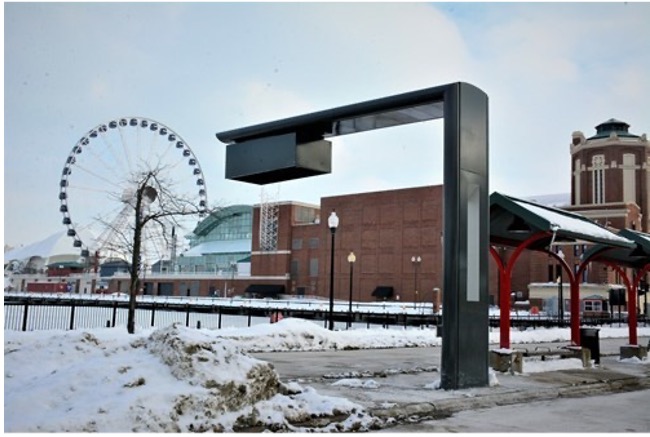
But she also pointed to a 2023 Associated Press column that says “to make electric buses work, the CTA has had to go to great lengths and expense. It built fast-charging sites on both ends of [a route served by an electric bus] that plug into the bus rooftops.”
It’s unclear whether those costs were included in the CTA’s total cost estimate for transitioning to a fully electric fleet by 2040. In 2022, the CTA issued a report saying, “Overall, scenarios transitioning to an electric bus fleet would be $1.7 to $2.9 billion more costly relative to comparable diesel scenarios, for the combined operating and capital costs evaluated over the 2022-2040 period.”
The unconcern at PACE and CTA is in stark contrast to Connect Transit in the Bloomington-Normal area.
A Proterra bus debacle there has been heavily documented by BLN News, a local watchdog outfit. Nine of Connect Transit’s 12 Proterra buses were not in operation recently for a host of reasons, according to BLN. BLN reports here, here and here contain scathing internal emails and letters by Connect Transit maintenance people and other officials describing a multitude of problems that quickly arose with Proterra buses after minimal use. A Breakthrough Ideas video interview of BLN’s Diane Benjamin on Proterra buses is here.
Why no alarm bells at PACE and CTA given the problems in other cities?
We could only speculate, which we will avoid.
Oh, one other thing about Proterra: Energy Secretary Jennifer Granholm sold her Proterra stock for $1.6 million just after President Biden hyped the company in 2021 and before the bankruptcy. The sale was among nine times Granholm violated stock disclosure laws in a single year.
*Mark Glennon is founder of Wirepoints.
UPATED AND CORRECTED: This column was updated to delete an image of an electric bus at a PACE announcement that was incorrectly identified as a Proterra bus.
 With $162 billion more from taxpayers, couldn’t you deliver a few bond upgrades, too
 Audio and summary
  A largely unasked question is becoming glaring: Is Illinois doing all it should to use artificial intelligence to make government cost less and work better? So far, the evidence says no.
** UPDATE ** Dateline 02/22/2023 The Metra Board of Pals and Family (Directors) has approved the purchase of Stadler battery powered streetcars for use on the old Rock Island Line. Not since the days to the ‘Ravioli Rocket’ will the few who still ride the Rock have such a conveyance. Get the cameras ready, photo op inbound on Track 9 3/4. Not since the advent of the RFP for battery locomotives has the MBoFP had such an opportunity for massive virtue signaling at the taxpayers’ expense.. Then these pricy gems will fail one by one, likely at normal Chicago Winter… Read more »
Chicago seems always at tail-end of progressive ideas already proven to be problematic and failing in practice. Because Chicago’s decision-makers usually don’t do thorough and unbiased research to support proposed new policies and purchases, because they usually don’t contact other municipality to fact-check actual results and outcomes, because they inevitably value the press-release value as opposed to the long-term effective impact upon Chicago residents and its taxpayers. And of course, the likely contract kickbacks and political contributions are of prime importance. Hello, red light camera contracts and subsequent graft indictments! Same issue with RE tax transfer tax, which has stymied… Read more »
We took an electric bus
Hoping it would transport us
It broke down twice because of the ice
Our EV experience wasn’t so nice
Big debate happening:
https://www.transittalent.com/articles/index.cfm?story=Bay_Area_Agencies_Split_On_Hydrogen_Vs_Electric_2-14-2024
Great article Mark. Your not going to get an honest answer from many transit agencies or manufacturers about the reality with battery electric buses. Many are blinded by climate alarmist ideology and haven’t thought through these ideas enough to make intelligent decisions. Chicago media just has to visit Chicago Avenue Garage on the West Side to see how many are parked every day that sit after 8 am. Chicago media cannot even write any honest stories about anything else, why would they go after CTA? If CTA admitted that the buses experience more downtime than uptime it would be admitting… Read more »
Very well said.
Electricity is not a source of energy. It is a byproduct of some other thermal, chemical or mechanical energy source. Electricity is much like the heat or light that comes from a campfire, it came from burning the logs. The woke left has our dumb population believing that “electricity comes from a wall outlet”. Electricity is also delivered at a 60% loss than if you simply burned the source fuel directly in the vehicle. So in essence EV”s are about the least efficient way to transport a vehicle. Additionally these busses require massive upgrades to local grid. Our town did… Read more »
Right on point. The heavy lift is the infrastructure it takes to charge the buses which involves quite a bit of engineering and public utility coordination in order to be feasible. This could take 1-4 years of construction depending on number of vehicles, frequency of charge, range, and climate. Politicians are liars and thieves this one is no different.
EV not for me
Zephyr Window
Can’t get to work via an EV? No problem. Just stay home and get paid, so long as you vote blue. All part of the plan to reduce everyone to an amebae that simply exists as part of the “ re- imagining “ of America.
Somebodys pocket involved in Illinois politics is getting more than lint put in their pocket. A list of failed EV buses that cost millions of tax dollars has absolutely no impact on the thinking of the people advocating their use.
Nothing moves without palm grease.
These busses’ are serving their purpose creating headlines for the King of Illinois who wants to be king of the whole USA. The disasters of the reality of it all will not be broadcast as the Illinois journalists have all been wooed by promises of funding from the King himself. This will assure their continuing support publicizing to the Country that Illinois is a green, clean utopia and, given the chance, the King can do it nationwide. Tighten up your wallet as higher taxes are on the way but that headline, higher taxes, will not be on the new court… Read more »
Your right. There are reports of EV busses spontaneously exploding or catching fire in France and England. Maybe more places . Shhhhhhhhhhh.
Please do your own search, it is on the web.
The CTA, Pace and the RTA are all over the media talking about a funding crisis in the near future, and a need for more tax money taken from you. That should be a total non-starter, as they seem to have more than enough money to pursue buying these unicorn buses, which don’t seem to work, particularly in the winter when some need them more.
In my youth I rode electrified CTA buses all the time on Belmont, Central, and other streets. They were powered by trolleys contacting overhead lines. Trolley buses are also common in European cities. Maybe instead of wasting money on battery BS, trolley buses should be brought back to Chicago.
Modern trolley buses — in San Francisco and elsewhere — have batteries so they can move for short distances off-wire — solving one of the big problems that they had when used in Chicago before 1973. Also, imho those old trolley buses were much faster than CTA’s battery-powered vehicles.
“The Hop “ in Milwaukee is the epitome of what a clean, efficient transportation system could be.
‘Crony Capitalism’ – The UniParty loves it. Taxpayers can go pound sand.
Another boondoggle brought to you be the climate change crew! I hope little Greta doesn’t see this article or she’ll be reduced to a puddle of tears, and Mayor Pete will need to take another extended leave. The climate change crew should be forced to take these buckets of bolts to work every day, assuming they actually have a job. Why aren’t Biden and Pritzker honest about the shortcomings of these, and other green initiatives? Where’s the transparency?
Where are the enhancements to the electric grid to support this rush to EVs?
How are apartment dwellers supposed to charge their EVs?
And this is the corker… how are citizens supposed to pay for EVs and their maintenance?
Is this perhaps a push to get city dwellers out of their personal vehicles and on public transportation?
Who has the master plan?
Inquiring minds want to know.
Tsk, tsk Pat! Too many questions that would leave local politicians stuttering like SloJoe
The infrastructure to provide for this is the definite heavy lift because it needs coordination with public utilities. Remember the climate change alarmists and environmental fanatics. Because they believe that the planet is going to end, their radical belief system is against any common sense. They feel that louder screaming and crying is the answer and that all fossil fuels need to be stopped immediately. This is who we are dealing with. They are deeply embedded into our government and many others. They are fanatics with zero facts on their side. Not all Tesla or solar panel owners are like… Read more »