
By: Ted Dabrowski and John Klingner
For decades Illinois lawmakers have made a mess of the state’s public pension plans. Now they’re about to do so again.
Several proposals to increase the pension benefits of Tier 2 workers – government workers hired after 2010 – are being floated in Illinois, some already in bill form. The purported reason for the increases is that some worker benefits may not be compliant with a federal requirement that requires a worker’s pension benefits be “at least equal” to what he or she would have received under Social Security.
The total cost to taxpayers for those potential changes – ranging from a few billion dollars to as much as $80 billion through 2045 – would make Illinois’ already untenable pension debts even more untenable. A recent Fitch report shows Illinoisans are already burdened with $172 billion in state-level pension debts – the largest in the country (see Appendix).
Unsurprisingly, these “solutions” are being promoted and pushed despite no formal evidence presented that anyone is out of compliance with the IRS’ “safe harbor” test – a test (Revenue Procedure 91-40) that determines if benefits meet the Social Security minimums. There’s been nothing from the IRS nor the state’s actuaries nor any of the various government employers that quantifies which workers – if any – are not in compliance, and what the costs of that noncompliance might be. Until lawmakers know the facts, they should do nothing to enhance the benefits of Tier 2.
The General Assembly should know whether the IRS safe harbor rules will be enforced or whether they are even enforceable. There’s an open question if the IRS has ever actually used safe harbor to force the payment of Social Security taxes for workers whose benefits are noncompliant. And even if imposed, there’s a question of how costly those taxes would be.
Also, given the Supreme Court’s recent rejection of the Chevron doctrine, there’s also the possibility that Illinois could challenge the legitimacy of the IRS safe harbor rules.
Another material concern is that lawmakers may try to make blanket changes to Tier 2 across all of Illinois’ state and local pension funds. That would be a costly mistake given that many pensioners in Illinois, like those in SERS and IMRF, are also covered by Social Security. By definition, those members can’t be out of compliance with safe harbor. Several of the other Tier 2 plans, like downstate police and fire, are not at risk of noncompliance due to previously-legislated pension sweeteners.
Considering so much is still unknown about the safe harbor issue, it would be political malpractice for Illinois lawmakers to pass any purported “fixes.” They should defend the Tier 2 laws as passed and not rush to change them out of fear of ambiguous federal rules and procedures.
Tier 2 deserves a defense much like the pension reform bill SB1 received when then-Attorney General Lisa Madigan argued for it in front of the state supreme court. She said, on behalf a Democratic majority, that “…the General Assembly has determined that the fiscal problems facing the state and its retirement systems cannot be solved without making some changes to the structure of the retirement systems.” That fact hasn’t changed in the 11 years since then.
The problem of Tier 2
Tier 2 pensions were originally created in 2011 to slow down the growth of Illinois’ pension debts, then already among the nation’s largest. Tier 2 reduced cost-of-living adjustments, capped pensionable salaries, and raised retirement ages, among other changes, for new government hires beginning in 2011.
However, Tier 2’s cost-saving measures may cause the benefits of some government workers – namely, Illinois’ highest-paid employees – to run afoul of the safe harbor rules.
The controversy centers on the highest-paid government workers because of the salary cap used to calculate Tier 2 pensions. Prior to 2011, pensions in Illinois weren’t capped, but Tier 2 changed that by implementing a pensionable salary cap equal to that of Social Security’s own cap, which in 2011 was $106,800.
The issue is that Illinois’ Tier 2 law limits the yearly increase of the pensionable salary cap to the lower of one-half the rate of inflation or 3%, while Social Security’s yearly salary cap grows at the full rate of inflation. That difference in growth rates over the years has opened up a large gap between the two caps. By 2024, Illinois’ Tier 2 pensionable salary cap was at $125,774, while the Social Security cap had grown to $168,600.
As that gap between the salary caps grows, the pensions of Illinois’ highest-paid government workers may eventually be worth less than the benefits they would get under Social Security. It’s the benefits of the big six-figure salary workers that could potentially be out of compliance.
The question is, how big does the gap in salary caps have to be before it becomes problematic? Even with 2024’s gap, the maximum $94,000 pension payout of a hypothetical Tier 2 retiree today far exceeds today’s maximum $45,864 Social Security benefit at full retirement age. It will take an analysis at the individual pensioner level to determine when and how such a worker falls out of compliance. At the moment it appears there is no entity – not the state, not the pension funds, not the IRS – that’s making that calculation today.
Enforcement?
Illinois lawmakers knew at the time of Tier 2’s passage in 2010 to be concerned about the federal standard for minimum benefits. In fact, in 2011 the state asked for and received a private letter ruling from the IRS on compliance. The IRS letter said that Tier 2 “satisfies the minimum benefit requirements… using the safe harbor formulas set forth in Revenue Procedure 91-40. Thus, Plan X qualifies as a retirement system…”
Those “safe harbor formulas” are provided by the IRS as a means to assure compliance with the minimum benefit standard. Most of the debate has centered on whether workers in Tier 2, as it stands, are within that safe harbor and, if not, what must be changed to bring it in.
But it’s an open question as to whether the IRS even enforces its minimum benefit rules for plans outside of the safe harbor. We were not able to identify any such instances nationally where the IRS has done so, though some examples may exist. Nevertheless, should the IRS eventually enforce minimum benefit standards, the question remains: what entity is responsible for testing for non-compliance, who and what will non-compliance apply to, and how much will it cost?
Theoretically, the IRS would compel the non-compliant government employer and employee to be added to the Social Security rolls and to pay the Social Security tax. That is likely all that would happen. Tier 2 itself would not be affected, nor would it be in violation of any law or regulation given that government-offered pension plans are explicitly excluded from ERISA, the 1974 law that strictly governs private-sector pension plans.
With regard to the Social Security tax, it may be far less costly than many are estimating. It’s unclear if the IRS would impose the tax on all compensation or only on the amount that a pension benefit falls short of Social Security.
If the latter is true, paying the Social Security tax may cost much less than any of the proposed Tier 2 “fixes.” If the former is true, the government should challenge the IRS’ decision-making.
There is also the possibility of Illinois challenging the IRS’ entire safe harbor scheme altogether. In recent years, states have challenged regulations that appear on their face to be an overreach, are inconsistent, or that frustrate public policy. Those challenges have been given more power with the Supreme Court’s recent ruling in Loper Bright Enterprises v Raimondo, which ended the Chevron doctrine. In short, the court ruled that administrative agencies do not have unilateral authority to decide on an interpretation of laws or develop regulations that aren’t clearly authorized by legislation.
As the safe harbor rules are written by the IRS and not part of the tax code passed by Congress, they may qualify as an overreach challengeable in court. This is particularly true because the rules may end up forcing Illinois to pay the state’s biggest Tier 2 pensioners even bigger pensions, creating an even larger burden on Illinois residents and the state’s pension systems.
Proposed “fixes”
Despite no evidence yet of the need for a Tier 2 fix, a few proposals are in play in Illinois.
First, several of the state’s civic organizations have proposed to hike the Tier 2 salary cap to the same level as the Social Security cap and have them grow at the same pace going forward. The state’s actuary, Segal Consulting, projected a $5.6 billion increase in total state pension costs through 2045 if the Tier 2 cap is raised for the five state pension funds.
Even more expensive is the legislation recently proposed by Rep. Stephanie Kifowit and Sen. Bob Martwick.
Their bill also makes equal the Tier 2 and Social Security salary caps going forward, but it also includes many other benefit increases that are straight-up giveaways to the unions. Martwick and Kifowit want Tier 2 workers to have a final average salary formula and retirement ages in line with Tier 1, as well as to receive automatic simple 3% cost-of-living adjustments going forward.
Finally, there are public employee unions, notably the Chicago Teachers Union, who are calling for the complete elimination of Tier 2 by restoring Tier 1 benefits. Several civic groups have warned that restoring Tier 1 for state-level employees alone would cost Illinois taxpayers an extra $82 billion in pension contributions through 2045.
One other issue regarding cost: which funds legislators make changes to matters greatly. A blanket change to Tier 2 across all state and local pension funds would cost Illinois taxpayers billions more than necessary, no matter which proposal lawmakers consider.
That’s because some workers in various funds, and nearly all members in IMRF and SERS, are already enrolled in Social Security and thus cannot be noncompliant with safe harbor. Other funds, such as the downstate police and fire funds, have recently had their benefits increased in various ways that leaves them at little risk of noncompliance. Increasing benefits for those workers would be an unnecessary cost.
The prudent course of action
The safe harbor issue is complicated and non-transparent, and from our own discussions with lawmakers, lawyers and tax officials, it appears no one has the facts. No one knows the depth of the problem, who’s impacted or how the issue will play out.
As we said above, it would be political malpractice for Illinois lawmakers to pass any purported “fixes” when so much is unknown.
Instead of rushing into legislation that may unnecessarily cost taxpayers billions, lawmakers should clearly understand the risk, if any, that the IRS will compel compliance with the underlying Social Security tax legislation and, if they do, what the mechanisms and costs of such compliance are. Lawmakers should be able to answer questions like these:
- Has the IRS ever enforced regulations and revenue procedures that elaborate on Section 3121, the relevant section on FICA taxes, of the Internal Revenue Code?
- If the IRS were to enforce those regulations, is there a reasonable case that could challenge Revenue Procedure 91-40, the safe harbor provision, from being enforced?
These questions should be answered before the legislature looks into how the IRS might enforce Revenue Procedure 91-40. The following questions then should be answered:
- What events might or will trigger an enforcement by the IRS?
- Which pension plans currently cause employees to be out of compliance with Revenue Procedure 91-40?
- If employees are found to be out of compliance, how will they be brought into compliance?
- If compliance involves enrolling the employees in Social Security, will it be done on an individual or class basis?
- Would Social Security taxes be imposed on all compensation or only that portion between the existing Tier 2 pensionable salary cap and the Social Security salary cap?
- Could employees out of compliance be cured by promising them a retirement benefit equal to or greater than they would receive from Social Security?
- What would be the cost of any enforcement?
- Would costs be imposed retroactively?
Once questions like the above are answered and all relevant options are subjected to a full actuarial analysis, Illinois lawmakers will be in a far better position to decide on their next course of action. For now, the most prudent choice is to do nothing.
However, if lawmakers remain compelled to act, there’s one piece of legislation they can consider. A bill by Rep. Blaine Wilhour, HB 5798, “provides that if an eligible Tier 2 member would receive a pension benefit that is less than the eligible Tier 2 member’s hypothetical Social Security benefit, then the eligible Tier 2 member’s pension benefit shall be increased to the amount of the hypothetical Social Security benefit plus $1.”
That language should give the state cover while lawmakers get their facts straight.
For further analysis of Illinois pensions and safe harbor, please see the following:
- Segal: June 2023 — Actuarial Study on Tier 2 Pension Safe Harbor Exemption
- Civic Committee & Civic Federation: Tier 2 Pensions and Safe Harbor Explained
- Segal: June 2024 – Actuarial Analysis of Downstate Police and Fire Tier 2 Pension Safe Harbor Exemption
- Illinois Municipal League: Downstate Plan Tier 2 Benefits under the Definition of Retirement System for FICA Exemption Purposes
Appendix.


 Audio and summary
  If this bill passes, say goodbye to local control over all Illinois parks and expect to see open drug and alcohol use, needles, no sanitation and fire hazards, but no ordinary park users.
As usual very nice and accurate summary of the issues. But, as we all know, what’s driving these bills for pension increases is CLEARLY not a genuine concern about meeting the SS minimum standards (or of any consequence of NOT being in compliance), but politicians being “politicians”, and supporting UNION desires and goals and with a to-hell-with the Taxpayers attitude. The #1, #1, and #3 priories of these legislators is continuing to get Union campaign contributions and the favorable block votes of the Union membership. NOTHING else is even on their radar.
Have to laugh at public union members using the scab description. Thanks
In any same world they would be a laughingstock. Instead, they run a grift they try to pass off as an education system.
Until they know what there doing, ha ha guess it will never get fixed. There isn’t a brain in Springfield that can fix this mess they created the math is in fathomable.
I agree that the math is fathomable. We just need more tax dollars to fund the pensions. Not that hard to comprehend.
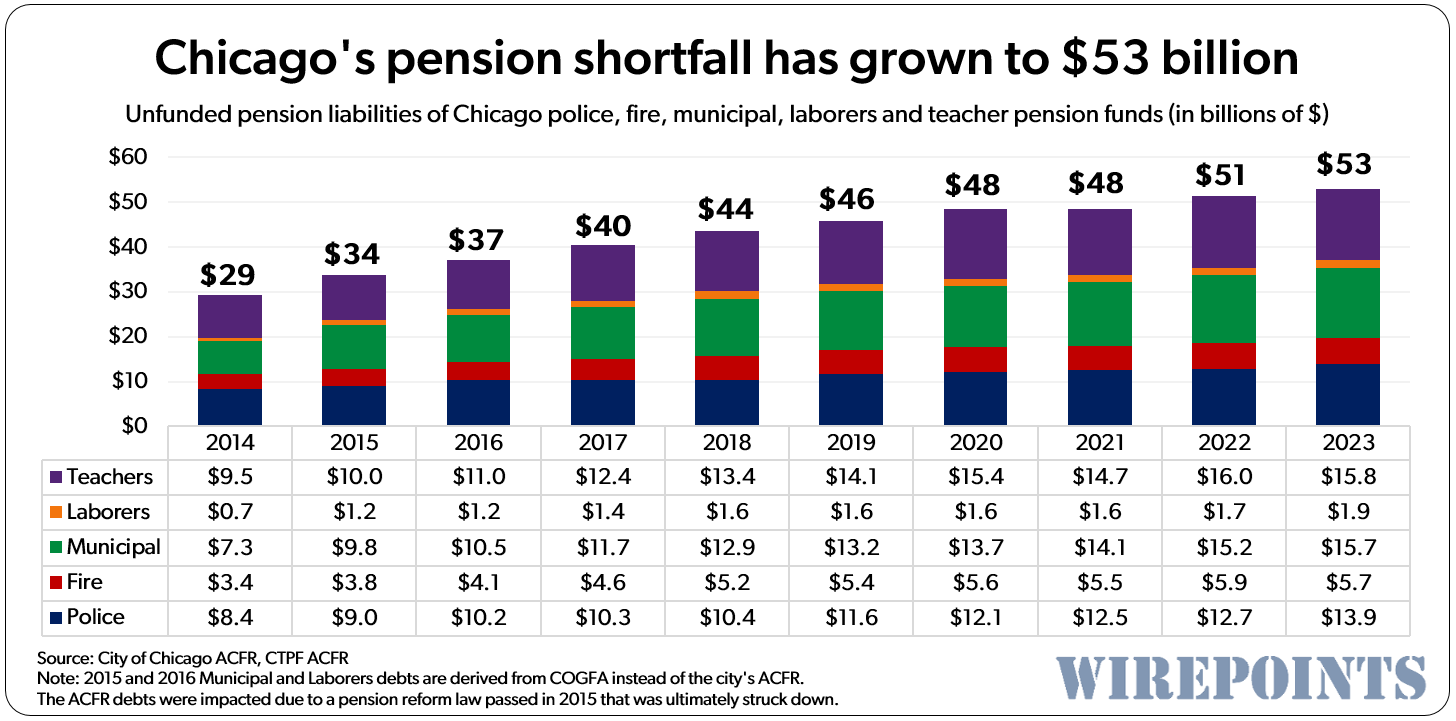
What makes you think that taxes can be raised in sufficient amounts to draw down the City’s 51 billion dollar pension debt? The debt has grown considerably since 2015 and by way of example property taxes have almost doubled since 2012? The federal Covid money did not reduce the pension liability a bit. What kind of tax increases would you realistically propose? Johnson couldn’t get one cent in property tax increases in this budget cycle. Bring Chicago home failed. Voters – even left leaning ones – increasingly don’t trust government official to show fiscal responsibility. Look at the defeat of… Read more »
How far back could SSA reach to collect employer and employee contributions that should have been paid (+ interest and penalties)? Someone should file a suit and then enter into a settlement to put this to bed. Make it a class action and let those who think they’ve been cheated opt out and hire their own lawyers and actuaries. This is Bleak House on Steroids.
After years of watching the Illinois pension issue problems starting with Edgar’s Ramp I have personally come to the conclusion that putting Illinois employees under the Social Security system is the only viable solution. However, in doing so, the politicians would not have the pension fund balances to raid for use in their vote buying spending programs so it will probably never happen.
No thanks. We prefer to keep our pension AND get social security. If the Senate passes the social security fairness act we can collect our pensions and get social security if we worked 40 quarters. We could also collect spousal benefits even if we never paid one dime into social security. No more WEP or GPO reductions for teachers and firefighters. It passed the cloture vote yesterday with 72 votes so it’s looking good. This bipartisan bill will make my retirement income great again!!! Even Trump supports it. Just think come January a bunch of retired CTU teachers can get… Read more »
Marie Antoinette loved her cake too. Or is that reference way over your head?
Qu’ils mangent de la brioche Not over my head but you obviously don’t understand it. The queen wasn’t the one eating the cake. The quote is suggestion for the citizens to eat it. No evidence exists that she even liked cake. Historians also disagree that she ever said it so it’s a perfect quote for the ignorant to repeat. Not to mention the wrongfully attributed quote is about the rulers indifference to the financial difficulties of its people. Union members are not the rulers. That status belongs to the elected leaders who continually short the pension funds. They are the… Read more »
Wow, the AI info is really impressive. I majored in French at Marquette, so I don’t need your copy and paste assistance. You can go back to your fantasy world where “scabs” will keep the trough full so union members can keep gorging themselves.
You know, Jshark, you’re what the French call les incompetents.
I want to focus on one line of your post namely “the elected leaders who continually short the pension funds.” This has irked me all the way back to Edgar’s so called plan way back when. I have my issues with the generosity of the plans but the annual underfunding has put us where we are at now. The politicians spend spend spend with assorted must have programs leaving the existing bills dead in the water. Millions and millions for example have been spent on headline generating endeavors for Pritzker’s political ambitions while we the taxpayers are left holding the… Read more »
Nothing happens in this state without the backing of the largest donors- public unions, especially teacher unions. Just look at the demands Stacy Davis Gates and her union made in the current contract negotiation. Green schools, housing allowances for teachers, paid abortions, on and on. They don’t want to divert more funds to pensions. They want those funds for themselves and their pet projects. They know they can scream Constitution! and believe they will be paid every dime of their pensions. Why not take all they can grab now? The taxpayers can be forced to cough up more later. Just… Read more »
Teach pigs to suck and put them in the barn with cows. That’s synergy worthy of CTU members and politicians. Indeed, that’s Animal Farm.
End all Pensions and go to a 401K with limits. Retirement age should be no different than the private sector. There are plenty of jobs that older firemen or cops can do for the State and City. End this rapping of the taxpayers. So many people are fleeing Illinois because of the excessive tax burden, that the remaining ones have to make up the difference.
Yes, we should go to a 401k-type system, but just remember that the unfunded pension liability is owed entirely for work already performed, which would not be reused by that change. That debt would remain.
I believe virtually all Illinois gov employees already have 457 type 401k accounts.
That’s an optional retirement savings program, optional, with no employer contributions. It’s a 457b program often referred to as Deferred Compensation. No federal taxes paid on the payments made to the 457 account while employed but taxes are then paid when withdrawn. Very similar rules to a traditional IRA about withdrawing funds upon leaving a public service position. That type of plan would be a good idea and should include a matching investment from the employing agency up to a certain amount. However as stated by Mark those previously retired employees would still receive pension payments under the old pension… Read more »
BS, they are absolutely looking at the pension payments. It is no secret you can get rich working for government, at a very young age. Double dipping is nothing new and has been talk about for generations. Follow the money and that is where the problem is. I know a public sector retiree that get $160,000 per year (3%increases every year) and thinks she is getting a lot of money but never gave a thought about giving a penny back to the state. Pension money is not taxed in Illinois, again no secret.
It would nice if you could post something that actually was understandable. A rambling collection of nonsense, put the whiskey bottle down
In Illinois, pension money isn’t taxed twice. The income was subjected to state income tax as it was earned. What is not taxed in Illinois is the gain. Since the State’s pension funds. Are so far in debt, as case could be made that there is no gain, current payroll deposits leave immediately to pay pensioners. Since every office holder worth his/her graft is on more than one public pension, think Dolton Mayor/ Thornton Township Committee woman; thins will only change when the banks quit lending.
Money that was earned and paid into pensions has never been taxed. Just like 401k contributions or employee health insurance premiums.
No, retirement deposits leave the paycheck before any federal tax is deducted but state taxation is deducted as the income is earned.
Illinois follows federal tax treatment for 401k and pension contributions and that money is not taxed when contributions are made. Respectfully, you are misinformed.
Pre-tax contributions, together with any earnings, accumulate tax-deferred until the employee terminates service, dies, or incurs unforeseeable financial hardship. Once distributions begin, the distributed monies are fully taxable as ordinary income for federal tax purposes. The funds are never taxed by the State of Illinois.
found at cms.illinois.gov
I suggest you call your pension board as I just did. As the employer reports and deducts pension contributions from a public sector paycheck, state tax is charged on the pension contribution and that money is forwarded to the State of Illinois Department of Revenue identifying you as the person paying the amount. Also, the United States Department of Commerce website offers a flow chart on the order in which deductions are taken from employee earned income. It gets quite confusing and convoluted but the rule of thumb is no honest W-2 paycheck employee can evade Federal or State income… Read more »
Just passed in House in waning days of Biden admin, Schumers going to push thru Senate– the Social Security Fairness Act, 327-75 is another important factor that’s a potential gift to are Illinois pubic sec hero class retirement deals which expanses access to SS if you worked as a SS taxed employee prior to becoming Illinois pubic sec employee and other ways to access SS benefits. A lot of reps where on board with this one. A giant gift to teachers union especially. (https://www.wsj.com/opinion/social-security-fairness-act-senate-republicans-unions-randi-weingarten-aeac9c0d?st=Brx3eX&reflink=article_email_share)
Hmmmm, maybe a subplot is machines in a hurry to pass generous Martwick Tier 2 fix’ going way beyond “safe harbor ” requirements before dopey taxpayer/homeowners wakeup and realize most public sec hero’s will be eligible for full SS thru Social Security Fairness Act on top of everything else?….unbalivable!!
I was looking at the bill more closely and it’s retroactive to December 2023. I’m looking at getting over 15k for a retroactive lump sum plus additional monthly payments. Now that’s a holiday bonus.
Wirepoints ban Jesse Sharky please
No. All of Illinois needs to hear the venomous lazy parasitic arrogance of CTU scum. That way when Illinois financially collapses and there is no federal bailout, there is no sympathy for these criminal scum who illegally colluded with politicians for decades in a votes and bribes for absurd wages and obscene pensions scam. Quid pro quo criminality and Illinois taxpayers owe them nothing. When these CTU primordial ooze receive their justice and are begging in the gutter, the citizens will remember J Shark and his Red For Ed excrement and will step over these useless carcasses and maybe kick… Read more »
Bahahahaha. You’re one funny ghost. Pension is going up 3% in January for about $400 per month. My social security benefit will be around $1300 a month. Now I’m also getting a lump sum retroactive check. So much winning ghost and no begging necessary.
Midas McDuck. Quack on!
Most of us are thankful that you’re no longer teaching these values to the young.
ABSOLUTELY FANTASTIC RETORTING / RESEARCH WP!!! This is a ton to digest and I will have to read many times. But thank you for stating what Ill pols avoid— that the current TIER 2 pension is still a way better deal in total $ payout than anything your going to get under SS, (with SS max payout at $45,864). Tier 2 pensions are ONLY out of POTENTIAL compliance with “safe harbor” because the of “the pensionable salary cap” part of pension calculation is not equal to SS. All the other factors in equation, date of max payout, etc that Martwick… Read more »
Typical Illinois Democrats can’t wait to pour gasoline on a raging fire. Shoot, ready, aim!
I think they know exactly what they are doing. Pandering to a large voting base.