
By: Mark Glennon*
“An electricity crisis is looming for Illinois. Is anybody paying attention in Springfield?” A Chicago Tribune headline asked that last week. Not yet, is the answer, but reality is now giving a swift kick in the butt to Illinois’ ruling climate fabulists. In this column, we will review the latest and look at how the regular media has ignored a crisis that what was entirely predictable. In a second piece, we will look at Gov. JB Pritzker’s response and what should be done now to head it off.
Illinois passed a massive clean energy bill in 2021 (“CEJA, “the Clean Energy and Jobs Act) mandating closing of all coal and natural gas fired power plants by 2045. It was an impossible goal to meet, but just pursing it would be astronomically expensive and certain to jeopardize reliable electricity supply, warned critics — “carnival barkers” — as Pritzker likes to call them, including Wirepoints.
But the carnival barkers were ignored by lawmakers and most of Illinois’ regular media.
It therefore surely came as a surprise to Illinoisans who saw that Tribune editorial last week: Just three years after passage of CEJA, it says, ” it appears the alarmists were right, and Pritzker and the green lobby were wrong.”
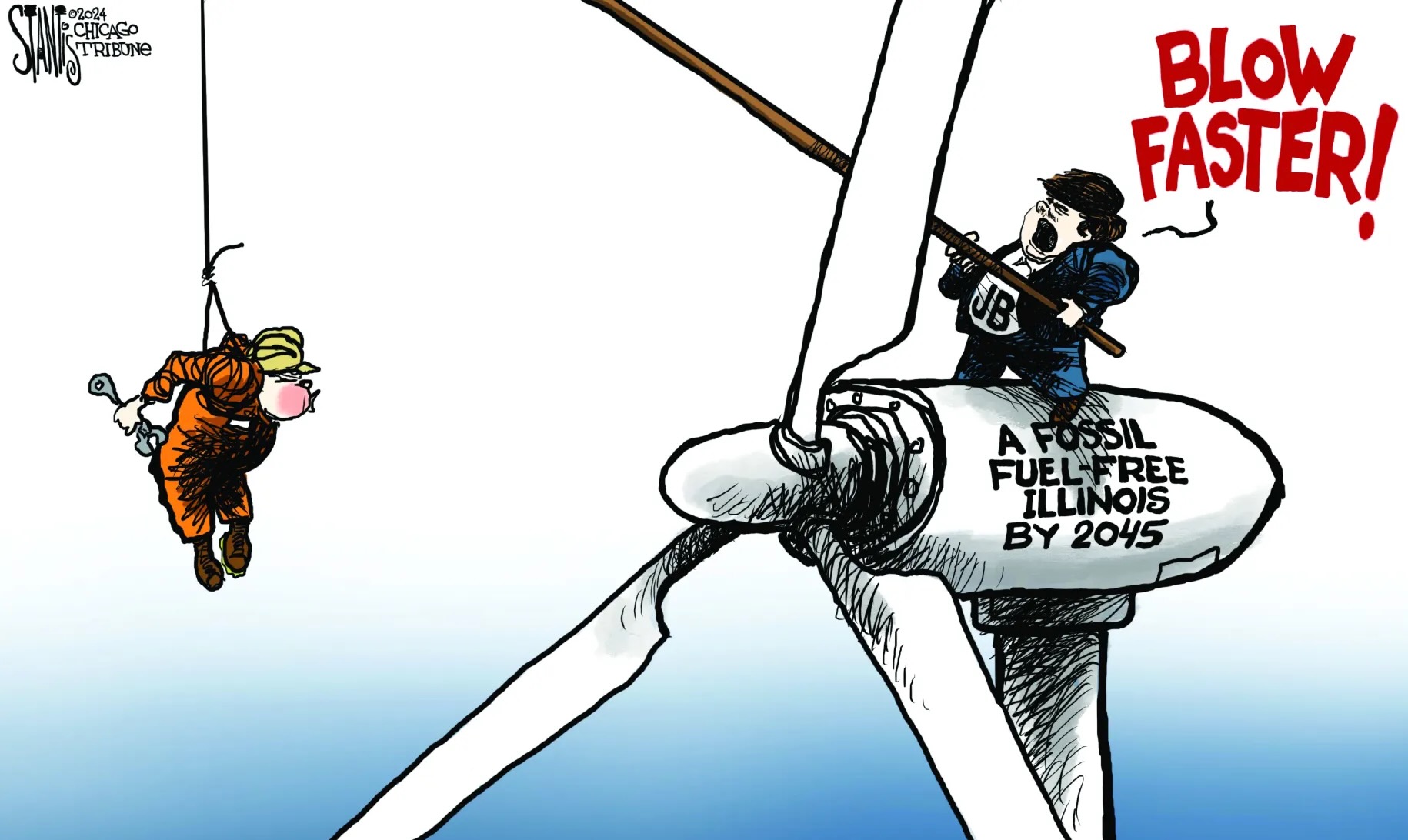
It’s a breakthrough for the Tribune to say that. The Tribune was long among the major media playing along with the green fairy tales while ignoring the warnings from energy realists. However, the facts described by the Tribune should have come as no surprise to those who have been paying attention to the alarmists.
The spark that set off the Tribune’s editorial is the jump in retail electricity costs that’s coming for most of Northern Illinois, where the electrical grid is managed by PJM Interconnection. PJM, like other grid operators, occasionally runs an auction for “capacity,” which is the electricity PJM needs in times of peak demand to keep its grid supplied. For northern Illinois, that electricity goes mostly to ComEd.
Those capacity costs get passed along to consumers, and capacity costs at the last auction soared more than 800%. The bottom line for consumers is that ComEd residential bills will soon rise by about 10.5% due to the capacity charge alone. But that’s just the start. In two years, capacity charges are predicted to be 2,200% higher than today, hiking average monthly ComEd residential bills by more than $35 compared with current charges, the Tribune wrote.
Central and southern Illinois may have a bigger problem. We’ve written earlier about dire warnings from that area’s grid operator, MISO, which says the area is at “high risk” for brownouts. Much of the area has already seen retail price hikes of 50%.
Three causes are widely agreed to be primarily responsible for these problems.
First, Illinois and some other states simply set too fast a deadline for shutting down power plants fueled by coal and natural gas. “Simple supply-and-demand realities are the reason,” as the Tribune said, and “growth in renewable power facilities such as wind and solar isn’t making up enough of the difference.”
Second, many new power sources have no way to connect to the grid. It’s a policy blunder of historic proportions that still hasn’t reached most of mainstream media. Hundreds of billions of dollars of federal subsidies were authorized for wind and solar projects and Illinois passed its mandates while ignoring the interconnection issue. As we wrote before, experts say a fix may cost trillions of dollars — and perhaps is not feasible at any price.
Third, artificial intelligence in computers consumes an astonishing amount of electricity, with some experts saying AI data centers could consume as much as 20% to 25% of U.S. power requirements by the end of this decade.
On that third point, you might cut lawmakers some slack because AI’s enormous energy demands only became fully recognized over the last couple years. The other two causes, however, were policy blunders that were apparent as they were made. Wirepoints is certainly not the only carnival barker that has been writing about those matters from the start. Some Republican lawmakers in Springfield have long objected to Illinois’ unrealistic green goals. Jeanne Ives wrote an excellent column yesterday at Break Through Ideas summarizing what critics of Illinois’ energy policy have long said.
Let’s return to that Tribune editorial because there’s something you should know about it.
Many reacted to it by asking why it took so long for the Tribune to write about the folly of Illinois energy policy. The Tribune has indeed been among the media blind to impending crisis.
But consider who wrote the editorial. Undoubtedly, it was Steve Daniels, who joined the board only last fall and was previously an energy reporter at Crain’s. The Tribune’s editorials improved markedly after Daniels arrived, and he should not be included among those guilty of ignoring Illinois energy problems.
At Crain’s, he was among the few in regular media to report on what critics were saying. In fact, he wrote specifically in March 2023 about the warnings PJM gave about what has now come to pass. His article began by saying, “The power grid operator serving northern Illinois and points east to the Mid-Atlantic is sounding the alarm about potential electricity shortages over the coming seven years, driven in part by state policies like Illinois’ clean-energy law that are forcing power plants to close.”

Perhaps most enlightening, Daniels wrote back in July 2022 about the blockheaded comments by the Pritzker Administration’s point man for negotiating CEJA. That was then-Deputy Governor Christian Mitchell, a political operative who had zero experience in the complicated energy field. When asked about reopening CEJA to loosen the timetable for closing fossil plants, Mitchell told Daniels in an interview, “The answer to that question is a very firm no.”
What about all the warnings that power companies themselves were giving about the new law? The Pritzker Administration wouldn’t have any of that, Daniels wrote, and Mitchell said the power companies lack credibility because they have profit motives.
There you have it, I suspect — the mentality of the folks who gave us CEJA: People trying to make a profit? Who cares what they say?
Mitchell, mercifully, is gone, and maybe the coming price hikes will finally pressure the state to fix what’s wrong with CEJA. In our next installment we’ll look at what those steps might be.
*Mark Glennon is founder of Wirepoints.
Earlier pertinent Wirepoints columns:
-
Progressive lawmakers line up behind costly fix for error they made in renewable energy plan
-
Electricity cost rising 50% in much of Illinois and risk of brownouts looms
-
Pritzker’s veto of bill to look at nuclear power reeks of petty, extremist politics
-
Floundering Illinois wind energy program blamed partly on (you guessed it) climate change
-
Should Illinois Follow Norway’s Lead To Break Impasse On Energy Bill By Just Writing A Check?
- New CUB Scandal Is Another Reason To Kill The Clean Energy Jobs Act
 Audio and summary
  If this bill passes, say goodbye to local control over all Illinois parks and expect to see open drug and alcohol use, needles, no sanitation and fire hazards, but no ordinary park users.
Live in SC. Power out 3 days due to Helene. We were lucky ones, some areas won’t get power for another week. Five states were hit with power outages. What would happen if most vehicles were EVs? Couldn’t go 300 miles to even evacuate. How do you recharge thousands of vehicles with no power? What if first responders and repair trucks were EVs? Resupply grocery stores with water and food? We used gas to power generators and keep refrigerators going. Can’t get electricity in gas can. Have read nothing in media of consequences of EVs in such storms with extensive… Read more »
The leftist future of AI and two EV’s in every garage is going to go down the tubes, considering it takes over 20 years to build a nuke plant due to the regulations. My mid-summer electric bill is still $90 and $120, we run the AC any time we want at 72 degrees, my hobbies involve a table saw, a drill press, two CNC machines, a metal mill, a lathe, etc and countless bench machines all of which I enjoy daily, and many draw 220v 20 amps. So I don’t know what these “high costs” are all about. My wife… Read more »
Is it just me or do the wheels seem to be coming off the bus in all directions. Schools, Taxes, deficits, budgets, Loop offices, crime, shotspotter, Venezuelan gangs, pensions, dwindling tax base, slave population. Things sure look rosy for Illinois and Chicago. But hey, it’s nothing a few more democrats, a bears game and a bar can’t fix. Pour another one for the simps.
Keep going, bro: Open borders, healthcare for illegals, green new deal, reparations, Soros prosecutors who won’t prosecute, weaponized legal system, end of private health insurance, corrupt media, government censorship, woke everything, antisemitism normalized…. Just off the top of my head.
Lot’s of money will be made by ComEd due to energy shortages.
I don’t think so. The ones who will be screwed are the regulated utilities like ComEd, owned by Exelon, that’s just a delivery operation. They have their rates set by government, and with consumers screaming, ComEd will get blamed and their pricing pushed down. But it’s not their fault. They just buy and resell electricity. They own no plants now. Constellation owns them now, which is part of why Constellation stock has done well. They are unregulated.
Pritzker will be inflicting pain on the people of Illinois long after he’s gone.
The Tribune, having paraded Pritzker’s “Clean energy and Jobs Act” suddenly finds itself in the morass that it helped create. Hundreds of jobs in the mining and coal related power plants were lost, the promised offset of “green jobs” didn’t happen and now higher power bills are on the way. The Tribune, seemingly complicit in it all, was just too happy flashing Pritzker’s lates headline for green energy geared for Pritzker’s planned Presidential run. Never once did the Tribune look below the Press releases to investigate the possibility that all was not as it was portrayed. Now Pritzker’s presidential run… Read more »
Here in CI, my energy bill from Ameren for my efficient home would average around $200/ mo. Now it is like $260/ mo – a $720/yr increase for the exact same amount of energy. All thanks to Pritzker and the Leftist Democrats. And they are not ‘dumb’ or ‘stupid’ – they know exactly what they are doing with their malfeasance to serve their ideology. Democrats are a full blown Marxist cult.
Remember this in November.
Amen.
Is there any IQ test given to would be or current politicians? Is there any pol that can think of costs and consequences for any legislation passed by them ahead of time by even a few days.? They just pass the feel good bill of the day and pat themselves on their back and dislocate their shoulders then go to the best health care paid for by the taxpayers. How many pols are educated in finance considering they are in charger of a $50B budget? Look at Sorenson who was a weatherman now in Congress. The D’s are throwing millions… Read more »
In decades past, the term used in Springfield for those feel-good airheads was “goo-goos.” Even lots of Dems used that term. You never hear that anymore because the goo-goos run things now.
Can we say “useful idiots?”
Beware of the IQ test because republicans are no smarter than democrats. As to qualifications for office: Donald Trump reality TV host becomes president, Arnold Schwarzenegger and Ronald Reagan were actors who became governors and one became president, Kari Lake started as a weekend weather gal running for senate, Dr. Oz a real doctor and played one on TV failed senate candidate. The democrats are the same with Al Franken, Jerry Springer, Cynthia Nixon, Melissa Gilbert, and others who either ran or held office. Not sure what proper qualifications should be so let’s let the voters decide.
I do not blame the politicians. I blame the voters. The K – 12 and now higher ed has to be changed. We need to take it back from those who control it at present. Critical thinking skills, reason and common sense education specifically mathematics, science, writing, reading, economics with and not at the expense of the Liberal Arts (history, literature, philosophy, religion) must be re-introduced to our students and future leaders. In the short term, those of us that want to wait it out have to expect some dark days ahead. It wasn’t overnight that we arrived at this… Read more »