
By Ted Dabrowski and John Klingner
Illinois’ Nov. 5 ballot will ask state residents this question: “Should the Illinois Constitution be amended to create an additional 3% tax on income greater than $1,000,000 for the purpose of dedicating funds raised to property tax relief?”
That question is the next multi-billion-dollar tax hike proposal from Gov. J.B. Pritzker and the General Assembly’s Democratic supermajority. The $4.5 billion tax hike has been dubbed the millionaires tax because it proposes to hit Illinoisans that make a million dollars or more with an additional 3% surcharge on any amount they make above one million. To entice more Illinoisans to support the referendum, the proposal is sugar coated with legislators saying they’ll dedicate “funds to property tax relief.”
To be clear, it’s only an advisory referendum, meaning the result will be nonbinding. But Illinois politicians and the public sector unions, in particular the Chicago Teachers Union, are desperate for more money to fund their big, expensive budgets and contracts. They need this referendum to tell them whether the framing of a progressive tax hike sweetened with property tax “relief” will work as a proposed constitutional amendment in 2026. If it does, look for them to try again to end Illinois’ flat tax structure.
Illinoisans should be even more skeptical of this referendum than they were when they rejected Gov. Pritzker’s progressive income tax amendment in 2020. Since then, politicians like Ald. Ed Burke and House Speaker Mike Madigan have been busted, in part for playing games with property taxes – games that often shift taxes away from big companies and onto smaller businesses and homeowners.
Even more painful, Gov. J.B. Pritzker promised Illinoisans property tax reform in 2020 but he never delivered. Property taxes have only gone up since – by roughly a billion dollars yearly – with many local governments raising their taxes by the max.
Illinois voters need to understand that the current batch of politicians in charge have no intention of reducing taxes in any way. Even when Gov. Pritzker lowered the sales tax on groceries, he turned around and gave local governments the power to raise their taxes by the same amount. Once it all plays out, it will end up being just a tax shift, not a tax cut.
Here are a few key issues Illinois voters should consider when approaching the ballot box.
The promises offered in a referendum mean nothing. This is one of the big reasons Illinoisans rejected Pritzker’s progressive tax in 2020 – they didn’t trust Illinois politicians.
In that referendum, Pritzker and the legislature said they would only target Illinois’ 3% wealthiest residents and give the remaining 97% a small tax cut. That structure should have been a slam dunk to getting a progressive tax passed, you would think. But no. It was rejected because everyone understood that once a progressive tax was passed, it would be easier for politicians to target specific income groups – including middle-income households. It would only be a matter of time.
It’s the same in this new referendum. Illinois pols can make you think there’s some property tax relief on the way, but given the upcoming budget deficits and what all the new public sector contracts are costing, there won’t be any money left over for tax relief. And then, in the next rounds, they’ll come after middle-income households.
The referendum does nothing to stop what’s actually pushing up property taxes. The referendum does nothing about the state’s massive pension costs and their impact on our taxes. It does nothing to reduce Illinois’ 7,000 units of local government, full of bureaucrats, bloat and duplication. And it does nothing to reduce the influence of Illinois’ public sector unions – the nation’s most powerful. Exhibit A is the Chicago Teachers Union and how it throws its weight around year after year. All aided and abetted by Illinois politicians.

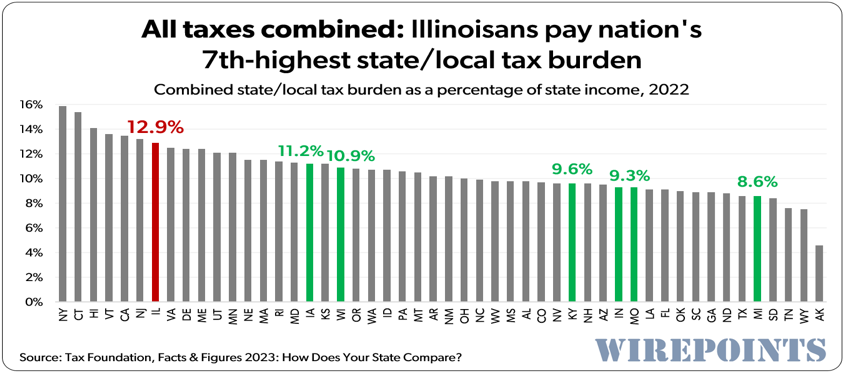
A tax swap would do nothing to lower the overall Illinois’ taxes, the nation’s 7th-highest tax burden. Even if Illinois politicians were to shift the burden away from property taxes by increasing income taxes, that would do nothing to cut Illinois’ overall tax burden. It’s just a shell game. We’d still have the nation’s 7th-highest burden overall. The same poor economic performance that Illinois has had over the last five years would likely continue.
True, you say, but at least property owners would be better off. Maybe for a moment. But since the legislature won’t pass reforms to slow down spending, any relief would be temporary. Property taxes would continue to rise like they have been.
And then there’s the fact that as the tax burden is shifted to the wealthy, their flight to other states would likely to accelerate. Fewer wealthy residents in Illinois would mean the burden rises on the rest. And that means more tax hikes.
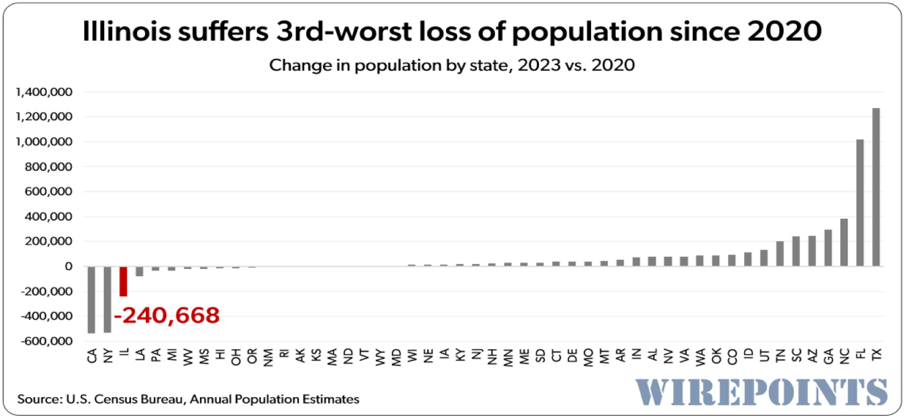
More taxes would likely mean more population shrinkage, higher tax rates. Illinois is already the third-biggest net loser of people to other states. High taxes, many claim, is one of the big reasons they leave.
That’s left Illinois shrinking in population. During the most recent decennial Census count, 2010-2020, Illinois was one of just three states to lose population, the other two being West Virginia and Mississippi. Since then, Illinois has lost another 240,000 in population, making the state the 3rd-biggest shrinker over the last three years.
A smaller population means the state’s growing spending burden falls on fewer and fewer people. And that means more tax hikes.
Read more from Wirepoints:
- Why the Chicago Teachers Union Always Gets What It Wants
- Chicago Public Schools spends $100 million yearly on its 20 emptiest schools. And it wants to spend another $1 billion on them.
- Another annual Census migration report, another 93,000 net loss of Illinoisans to other states
- Don’t look now, but here come the tax hikes on Illinoisans
- Illinois’ rich, young residents join the exodus to other states
 Audio and summary
  If this bill passes, say goodbye to local control over all Illinois parks and expect to see open drug and alcohol use, needles, no sanitation and fire hazards, but no ordinary park users.
Only ignorant people would think they will get property tax relief from this. Typical government lies.
Good article, thank you!
I moved out of Chicago/Cook County a few years ago. Now I’m just biding my time in the last few years of my career until i can put Illinois in the rear view mirror. It’s a city/state with such interesting potential, but the population keeps voting to kill the potential of the city/state. I am very curious to see how far it can go before it breaks.
Matt, good for you in recognizing that it’s no longer a question of “if” but “when” it breaks. Hope you get out before the break.
What Pritzker did with the gasoline tax is a great example of why taxpayer’s should vote ‘NO’.
“Trust’ and ‘IL politician’ are mutually exclusive…
Like oil & water, they don’t mix…
Most of Illinois’ millionaires are either Democrats or strongly support the Democrat party and its policies. I have no issue with having them pay more for what gets foisted on the rest of us who are struggling to get by.
I say we cut municipal spending which translates into lower property taxes. Start with funds going to illegals. Then proceed to mayor’s office security detail and his wife’s office decorating budget.