
By: Matt Rosenberg and Ted Dabrowski
In 2020 and 2021, the Chicago Transit Authority (CTA) partied like it was pre-Covid 2019. The agency kept running trains and buses at the same levels as in 2019 even though ridership numbers had taken a huge 60 percent plunge due to the pandemic. Passenger fare revenue collapsed, and yet CTA officials didn’t cut operating expenses a penny thanks to billions in federal Covid handouts. Now with the party set to end – federal relief runs dry in 2025 – Regional Transit Authority (RTA) officials say they want tax hikes to keep running Chicagoland’s too-empty trains and buses, including those of the CTA. RTA menu options include higher sales taxes, an increase in the motor fuel tax and even a vehicle mileage tax.
Instead of resorting to more tax hikes on Illinoisans to prop up a failing transit system, the CTA should do something it has never done: make the agency more efficient. CTA must dramatically reduce costs and, given new post-Covid dynamics, cut service to better match revenues.
That said, the best remedy for CTA is a growing, vibrant, and safe Chicago which solves escalating crime, lowers taxes, and fights corruption to attract more of the employers, workers, and convention traffic for which the city was once famous. Since that’s not likely to come anytime soon, the only focus for the CTA should be right-sizing.
RTA sees ridership, revenue drought through decade’s end: it may extend further
Even with the pandemic largely behind us, CTA ridership in 2022 still remains nearly 40 percent below levels in 2019. RTA officials – who coordinate the CTA, suburban Metra commuter trains to and from Chicago, and the suburban PACE bus system – say there will be no full ridership recovery post-Covid. They say that more taxes will have to increasingly replace falling farebox revenues. They identify as causes increased violent crime, the rise of remote and hybrid work, and ride-share services like Uber and Lyft. It’s spelled out in a new RTA report.
“Transit has survived the pandemic, but ridership – and with it, revenue from fares – sustained precipitous declines and has not returned to pre-COVID levels. Related economic shifts and other factors have resulted in a system more vulnerable to violent crime and labor shortages have impacted every aspect of service….(Regional) ridership crossed a million daily rides threshold in the fall of 2022. However, this return is not enough for fiscal stability and puts into question the reliance on fares moving forward. Moreover, ridership isn’t expected to recover to 2019 levels for the foreseeable future. The public health and safety restrictions in place during the pandemic, the increase in people working from home, and changes in how people travel have all combined to drastically reduce transit ridership since March 2020. While riders are returning to the system, the impacts of the pandemic and permanent changes in remote and hybrid work are projected to result in lower levels of ridership for the remainder of the decade compared to 2019.”
Call it a fiscal train wreck enabled by Washington, D.C. Cushioned with a hefty share of $3.5 billion in federal Covid-era transit handouts to Chicagoland transit agencies via the RTA, the CTA ran a pre-Covid schedule with Covid ridership, wasting taxpayer dollars as service frequency far outpaced passenger miles. It was and is unsustainable. Even in October 2022, unlinked passenger trips – meaning all boardings of transit vehicles – were down 38 percent versus the 2019 full-year average.
 CTA data reveals a transit agency in fiscal free-fall
As the new push for transit taxes begins to gain steam, here’s a sobering close-up of a transit agency in fiscal free-fall. It comes from CTA reports to the National Transit Database. They reveal much that mere ridership data – the usual staple of media reports – does not. Here are some key data points.
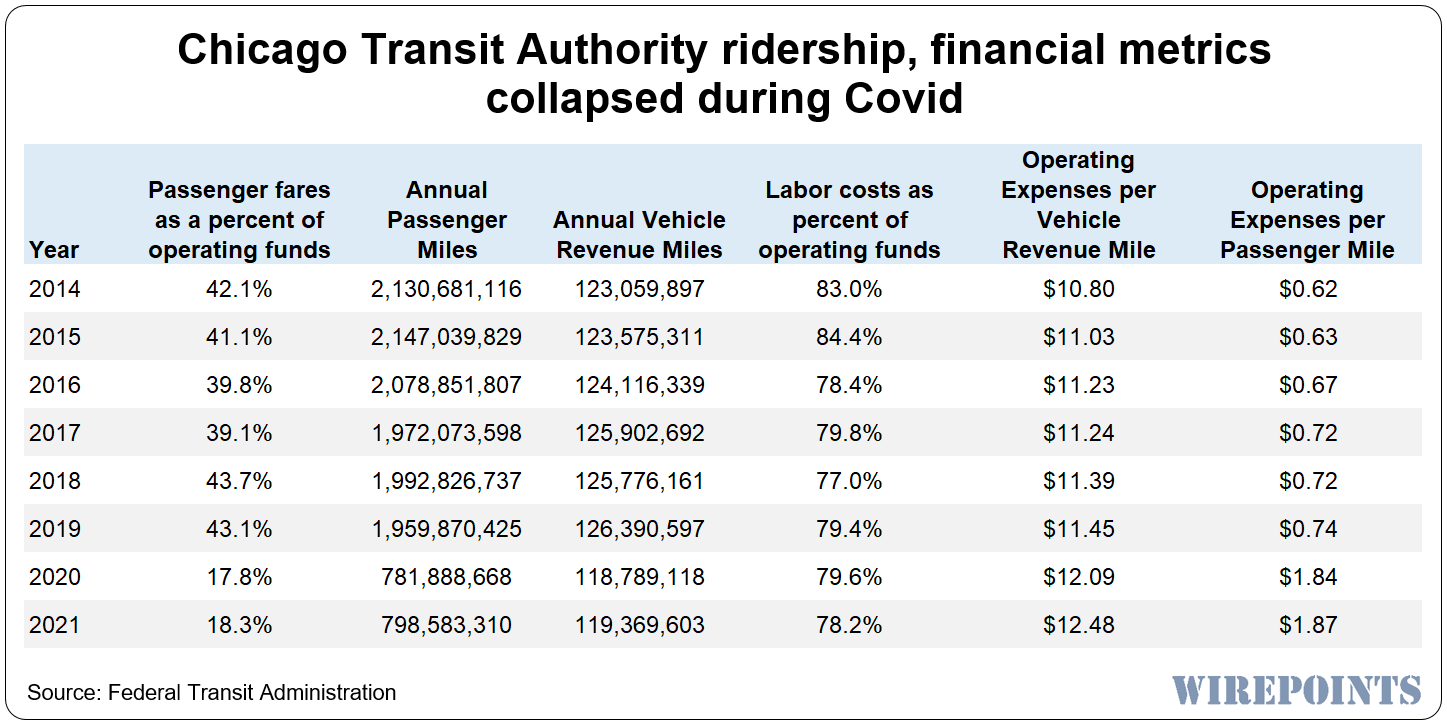
- From 2014 through 2021 CTA farebox revenues as a percent of operating costs plunged from 42 percent to 18 percent.

- Annual Passenger Miles for the CTA in 2021 plummeted 63 percent versus 2014 but the number of miles that fare-seeking buses and trains ran – so called “Vehicle Revenue Miles” – was down only 3 percent. In other words, ridership remains sharply down after Covid but service mileage hasn’t budged. On-time performance is far worse, though. More on that in a later section.

- With buses and trains running as many miles as before Covid but drawing so many fewer passengers, CTA’s operating expenses per passenger mile are up 150 percent from 2019 through 2021.
 Violent crime, service woes, and a changing downtown add to CTA pressures
CTA’s steady high costs, diminished revenues, and regional pressure for transit tax hikes are intertwined with three more problems. They are CTA violent crime, CTA service deterioration, and the shift to remote office work.
The City of Chicago’s crime data portal shows that based on results through November 29, year-end violent crime on the CTA will reach a post-Covid high.
 Due in some large part to their concerns about on-board crime – CTA is hemorrhaging bus and train operators. This has resulted in highly irregular service or so-called “ghost buses” and “ghost trains” which are very late or don’t show at all.
On top of that, overall downtown crime in the area’s two key police districts show heightened danger for passengers who make it there safely on the CTA and exit to the streets. Despite its many attractions, downtown is increasingly seen as risky territory. That hurts ridership, too.
Murder, shootings, sexual assaults, vehicle thefts rising in and around downtown
In District 1, covering the South Loop and Near South Side through Week 49 of this year versus the same span in 2019, murders are up 533 percent (from 3 to 19). Shooting incidents are up 240 percent. Motor vehicle thefts have risen 324 percent, criminal sexual assaults 20 percent, robberies 21 percent, and aggravated batteries 10 percent. In District 18 covering the North Loop and Near North Side, for year-to-date 2022 versus 2019, murders are up 225 percent (from 4 to 13). Motor vehicle thefts are 141 percent higher, shootings up 83 percent, and criminal sexual assaults have grown by 50 percent.
Meanwhile downtown post-Covid Chicago continues to pose ongoing risks not only for transit users but also commercial lessors and office workers. A number of LaSalle Street office buildings that were long home to financial firms have now emptied out and are being eyed for conversion to apartments. Hefty taxpayer subsidies will be required.
But the trend away from downtown is broader than just financial sector tenants on LaSalle Street. Growing remote work has partially hollowed out downtown Chicago. One metric used by business analysts is mobile phone “locations” or tracked presences within specific areas. In May 2022, these visits to downtown Chicago captured through tracked cell phone location data were only 43 percent of what they were in May 2019, according to a UC Berkeley report.
Key card swipe rates in downtown office buildings have also dropped markedly, though now they have rebounded somewhat. Still, at November’s end, swipes in downtown Chicago office buildings were registered for just 48.5 percent of cards issued, according to Kastle Systems “Back To Work Barometer.” Hybrid work takes a toll. Downtown Chicago merchants in places like the Metra station say they know all too well: Mondays and Fridays, it’s a ghost town.
The takeaway: crime on the CTA and crime downtown threaten to permanently gut CTA ridership if post-Covid work patterns alone do not.
RTA claims that “fiscal cliff” and “existential crisis” require higher transit taxes
The new RTA report acknowledges getting $3.5 billion in federal Covid relief and warns that “this federal relief funding is likely to run out in 2025.” What happens after that? The RTA report rolls out a number of new tax strategies lawmakers will surely consider. They include congestion pricing, a vehicle mileage tax, higher tolls, and increases in the state motor fuel tax and the RTA sales tax.
The RTA tax hike menu also includes expanding the agency’s own sales tax from goods to now-exempt services, and expanding Chicago’s real estate transfer tax from the city to the much larger RTA district.
RTA writes, “…sales taxes and federal emergency funds will keep the region’s buses and trains running into 2025, when our system encounters a fiscal cliff. If the current funding model that is reliant upon fares is not changed and additional funding is not secured, the transit agencies will face an existential crisis that neither fare hikes or service cuts can solve while preserving a useful and equitable transit system for the region.”
Somebody should remind the RTA of the tax burden Chicagoland residents already face. Chicago’s combined 10.25 percent sales tax is already the 2nd-highest of any big city in the nation. Illinoisans as a whole already pay the nation’s 2nd-highest gas taxes thanks to Governor Pritzker’s doubling of the motor fuel tax in 2019. And, of course, Illinoisans already pay the highest effective property tax rate in the country.
The RTA won’t be alone in the line to squeeze more out of taxpayers. Other local and regional taxing bodies will have their hands out too. Layering on more taxes will only encourage wealth and employer flight. It’s a strategy for decay, nothing more.
The right way forward
Of course, the other option is rightsizing service. In the CTA’s case, bad misalignment of current operating expenses with operating revenues should be grounds for a fresh take on service cutback plans after 2023 or 2024 based on several different ridership scenarios.
Chicago’s broader solution, however, should be a focus on growth. If crime, lousy public schools, high taxes, and corruption all deter employers from staying, growing, or moving to Chicago – and that is too often true today – then the way Chicago does business needs to be turned on its head.
Appendix
Read more from Wirepoints:
- Electronic monitoring horror show grows as lawmakers skate past SAFE-T reforms
- Poor communities bear the brunt of crime unleashed by Cook County bail reform and the SAFE-T Act: New Manhattan Institute report
- Chicago’s progressive agenda has been destructive for black communities
- No police available for shootings, robberies, assaults, and more: Ongoing 911 response failures heighten risk for Chicagoans
 Audio and summary
  If this bill passes, say goodbye to local control over all Illinois parks and expect to see open drug and alcohol use, needles, no sanitation and fire hazards, but no ordinary park users.
I am not sure, but I think the original Mayor Richard J. Daley appeased the transit union by tying their raise to the cost of living. I believe that there are bus drivers earning more than $100,000 a year. Look folks, as far as I am concerned, taxes at the state and federal level are nothing more than a money laundering operation to enrich the political elites of both parties. I left Illinois 16 years ago, and I am very glad I did.
All possible tangents bear relevance (two-parent household, schooling, value-basis in social formation, repurposing real property in “the canyons”, all bear utmost merit as points for discussion).
Along purely medical lines, the former pandemic was eminently treatable.
By extension the current malaise or public malignment wrt mass transit is steeped in official apathy and conditioned reflex. Why suffer or die if you don’t really have to?
Time to get rid of all the political hacks in these agencies, and hire private management to run these boondoggles more efficiently. Race, gender, and pronouns not on the list for quality. Incentivize production.
Any or and every public transportation entity relies on taxpayers to support their expense and function. ALL taxpayers should be out raged that every time the head honchos believe they need a raise or a new toy, they right away string up the taxpayers and pick their pockets. No matter the reason, whether the buses and trains are empty to won’t matter, because the bottomless wallet of the taxpayers is never ending until….until……they move out. Soon that’ll be sooo very many….There is no end to this government over reach.
Hey WP – RTA talking head is subtweeting you: https://twitter.com/Jessica_Cabe/status/1602818763862204422
“Hundreds of thousands relied on empty buses and trains” is not the winning message she thinks it is.
But her profile says she’s “antifascist,” so there must be great virtue in her thinking. I supplemented her tweet with the link to our story. Thanks for the heads up.
She also appears to tweet into the void. Probably while sitting on the toilet. Most of her tweets have no comments or engagement. No one reads what she is saying. Pretty sad for a comms director.
Additionally, she gets 8 replies to her tweet and she actually says “The Mean Strangers are coming…”
She’s insane. She’s an insane person. The only thing that would make her twitter bio better would be her pronouns but maybe even she knows that is a bridge to far for the normal world.
I would’ve assumed she was pro-fascist had she not identified herself. Funny, the type of person that needs to identify that way will be the first one requesting “your papers, please” in their ideal Tankie state.
“I’m not a fascist, but you can only travel from place to place when and how I say so.” lol
She sounds like a typical Northwestern student, lol…
If locals really controlled the funding, rather than most of it subject to federal and state rules, there’d be straightforward solutions. For instance, instead of spending $3 billion on the Red Line extension, make improvements to Metra Electric, reduce fares, coordinate schedules, and improve some bus routes. And give a cash bonus of, say $1000 to everybody living in the service area. Plus $10,000 cash under the table for all elected public and union officials involved. It’d still be cheaper than what they’re doing, and more helpful to more people. But federal rules would prohibit this. And btw, your crime… Read more »
Evel Knievel used to light cigars with $100 bills. Mostly as a publicity stunt, the funds still came out of his pocket. When a similar escapade is done with tax dollars it rapidly loses its humor. And yet here we are. Ridership decreasing, crime increasing, demand for the service nearly forty percent of what it was, a for profit venture would pivot and look for new ways to stay solvent. In real time we get to witness why the private sector is so much more efficient than the public sector. They are unable to print money or raise taxes. They… Read more »
Hire and train Roaming Teams of Canine Units. Dog’s are relatively ‘cheap to keep’. They don’t require union dues or benefits, never require vacation or sick days and work for about $6 a day and that’s ‘high protein’). Hire enough Cops and reach out to the military or professional training facilities for trained dogs. Put a few videos on the news and Voila’. Watch crime plummet and ridership return.
Sounds like house cleaning needs to be done at the top levels and new leadership put in but we both know that will never happen. As long as corruption is considered the norm in the city things will never change.
Fraud, waste, and abuse are the hallmarks of government. When any system becomes unprofitable, it should undergo a readjustment. Billing the “peasants” for your wastefulness is wrong. Americans have lost the spirit that made them the freest people in the world. They now tolerate a government that treats them like serfs.
It all comes down to the mindset of liberal-run communities. When mismanagement occurs well just let the taxpayer take the fall. Soon there will not be enough taxpayers left to fill the cookie jar. Fiscal responsibility and living within the means of your tax allotment have never been the liberal way. Mind you the violence and thuggery of train platforms and bus stops have not helped much. Thank you to Matt for keeping those that care informed.
Yup, in most second and third ring suburbs when you see a Pace bus its always empty. Maybe closer in like Oak Park, Oak Lawn, first ring suburbs you’d get a few riders. Since skyscrapers full of office workers are now obsolete, its time to “right size” the city’s transportation.
The CTA public transportation boondoggle is just another example of the gross malpractice, mismanagement, and blatant fraud by liberal practitioners of mass public pain and suffering. I’m sure that there are a lot of rich and powerful people getting much richer off the backs of honest hardworking Chicagoans with the CTA mess.
The history of public transportation is a series of great hopes collapsing into bankruptcy since Dewitt Clinton allowed barge travel along the newly opened Erie Canal. Too much Government regulation is most often the cause. Keep your hopes up for bullet train like California is building. It may solve all our problems.
Another insightful piece by Matt Rosenberg. While I may not agree with all the causal factors Mr. Rosenberg highlights in pointing to the waste that has become the CTA, I remain uplifted by this type of quality, well-researched journalism.
Perhaps the rulers of the former Second City can look west to the current Second City for inspiration . . . .
Karen Bass was sworn in as mayor of Los Angeles yesterday. (Incidentally, she came this close to being Biden’s running mate.) One of her campaign promises was free train and bus transportation for all Angelinos. How it will be funded is another story, but a promise is a promise, right?
It would be an even bigger hit in Chicago because those experiencing homelessness need shelter at this time of year infinitely more than someone living on Venice Beach.
I hate waste in every way and raising taxes is not the solution to combatting waste. it’s terrible that the CTA doesn’t know how to plan properly, so as to avoid wasting its resources. However, as a regular rider of CTA buses and trains, I have to admit I want the buses and trains to run quite frequently. Cutting the number of cars on trains and using smaller buses combats waste and makes sense during down times….
This is a very well written piece. However, it fails to accurately identify the cause of this mess. It’s not COVID that caused this prolonged ridership drop. It is caused by government’s (state and local) reaction to the pandemic and the BLM riots. By June of 2020 it was clear the “Mitigations” including masks were useless in preventing the spread of COVID. Governments answer was, lets do more of the same. They closed parks, walking trails, forest preserves etc. Turning centuries of medical knowledge on its head. They actually made getting fresh air illegal. Except in the minds of a… Read more »
There are so many broken parts and so many disconnects in the tackling of an issue like this one. It makes the ability to comment equally as disconnected….until we all realize it is actually very connected underneath….and we ask the eternal question: who pays/who gets? We KNOW who pays – the question, who gets? We know it is the unions, yes. (BTW – did the Constitutional question on the recent ballot affect the ability to dismiss large numbers of union transit workers????) But – who ELSE is getting their share of this massive amount of money? Where DOES it all… Read more »
Is it just me or does everything with Chicago in its‘name a disaster and train wreck/ dumpster fire? Chicago Transit Authority, Chicago Public Schools, all Chicago departments? The jinx of Chicago! Da Mare!
I drive and own a car. Why would I ride unbearably rancid CTA buses and trains?
It’s easy to scare people away but difficult to unscare them back.
A friend who lives in Old Town rides the CTA says none of her friends ride it anymore and the buses are empty.
Why do people continue to vote in people who destroy the city?
Springfield is very similar. The craziest part are that the stops are in thh by E middle of nowhere.
Waxing poetic. From Skokie, taking the L downtown to Marshall Field’s or to the Chicago Public Library, late 1960’s when I was a kid, by myself. In the last 10 years from far north suburbia, if I have to go to the city, I’ll take Metra to Union Station, then Uber. But that’s rare. As many have stated, our priorities have changed–we don’t have to go to the city anymore. And that really p*sses me off. Yes, the 2020 riots were a game-changer for me. I used to love Andersonville. Meeting friends at Calo on Clark or at Hopleaf not… Read more »
Excellent article. And while a sane response is a resizing of the RTA, and addressing issues such as escalating crime. Instead, Illinoisans will find their pockets being picked.
Only in govt is appropriating even more of other people’s money the solution to mismanagement and decreasing customer demand. If anyone wonders what happens when “free money” like stimmy checks and other Covid cash does, the CTA may well be the poster child of examples. No product/service has ever improved by simply making it more expensive. And this is the mentality that would manage health care if given the chance. It is really too bad that there is not a field of study that makes cause/effect predictions about these things. While govt is not a business, per se, it can… Read more »
What a comprehensive article on the CTA. I can’t believe the increase in crime in district 1 of the south loop. Shooting incidents up 240% and motor vehicle thefts up 340! Near North district 18 has murders up 225% and vehicle thefts up 141%. Whoa Nellie. In my salad days, I lived in Lincoln Park and as a twenty-something with no money had no fears of walking the lakefront or riding the “L” at 2 am. I took the train into the Loop recently from the leafy suburgs and upon the return trip home stopped at the bar in Ogilvie… Read more »
Thank you for your example of journalistic excellence. Are there other large cities that are handling this problem better?
Covid & CRIME are the reasons ridership is down. And now they want to expand the notorious Red Line. I live in Rogers Park yet I don’t and won’t use it, though I expect I will pay anyway.
As other posters have stated, most of CTA’s 10,000 employees are in a union, one of the benefits of being in the union is zero residency requirements. This allows the bargained for members at CTA to take home more pay if living in Wisconsin or Indiana. Its actually a big deal. Union employees are being taken care of 100%. That is how the state, county, and city run. Granted they show need to clock in and actually show up for work. The die has been cast and everything you see with CTA, CPS, CPD, its all completely unsustainable. Bozo the… Read more »
maybe I’m smoking the wrong end of the pipe (again). But from UBER web site, I calculated cost from my nw side home to downtown for an UBER ride, approx $1.82 per mile vrs $1.87 cost per mile for CTA ride (not sure if $1.87 includes pension & benefits?) and amazingly the cost about the same. If anything shows how much CTA riders are astronomically subsidized. Or am I doing something wrong in comparison?
The CTA is emblematic of Chicago and probably most other formerly great Democratic led cities both here and along the east coast. Like the Police Department the Mass transit operators can’t keep their skilled employees despite cash inducements as the work becomes more dangerous and rules upon rules make their jobs all the harder to do. In the meantime, these formerly great cities slowly erode their tax bases as those have become fed up with continued living here despite the otherwise attractiveness of big city living flee.
The Covid relief free for all just continues to prove what a mistake it was. Billions of dollars wasted, instead of cost cutting or reassessed spending.
Chicago still sending relief checks, and small business fraud funds to the unverified, while crime continues to destroy and decimate every norm of society.
Elections have consequences.
There is no market for the services CTA and RTA are selling. They must adapt their services, cut costs and reduce headcount to survive. There are no other options
Another terrific piece, backed up by facts and data. Hopefully this will reach the folks that need to read it – city and transit officials.
Taxpayers will pay. Once you have paid you have been laid. Government ALWAYS wins and the taxpayer ALWAYS loses.
“If you ain’t first, then you’re last!”–also by REESE BOBBY.
Shake n Bake.
Thank you for this needful article. I appreciate the plethora of statistics, even though they are rather shocking and sobering. You nailed the solution right here: “Instead of resorting to more tax hikes on Illinoisans to prop up a failing transit system, the CTA should do something it has never done: make the agency more efficient. CTA must dramatically reduce costs and, given new post-Covid dynamics, cut service to better match revenues.” As did, your reader who commented below, Jerald L. Dyson: “Who benefits by the CTA continuing to run at full service rates with no passengers. Care to take… Read more »
RE: Destination – Chicago’s Union Station As it relates to Metra, the destination is key. Although I have total confidence in Metra, once in Chicago, I have zero confidence in the ability to keep anyone safe. Thus, it is simply not worth it. When every trip and every step along the walk to your destination in Chicago is fear-based, you simply don’t want to do it if you have alternatives. As for the CTA: Zero confidence in the safety of the system. Root cause: Chicago and Mayor Lightfoot, AG Foxx, and the news media that does not hold them accountable.… Read more »
As a south side girl who worked downtown I rode the CTA to and from work. I had to chuckle at your stating busses are near empty. If the weather was bad those busses were crammed full of people. We knew it wasn’t likely another one would be coming soon. Even back then people moaned and groaned about the running of the CTA. (1970s) As I was reading this I wondered about their wanting extra taxes. Hmm! My mind went to the daily reminder of how they want to illuminate all fossil fuel modes of transportation. Can’t help but wonder… Read more »
When police look at a crime…and are looking for a perpetrator, one of the first questions they ask is “who benefits”…looking for motive. Other than concluding that committees can’t run anything…you have to ask who benefits by the CTA continuing to run at full service rates with no passengers. Care to take a guess…my guess is Unions, of course. The entire function of Illinois and Chicago government seems to be to enrich unions. Nobody else benefits.
In addition to bureaucratic incompetence, serving the union master truly is the reason why the RTA doesn’t consider an overhaul of their system. From the statistics I saw, over 80% of CTA employees are unionized. Service rightsizing is not an option, it can’t be. Thus yet another demand on the wallets of taxpayers.
The lack of ridership and the mismanagement of the transit system is just a symptom of the complete mismanagement of the city by the mayor and the Democrats. Is there a plan to bring people back to the city to work? Probably not. With crime out of control, who really would want to ride the Chicago commuter system? Is there any point of exposing yourself to the thugs who are in control of the city? Of course the answer of the bureaucrats is not to reevaluate what they are doing, but to stick it to the taxpayers.
Several of my friends who live in Evanston, Wilmette, Skokie, and other northern locations simply will not venture into Chicago, even in their cars. Forget about them taking public transit. It’s just too dangerous, and they don’t want to have any part of dealing with violent criminals. As they get older, upper sixties to seventies, they have completely rethought what they considered to be essential or even desirable in their lives. No longer do they go down to the formerly Magnificent Mile to shop. Too dangerous. While they would take the train in the past, today it’s a no-brainer that… Read more »
Great reporting. Remote work is only gong to increase locally & nationally. Question, do the CTA labor figures include all pension & benefit costs at 100% funded?
CTA’s pension plan is around 55% funded but also assumes a 8.25% rate of return, which inflates that funding percentage a bit. If they used 7% like the state systems, that would put them under 50%.
The CTA has to be safe to bring back riders.The fiscal mis-management has been an ongoing story for decades, the story is once again unsettling.
Hmm, they’ve taken a page out of the CPS book. Less enrollment requires a larger budget!
You’ve nailed down the entire crap show. I’ve got nothing to add other than a continued head shaking. Like a bobble head on my dash.
I live on a street for a bus route. Busses regularly run, every 1/2 hour it seems, and I’ve never seen more than 2 people on them. Most of the time there isn’t anyone.
In cases like this, it would simply be more cost – effective to provide these few riders with a car.. public transit is increasingly a “dead duck”…
Here in Rockford the buses usually only have a few people on then especially during off peak hours yet they are using full size buses that consume a lot of fuel. Why not switch to the small buses in off peak?
What’s the carbon footprint of these empty buses?
The work from home shift, the degeneration of the Loop into a dystopian crime hell-scape, and the Democrat policy of paying people not to work have made public transit (at least as it exists now) obsolete.