
By: Ted Dabrowski and John Klingner
Illinois has lost more full-time equivalent students over the last decade than any other state in the country, according to a 2020 College Board report (see Appendix). Tuition has doubled in the past 15 years, pushing it to the 4th-highest in the country. And administrative bloat has siphoned money from university classrooms, according to Illinois Senate Democrats.
State lawmakers and education officials have for a long time blamed Illinois’ higher education woes on a lack of funding, giving the impression that students have fled and tuition has jumped because overall state support for higher education has dried up.
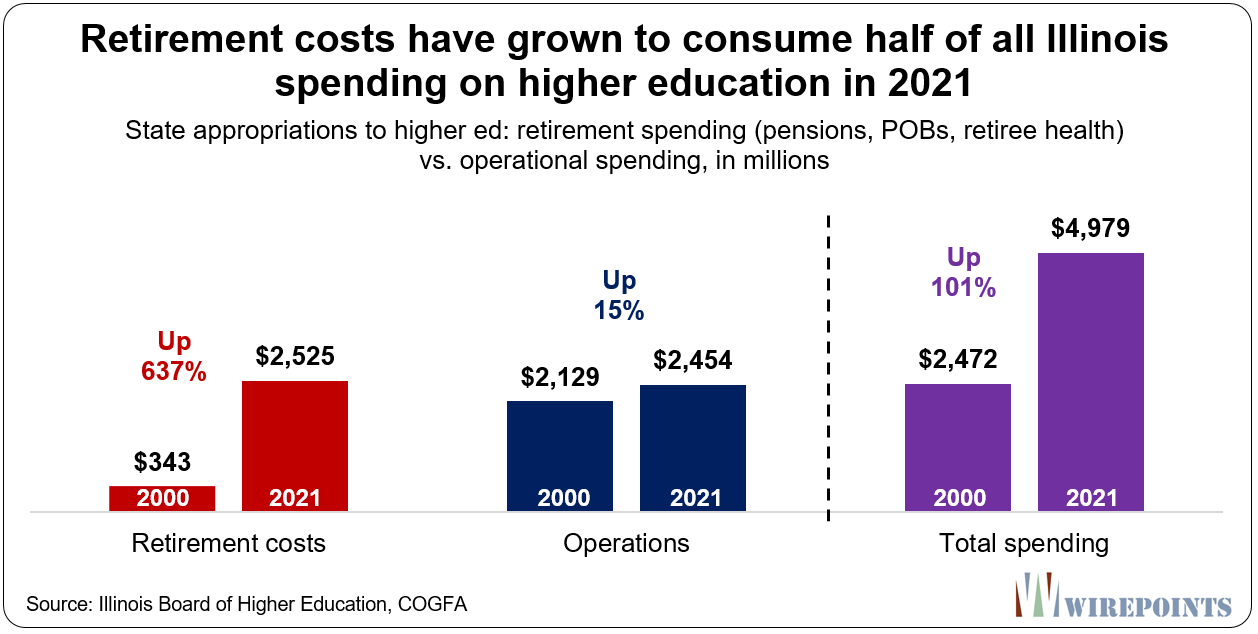
That’s simply not true. Total state spending on higher education has more than doubled to $5 billion today from $2.5 billion in 2000 – an increase of about 3.4 percent annually and above the average 2.1 percent inflation rate over the same period. The real problem is that the entire increase has been sucked up by skyrocketing retirement costs, putting pressure on many aspects of higher ed.
A Wirepoints analysis of higher ed spending shows that of the new, cumulative state appropriations to higher education over and above base spending in 2000, every dollar has gone to pensions, and then some.
As the below graphic shows, state spending on operations (funds for universities, colleges, student aid, technical education, and other grants) remained flat or fell over the entire period to make room for the steep increase in retirement spending for higher ed pensions and retiree health insurance.
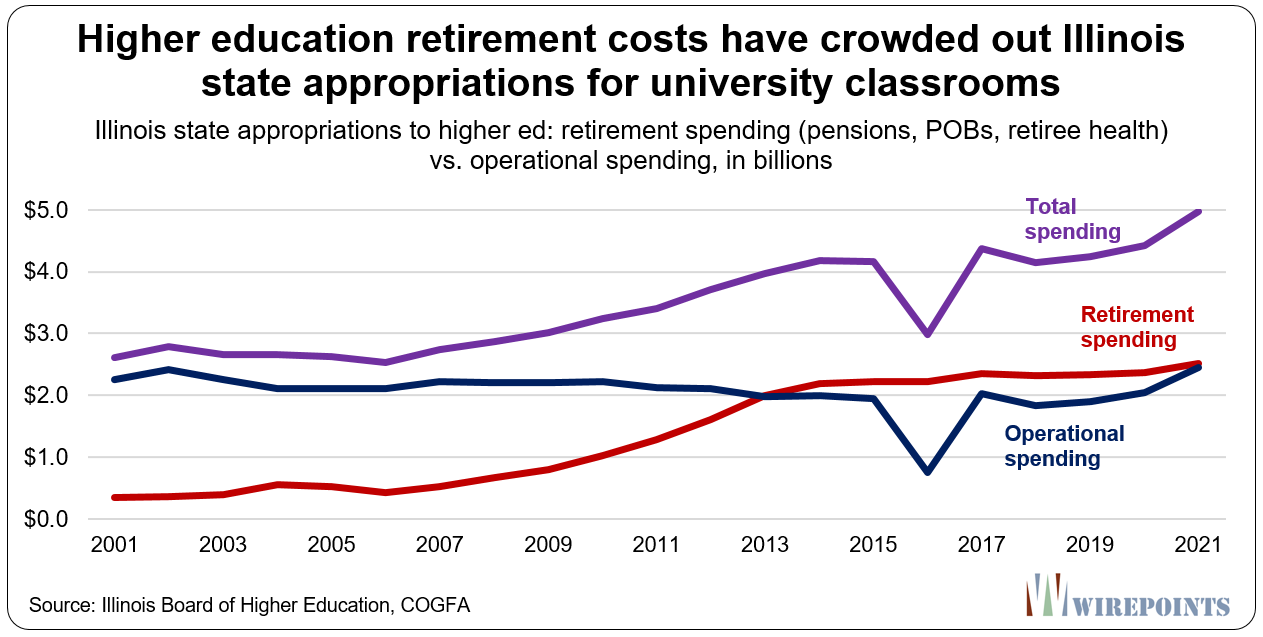 As a result, more than half of all state university and college appropriations go to retirement costs today, up from just 14 percent in 2000.
 Overpromised and overgenerous pensions
In 2015, the growing cost of student tuition and a compensation scandal at the College of DuPage sparked the Illinois Senate Democratic Caucus to launch an investigation into the growing costs of the university system’s administrative bureaucracy. Their Investigative Report on Executive Compensation at Illinois Higher Education Institutions reported that:
“While tuition at Illinois’ public institutions has skyrocketed, so has executive compensation. This report finds that tuition increases have coincided with a dramatic increase in administrative costs, including the size of administrative departments and compensation packages for executives.”
Data from the National Center on Education Statistics further revealed that the administrative and management staff in Illinois higher ed grew by 26.4 percent from 2005-2015, compared to a 2.1 percent increase in instructional staff and a 2.9 percent drop in FTE enrollment.
The Senate Democratic Caucus also found that the expanding bureaucracy in higher ed grew the state’s pension costs.
“Much of this revenue growth has been used to support an increasingly larger bureaucracy and excessive administrative salaries. This is also evidenced by ever increasing state tax contributions required to cover the pension and health care expenses of this administrative growth.”
In fact, the total pension benefits promised to university workers (accrued liabilities) grew more than 1,000 percent (7.6 percent annually) from 1987 through 2020 – far faster than the state budget, Illinois’ economy or taxpayer incomes could keep up with. The rapid growth in pension benefits was the subject of Wirepoints’ Special Report: Illinois Pensions – Overpromised & Overgenerous
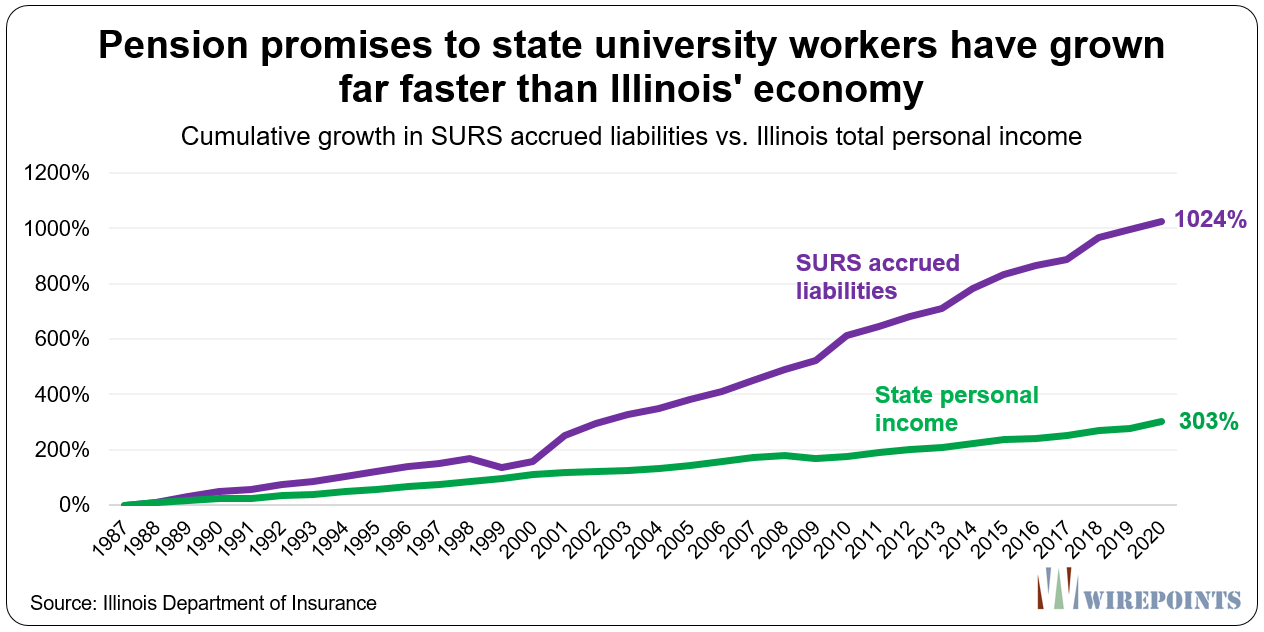 The core problem with university pensions is the same as the state’s retirement crisis a whole: benefits were overpromised by Illinois lawmakers.
The perks and benefits they’ve given away over the past few decades – high salaries, spiking, early retirement ages, 3 percent cost-of-living adjustments, and more – mean career university workers receive retirement benefits far beyond what most Illinoisans in the private sector can afford.
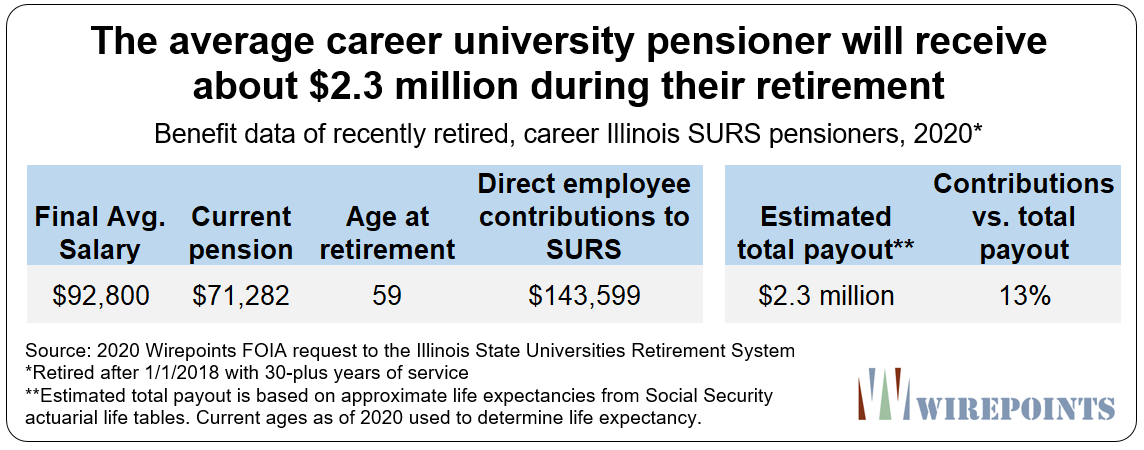
Take Illinois’ recently retired career university workers – retired after 1/1/2017 with 30-plus years of service. On average, they ended their careers with a final salary of $93,000 and began collecting benefits at age 59. They get an average pension of $71,000 a year and can expect $2.3 million in total benefits over their lifetime.
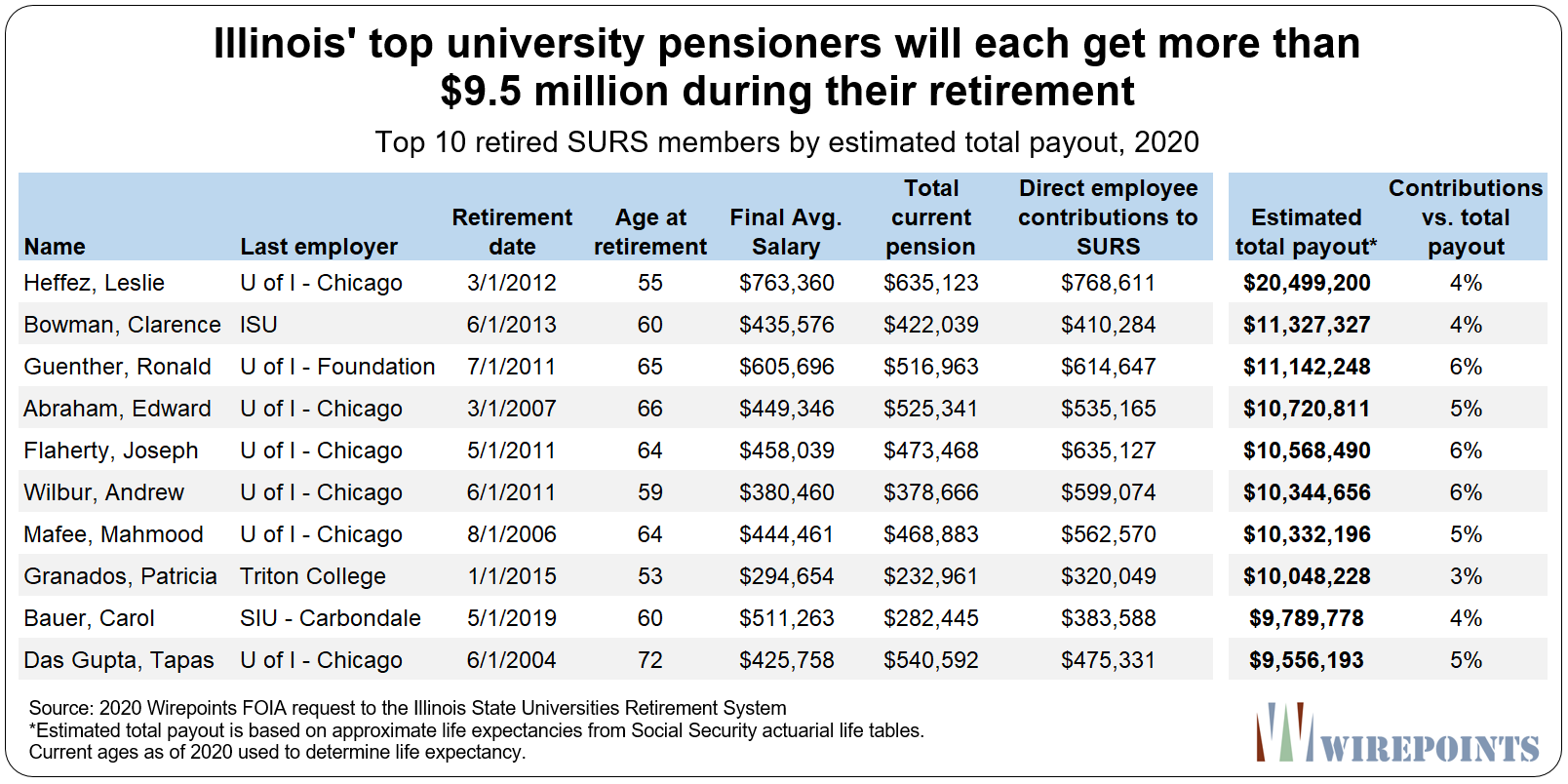
 Top State University Retirement System pensioners can make far more than that – largely due to their six-figure final salaries and early retirements. A majority of the top retirees in the graphic below retired with a $450,000-plus salary and will receive more than $9.5 million in lifetime benefits.
Some of the retirees below were medical doctors at the public universities, but many other top beneficiaries such as Clarence Bowman and Patricia Granados were university administrators. Bowman, a former president of ISU, retired at 60 with a final average salary of $435,000 and a starting annual pension of $347,000. After several years of a 3 percent compounded COLA, his pension now exceeds $422,000. His COLA increase for just one year is now more than $12,000.
 Hiked tuitions
As pension costs have devoured the state’s – taxpayers’ – appropriations toward higher ed, Illinois’ education complex has increasingly shifted the burden onto students through higher tuitions. The Senate Democratic Caucus report noted that as state money was diverted from classrooms to pensions, universities hiked tuition so much that college and university officials had money left over to spend on more administrators and higher salaries:
“While state operating support for public universities has declined by 7% over the last decade, the corresponding increase in tuition and fee revenue has not only offset state budget cuts, but sustained annual public university revenue growth rate in excess of 5%.
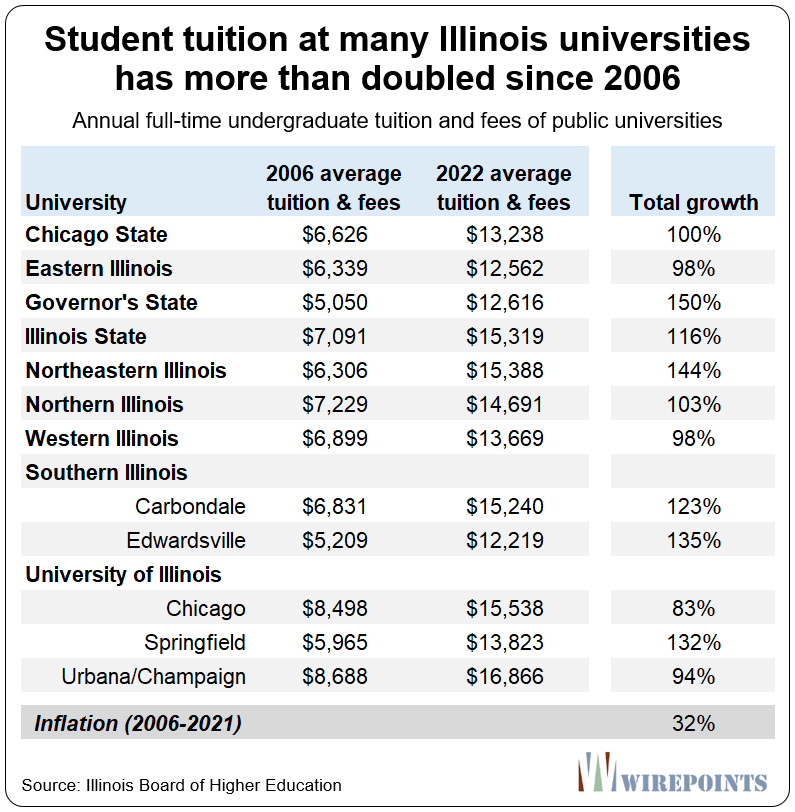
In all, the average tuition and fees at several Illinois public universities have more than doubled since 2006, according to the earliest data available from Illinois Board of Higher Education.
Students at Northern Illinois University, for example, paid a tuition of $7,229 a year in 2006. By 2022, tuition will have doubled to $14,691. That increase is three times more than the growth in inflation over the period.
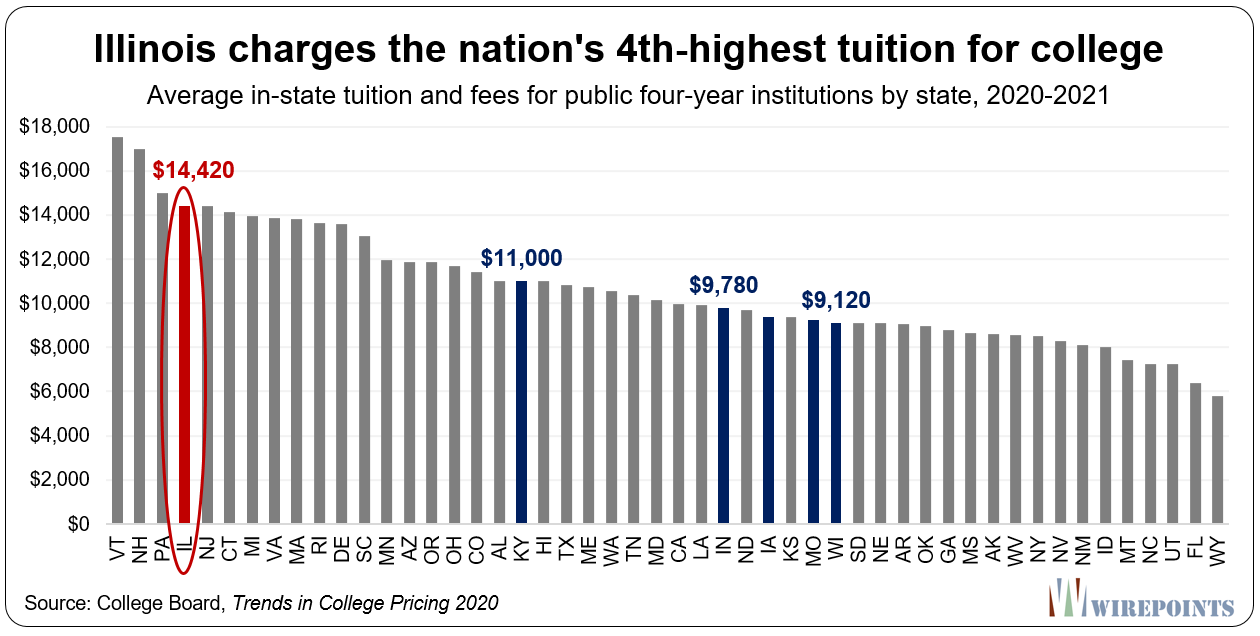
 All that has pushed Illinois’ in-state tuition for public 4-year institutions to the fourth-highest level in the country, according to the College Board. At $14,420, Illinois only trails Vermont, New Hampshire and Pennsylvania. All of Illinois’ neighbors have far lower tuition and fees, with Indiana, Iowa, Missouri and Wisconsin charging less than $10,000 per student.
 One interesting note regarding the Senate Democratic Caucus report is that it strongly criticized the state of higher education before Bruce Rauner became governor. Gov. Rauner became the punching bag for the problems in higher ed after his 2016-2017 budget impasses, but the Dem’s report shows clearly that the majority of the problems in higher ed preceded him. Rauner deserves blame for his many governance failures, which we documented here, but not for the crisis in higher education.
Fix the pensions, stop the bleed
The Illinois Board of Higher Education has responded to the state’s loss of students by calling for hundreds of millions in more funding for grants, subsidies and an even greater focus on “equity.”
They’re treating the symptoms rather than the disease. As long as Illinois lawmakers continue to ignore major pension reform – which we outline here – expect Illinois’ youth to continue to leave Illinois’ borders in search for an affordable, quality education.
Appendix
The College Board reported last year that Illinois’ full-time equivalent student enrollment dropped more over the last decade than in any other state in the country. Illinois lost 17 percent of its FTE in 2018 compared to 2008.

Read more from Wirepoints:
- Politicians’ next pension “fix”: Gambling with your money
- A Chicago Loan Program To Help Pay Property Taxes – Funded By Property Taxes
- New Financial Statements: Illinois Plummets $6.7 Billion Deeper Into Debt
- While Illinoisans are distracted, politicians run up the bill. Keep an eye on your district’s teachers contract
 A mess of uncertainty and litigation is sure to follow.
 With $162 billion more from taxpayers, couldn’t you deliver a few bond upgrades, too
Our son is going to UCF in orlando…AWESOME university and it cost less to go there “out of state” than to stay in IL. He is a top student and received nice $$$ to attend there….We are out of IL in the next 12 mos…this state blows.
There are VERY few groups more GREEDY than Public Sector workers, and VERY few groups more self-serving and Taxpayer-betraying than the Elected Officials that grant these WAY too-generous,unnecessary, and unaffordable Public pensions and retiree healthcare benefits.
“…these WAY too-generous,unnecessary, and unaffordable Public pensions and retiree healthcare benefits.”
Your ardor is impressive, I suppose, but there is no Earthly way you can substantiate that, which makes the rest of your statement moot, n’est-ce pas?
Not under oath. Perhaps hyperbole again. Opinion is akin to politicians promises where substantiation is not expected in our Earthly domain. autre déposant ne dit pas.
Tough Love is an advocate of extreme (50 percent or more) cuts in pension accruals. I believe that should require very convincing data.
TBH, I believe he is first and foremost an advocate of Defined Compensation systems, “no more generous than typical private sector workers receive”, and, no retiree healthcare.
“Got a problem with EQUAL? ”
Is, or was his favorite catchphrase. 50 percent
DB reductions being his fallback position.
That’s a whole other debate.
who cares? Just cut the pensions and let them eat cake. THe state is broke and half of something is better than nothing.
“half of something is better than nothing” Not going to happen. If there isn’t enough money to pay everything then pensions and other debt will be paid first. I’m continually amazed that people think it’s the pensioners that will be eating cake when it will be the taxpayers. Someday (far into the future) maybe you will get relief from the courts. If that were to happen it would be no where near a 50% cut. Maybe 5% cut like Detroit. So that 100k pension that would be worth 180k in 20 years will be cut 170k. All of these discussion… Read more »
Good luck keeping the producers in this state.
IL has no military to enforce, the administration is and has been a joke for generations and the exits are wide open.
I went to IIT, but my girls won’t stay in state, per my advice, too much wonkery now and no real future here anymore.
Good luck, our household $400K+ per annum not paying for IL nonsense anymore.
And .. wait for it .. more will leave.
Enjoy the dirtbags remaining.
“more will leave”
In the last 10 years the state lost 18k residents and overall revenue grew by 65%. Until revenue declines your threat of leaving is meaningless to the GA. In fact, the idea of conservatives leaving but revenue growing only encourages the GA to push forward.
Let’s count real earners, not the dreamer types.
The tax donkeys are leaving.
The GA can fiddle away, like I said, the dirtbags will keep them busy.
IL needs an obtuse populace to exist.
The “real earners” are leaving yet GDP continues to grow. I just don’t understand why the GA isn’t scared by your threat.
Colorado School of Mines .. better education, better scenery, and actual skiing.
It’s that simple, there are alternatives to this mess.
I hope others follow.
Please wallow in the mire here, you and this state deserve one another.
Golden Colorado is beautiful. It’s on my list of places to own a home in retirement. Who knows, maybe we will be neighbors. Probably won’t live there year round because of the winter but definitely worth a second home. May keep Illinois as my main residence though because retirement income (400k in retirement income will cause you to pay over 17k in CO taxes) isn’t taxed in the state. Then again maybe Tennessee or Florida.
Perhaps you could keep an eye on my home in Golden while I’m out of town.
I honestly prefer Whistler BC, but can’t stay there longer than the 5 weeks yearly local zoning allows. Hence, solid rental income, though these last 2 years have been thinner. The Chinese buying all properties in Vancouver, Richmond and Westmount all the way to Squamish really, has made for proper ROI since we bought in 2006. Colorado School of Mines has a proper Nuclear program, so don’t expect to see myself or the girls too much, we’ll be busy for a few years. Enjoy TN and FL, many IL transplants there. I imagine an IL tranplant either being 100% based,… Read more »
“In fact, the idea of conservatives leaving but revenue growing only encourages the GA to push forward.”
The goal is to expel them from the state. They’ve made it abundantly clear. We are the enemy, sad really.
Everyone gets relief and a raise when they move out of state. Simple solution to a complex problem.
The answer is simple, really: I sent my college freshman and junior out of state because the schools they attend in Indiana only cost me slightly more than U of Illinois without all the social justice nonsense jammed down their throats. and I hope they are smart enough to seek internships in that state and make a life there rather than return to the Chicago area. And my wife and I will behind shortly once I am able to retire.
https://eadn-wc01-3158345.nxedge.io/wp-content/uploads/2020/09/Pension-bene%EF%AC%81t-growth-overwhelms-Illinois-economy-state-revenues.png “There is much mention of accrued liabilities and their growth of 8.5% and then somehow creating charts of “benefit growth” to accrued liabilities (funding shortfall). Twisted – Accrued liabilities are NOT benefit growth.” Martin Anderson, Sept., 2020 “The official pension reporting remains phony and understates the crisis, as our report details, which is affirmed by Nobel economists, Moody’s and countless financial experts.” “This second part of Wirepoints’ four-part series outlines how those overpromised benefits, and not underfunding, have been the real cause of Illinois’ crisis.” Mark Glennon, Sept., 2020 …………………….. Interested in reading these Nobel economists and financial experts.… Read more »
“I’m still going with underfunding”
Of course, it’s the far easier and more self-justifying conclusion, isn’t it? Public unions just got screwed- end of story.
The complexity of how we got here and who is to blame- the beneficiaries have no interest. They just know they got screwed and the public better pay.
Pay or don’t pay, https://quotefancy.com/media/wallpaper/3840×2160/2885183-George-W-Bush-Quote-You-cannot-solve-a-problem-unless-you-diagnose.jpg Ironic George Bush (either one) is the best quote I could find. The clear implication is that pensions are excessive, in which case pension reductions –would be– the logical solution. It is true, generally, that for public workers, pensions and benefits are a greater –portion– of compensation than for private workers, yet empirical data just does not confirm that overall, public workers have higher total compensation. Generally, state and local government workers earn lower wages than equivalent private workers, and the higher pensions counteract the lower wages; deferred compensation. The logical result of reducing pensions… Read more »
Keyword =”equivalent” private workers. Equivalent based on what? Years of education, because all degrees are equivalent?
PP, Education is only one factor. It is a handy reference because generally higher education results in higher pay. The following analysis doesn’t even consider education levels. ” Up until this point, our focus has been on mean public–private compensation differentials. However, differences in the wage distributions of the public and private sectors extend beyond the differences at the mean—in particular, the distribution of pay in the public sector tends to be less dispersed (Poterba and Rueben 1994; Belman and Heywood 2004a). We revisit this point here, using quantile regression techniques to assess public–private differentials at different points of the… Read more »
So the public sector enjoys a premium up to the median. That implies that every private sector worker below the median is paying benefits to his public sector counterpart that he himself cannot afford. You don’t see that as a problem. And yes, anyone who rents property pays this tax indirectly. It is simply funneled through the landlord. The statement also implies that there is no excess benefit above the median, but that is not a proper conclusion simply from the statistics. For example, in the private sector, workers do not automatically receive a pay increase if they decide to… Read more »
“So the public sector enjoys a premium up to the median.” Absolutely not. That is one generalized statement from one study. Nailing Jello to a tree again. You literally cannot take that to the bank. You will never get consensus on the difference in pay because of the different assumptions in the studies, right or wrong. Gittleman, for instance, does not control for employer size. If you recall, susan quoted BLS statistics showing public workers earn about 47 percent more than private workers. However, BLS also breaks down compensation by employer size, and employees of establishments of 500 or more… Read more »
Baloney Stephen, and you know it …….
While in some states Public Sector workers (on average) earn a SMALL amount less than their Private Sector counterparts, the extraordinarily high value of thier promised pensions and retiree healthcare benefits outweights any “wage” shortfall MANY MANY times over.
And just think you coulda been a contenda, too, iinstead of a bum which is what you are.
https://www.memesmonkey.com/images/memesmonkey/s_f9/f95eb92f4fed726525c7f46a8cb89e79.jpeg
There’s a lot at stake here. Let us know when you find consensus. As opposed to dueling studies.
Also, as you are aware, benefits “outweights” wages –only– at lower income levels. (Public policy decision😉)
And it’s “their”. (And ” outweighs”)
If this was easy, anyone could do it.
If the image is too subtle, it means that no, I don’t “know it”. And neither do you.
Accrued liabilities in the chart reflect the impact of salary hikes and legislative benefit hikes over time, although there are many other aspects to the actuarial calculation, including the discount rate. Here is one definition of accrued liabilities. “Pension Liabilities: Also referred to as Actuarial Accrued Liabilities (AAL), pension liabilities are the present value of promised pension benefits, or pension obligations. In any given year, a pension plan’s actuary calculates the total value of liabilities that have accrued, and this figure is used to determine the plan’s unfunded liability. At any given time the recognized value of accrued liabilities on… Read more »
Do the direct employee contributions to the pension fund include employer pension pickups?
I don’t think SURS participants get pension pickups, at least not on a grand scale. If you do a random search on higher ed salaries, you don’t see anyone getting “retirement enhancements.”
It costs very little for a college to stand up any number of “woke” classes. All you need are desks and an indoctrinator. But for a college to stand up real engineering, physics, chemistry, bio, etc classes takes bucks. You need labs, equipment, computers and a low paid “indoctrinator” wont do, you’ll need a real engineer, chemist or physicist to teach it. When funds are going to pensions, I could see how colleges will only afford to stand up useless indoctrination drivel, gender, race, intersectionality. Hard engineering and science will go to the wayside.
You just graduated as an honors student from Neuqua Valley. Your parents spent the last two decades paying over $10K/yr in property taxes to fund your public education. You were accepted by UIUC, but not in your preferred major. What do you do? Why would you choose to stay in Illinois? What makes Illinois universities a compelling choice, other than maybe some of your friends are going to Illinois State or NIU is an hour drive? Why spend four years in a prairie town in the same boring state you grew up in when there are far more compelling choices… Read more »
Not to be snarky, but I know from personal experience the top selective employers also frown on the Lefty private colleges, e.g. DePaul. If you want the best value for success, avoid Illinois altogether. Parents understand this.
Of course, if you went to UIUC you would be able to spell Colorado. Top students do well at Illinois. If your honors student can’t reach his goal at UIUC, then that likely tells us about his honors degree from NV. If you aren’t a 3.5 (minimum) you won’t get near the business or engineering schools, and why should you? There are alternative programs in LAS and other schools that allow for business minors, etc. I have one who graduated from UIUC and one there now. The grad is two years out of her masters (UIUC paid for it) and… Read more »
Yes, everything you’ve listed about UIUC is certainly true. But many other students make the decision to go to college elsewhere. UIUC student population is just a tiny sliver of the entire statewide college attending population. UIUC is the state flagship and it by definition elite and they compete with other Big 10 graduates. There’s a very steep fall off after UIUC to UIC, and then you’re basically in the gutter with every other school after that.
I agree entirely.
Yes, UIUC is still a top-notch university. For example, it is consistently ranked among the top 10 engineering schools in the entire country. For those having to stay in the Chicago area and not wanting to spend a lot of money at a private university, UIC is a good, alternate pick. U.S. News still ranks UIC as one of the top 100 engineering schools in the country, so that’s not bad. A UIC engineering degree should get you a good job.
But UIUC engineering isn’t exactly filled with IL high school graduates either, my understanding is that its a lot of foreign students and transplants. Its very difficult to get into too. Someone correct me if I”m wrong. And people gloss over that UIUC might be the ugliest and least attractive campus in all of the Big 10. And Urbana-Champaign is not a good college town either. Easily the dumpiest of all the Big 10 schools in the jankiest of towns. UofI can’t even compare to the beauty and lakes and lifestyle of Madison or Ann Arbor, or the architecture of… Read more »
When the notion of separating Illinois into Chicago and AltIllinois is criticized by Chicago, the claim is that AltIll receives a greater share of State funding than its remittance.
The deliberately overlooked fact is that a significant chunk of that is accounted for by paying off universities’ (and prisons, and roadwork) overpriced obligations.
If Altillinois were to separate and create a fiscally sustainable State charter, Chicago could open its own state schools and prisons and maintain whatever fisval policies they deem appropriate.
To paraphrase Henny Youngman: Take my University…please.
AltIllinois would be freed from the unfunded mandates imposed to us by the Chicago focused legislature.
While I don’t agree with the idea of separating Illinois into two states, I do think it’s funny that Blue Chicago likes to brag about the state funding disparities but forgets that a new state aka “AltIllinois” would be deep red with 2 Republican US senators. That funding disparity is the price of keeping the Durbin/Duckworth dud-namic duo and tipping the balance of the Senate.
Splitting will never occur in our lifetime. An academic exercise if ever there was one.
You miss the point, which is to educate taxpayers about the vast amounts of money taken from them, without any value in return, by Illinois Political Industry.
Also, a similar outcome (to succession) could be achieved by incorporating the vast swathes of unincorporated Illinois into Village(s).
This would divert State funding from Chicago, and it would enable libertarian-minded Villages to use economic leverage on existing school districts to allow for detachment-annexation into newly formed, fiscally responsible, AltIll Village schools.
And those relatively minuscule pension contributions at the early part of the Edgar Ramp (1995-2005) allowed the state to pad the salaries these pensions are based on today.
I wonder if any of these professors would have been willing to trade their raises during that timespan for larger state pension contributions? Guessing no.
Add this to their sabbaticals, long vacations, tenure and contract rights … you have something like a Komodo dragon’s wisdom tooth to extract. With a bit of luck, these institutions can attract a large number of students from the families of corrupt Asian or Afghan politicians who can afford out-of-state tuition and add to diversity.
As with public K-12, the quality of public higher ed in Illinois is in general no better than average and thus a poor value. Parents and students are voting with their feet.
I am surprised by the mediocre quality of Illinois’ public universities. Go beyond the Champaign Urbana campus (which for financial reasons appears to rely on an outsize number of students from China), and there is no public school in Illinois which rises above average or mediocre. Of course, some will argue otherwise, but declining attendance (as well as mediocre scores on sites such as Niche) tell a story of decline. My home state of Virginia has educational opportunities that far, far outstrip Illinois, and I have intuited that not having public sector unions is a significant advantage to the state.… Read more »
“By the way, for clarity, a dedicated student with focus can do well at Illinois schools. The perception is, however, these schools are not delivering on value or opportunities.” Illinois degrees, other than UofI and UIC, have little value in the Chicago area. There are just too many Big 10, state flagships and selective private school grads competing for jobs. An Illinois state school grad (other than the two above) is figuratively drowned out in a sea grads from far, far better schools. Maybe that $100k degree from Eastern Illinois University will get you a dead end job in A/R… Read more »
Debtsor – I have no doubt you are correct. So many of my high school competitors stayed in state, U of I, Illinois State, Southern, etc., but none of their kids do. I was an Assistant GC at a Big 4 and there were partners in the attest function from ISU and Northern, although I concede Notre Dame, Michigan and U of I were far better bets. Perhaps times have changed. I went to school with JB (on athletic scholarship) and found I had nothing in common with most of my classmates. I was poor from a bad circumstance, but… Read more »