
By: Ted Dabrowski and John Klingner
It was just a year ago that Gov. J.B. Pritzker and other state leaders were celebrating an improvement in Illinois’ pension and budget health. The official state pension shortfall had fallen to $130 billion from $144 billion the year before and the state coffers were flush with cash. Illinois had even gotten its first credit upgrade in 20 years.
Pritzker and team took full credit for the results. Never mind the multi-trillion-infusion of federal dollars that fueled what Pew called a “once-in-a-generation” 25% stock market rally, or the nearly $200 billion in federal Covid aid that turbocharged the state’s tax revenues.
Now the steroids which have propped up the state’s budget and economy for two years are wearing off. The stock market’s recent 12-month decline is expected to wipe out whatever improvement the state’s pension plans had last year and the fiscal impact of the bailouts is wearing off. The nation’s economy is also in a recession, not to mention the impact of 40-year high inflation on Illinoisans.
Gov. Pritzker hasn’t mentioned any of that bad news while touting his accomplishments on the national pre-campaign trail. Here’s what he should be telling you:
The market drop will drive up Illinois’ pension shortfalls
The market’s last 12 months that ended June 30 prompted a recent WSJ editorial to report “the good times are coming to an end.” The paper reported that state and local pension funds across the country were hit with their biggest investment losses since at least FY 2009.
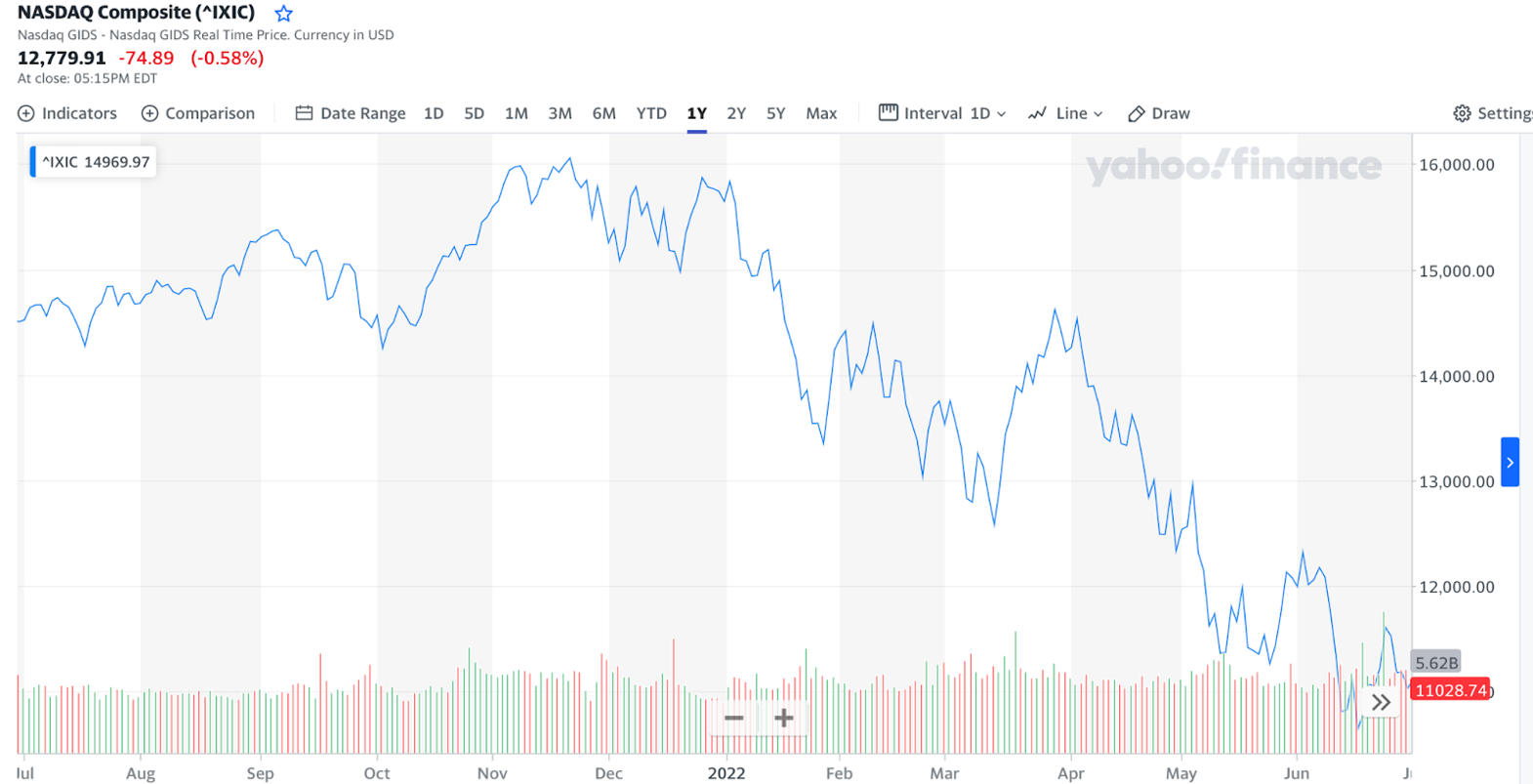
Every market was down for the fiscal year. The Dow Jones and S&P lost about 11 percent, while the tech-heavy NASDAQ dropped by 24 percent. The stock markets were hit particularly hard from January 2022 to June 2022, which was the biggest first-half-of-the-year drop since 1970.
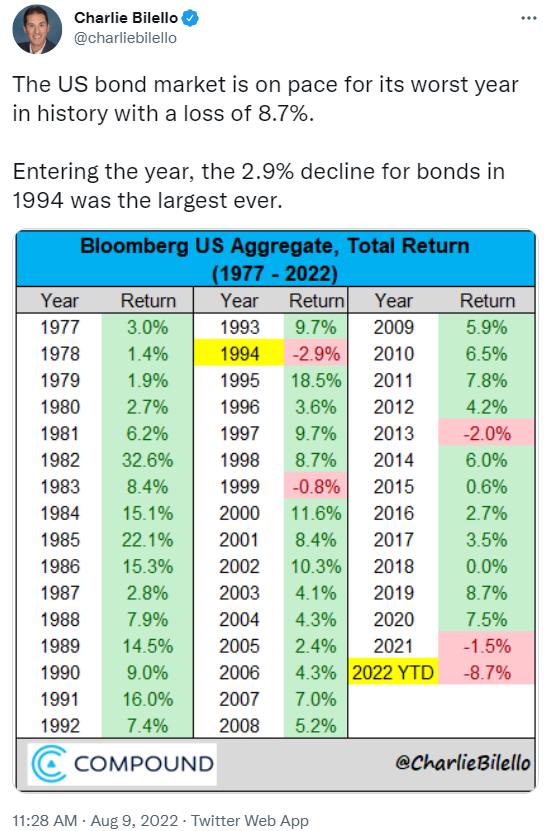
 To make things worse, typically safe bond investments have also generated big losses, especially in the last six months of the fiscal year. In fact, the Bloomberg aggregate index shows bonds fell about 10 percent in FY 2022 – the worst performance in decades.
 It’s not enough for Illinois’ five state-run pension funds to break even on their investments – they assume investment returns of about 7 percent yearly. That means if the funds end up losing, say, 6 percent on their investments, it’s a 13 percent hit to the funds. Based on those size of losses, pension debts could end up rising to $146 billion in FY 2022 – a new record.
The nation’s recession may put the squeeze on revenues
Illinois received $186 billion in private and public federal Covid aid and that money has been largely spent or accounted for. As the funds fully dry up, Illinois’ tax receipts will no longer be artificially propped up.
The economic hangover is already being felt nationally and in Illinois. The nation’s GDP has fallen for two straight quarters, down -1.6 and -0.9 percent, ushering in a recession, while Q1 2020 already saw Illinois’ real GDP shrink by -0.6 percent.
The Q2 numbers for individual states won’t be out for another month or so, but Illinois will almost certainly end up in a recession along with the rest of the nation.
Illinois’ economy will also be sapped by the impact of inflation on consumers, who’ve seen they’re real earnings fall by 3.0 percent over the last 12 months. Inflation is still blazingly high, with prices still up 8.5 percent year-over-year in July.
All those negatives combined will inevitably have a negative effect on the state’s revenues.
*************
Less than a year ago, Gov. Pritzker and other state leaders were celebrating the state’s “good fortune,” they wanted everyone to know about it. They brushed off the need for reforms.
With all these trends headed in the wrong direction, expect Illinois’ long-running pension and budget crises to come back, proving the need for reforms never went away.
Read more from Wirepoints:
- Nine things Gov. Pritzker didn’t tell you about Illinois’ 2023 budget
- Pritzker’s Takes Two Of His Favorite Whoppers On The Presidential Campaign Trail
- New analysis projects big hit to public pensions in Illinois and the nation from recent market losses
- Illinois economy, jobs suffer under potential presidential candidate J.B. Pritzker
 Audio and summary
  If this bill passes, say goodbye to local control over all Illinois parks and expect to see open drug and alcohol use, needles, no sanitation and fire hazards, but no ordinary park users.
Pension fund rate of return is overstated. It should be no greater than 4 percent. Years like the recent one support this point. The state pension fund deficit is likely well over 200 billion dollars – and of course – this is just the state – and excludes retiree health benefits.
Wait…
These are the *good* years…!?!?!?!???
The bond market is the real killer for pension funds this past year. Usually in a bear market, bonds help to offset some of the losses, even though the funds all heavy into equities.
Other states received bond rating upgrades as well for doing nothing more than accepting federal bailout dollars, just like Illinois. JB and Mendoza pretended they did something special.
Rauner wasn’t great, but I’d imagine if he had a 5% income tax rate his entire tenure plus a boatload of federal dollars at his disposal, the ratings agencies would’ve handed out upgrades as well. The ratings agencies weren’t nearly as upset about the budget impasse as they were about the obvious revenue shortage which led to the impasse.
Pritzker and Susana Mendoza were taking victory laps with all the federal money poured in. Then they gaslighted everyone in Illinois and the bond rating companies to get an upgrade on Illinois’ bond rating. What a load of crap!
Like a lottery winner squandering all their prize money…
The electorate has their collective heads in the sand. It will all come crashing down eventually, the Ponzi scheme will unravel. In true Profile in Courage fashion, legislators will move to protect their pensions and slash those of widows trying to get by on 2 grand a month.