
By: Mark Glennon*
The U.S Environmental Protection Agency is ramping up spending for electric school buses. There’s just one problem: Growing evidence says they don’t work reliably. More examples appear every week of severe product failures, in some cases knocking entire fleets out of action. That’s in addition to long-standing claims that E-buses are far more expensive than conventional ones.
As reported last month by Marketplace (a division of Minnesota Public Radio) and some others:
The EPA program has funded $1.8 billion of clean buses so far. In the next five years that number’s going to go up to $5 billion. Since the federal government is footing the bill for these new buses, adopting them and getting them on the roads was a no-brainer for many school districts.
But without that money, many school district officials say they wouldn’t have purchased these vehicles, mostly because they’re super expensive. A new electric school bus can cost about $350,000. That’s more than triple the cost of a new diesel bus. Plus, districts have to install expensive charging infrastructure. Schools will save on cost per mile and bus maintenance over time, but that still that doesn’t make up for that high price tag.
We earlier wrote about myriad reports of problems with mass transit E-buses, particularly those made by Proterra. In theory, E-buses might make better sense for schools because of limited usage times and the ability to recharge during school hours.
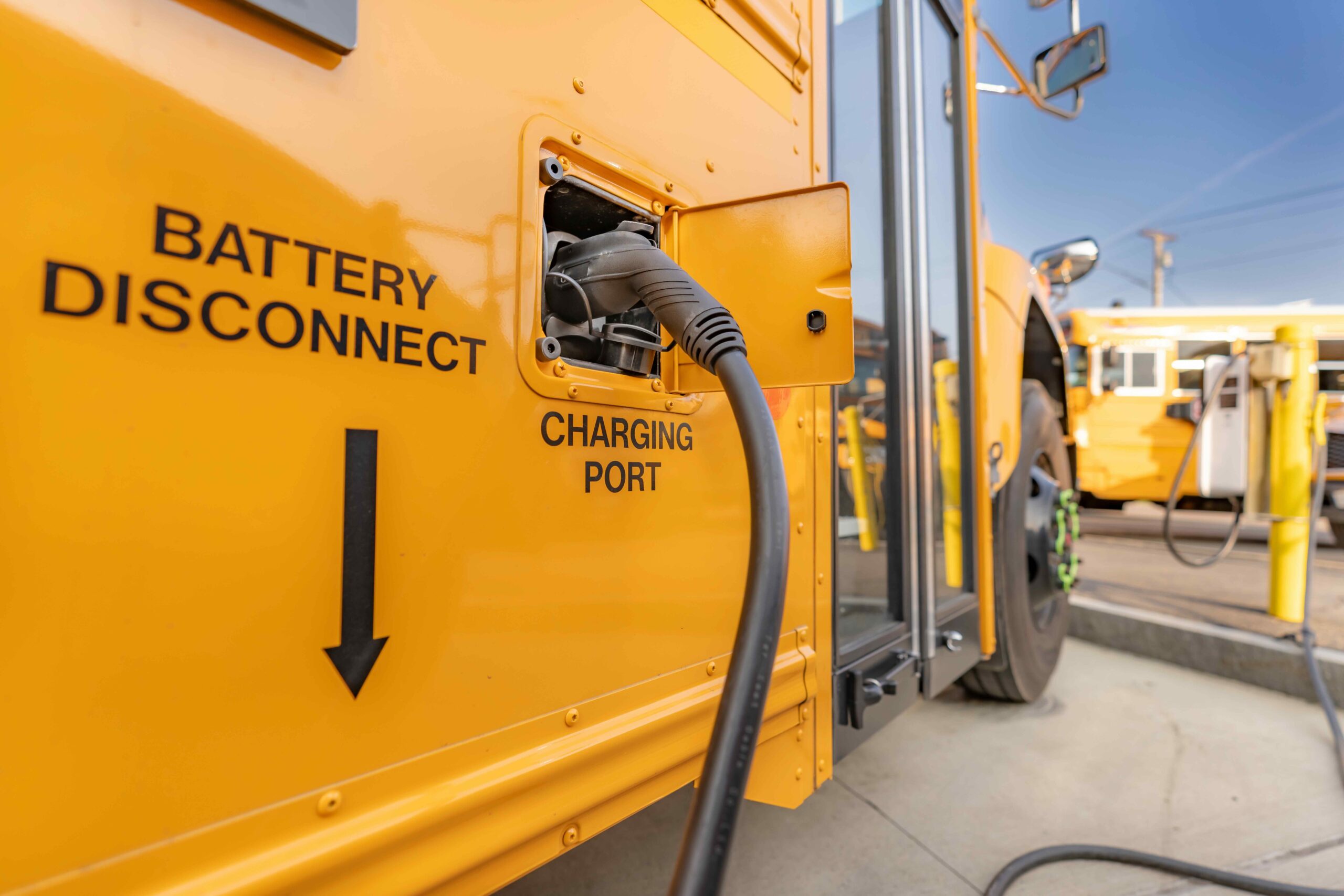 But examples of school E-bus problems are proliferating nevertheless.
In Maine, the Department of Education is advising all Lion Electric Co. electric school buses be parked until further inspections are done. Maine communities Winthrop, Vinalhaven and Yarmouth all had major problems last fall with school E-buses made by Lion.
In New York, Government Technology reported last week that 20 out of 100 electric school buses are down on any given day, due to problems with the buses or with their charging devices. In Bethlehem, New York, five of the seven electric buses purchased three years ago have been off the road in recent weeks.
Republican lawmakers recently joined some officials from New York’s education community calling for a pause on the 2027 statewide implementation of the electric school bus mandate. They cited problems with poor reliability, inability to operate in cold weather and cost to allow for the completion of a pilot program, cost-benefit analysis and other feasibility assessments.
“This mandated conversion will have a price tag in the billions, with New York State taxpayers simply expected to foot the bill,” said New York Senator George Borrello. “Like so much of the state’s climate agenda, there is no cost-benefit analysis of this mandate or any realistic plan for how to pay for it.”
In Ann Arbor, Michigan, E-buses have had “a lot of downtime and performance issues” and aren’t “fully on the road,” despite the fact that they are “approximately five times more expensive than regular buses,” according to the school district’s environmental sustainability director. The infrastructure upgrades required to use the buses, meanwhile, were “originally estimated to be only about $50,000” but “ended up being more like $200,000…. I have a number of colleagues in different states who are facing similar challenges,” she said.
An embarrassing set of recommendations for how to keep school E-buses working adequately in cold weather is published by the federal government’s Joint Office of Energy and Transportation. Keep the buses in a heated garage overnight to better facilitate charging, says the publication. Add heated drivers’ seats and more insulation to take the electric load off the heating system, the publication also says.
Beyond school buses, transit authorities continue to report new problems beyond the examples we listed earlier. Milwaukee is among the latest. It’s county-wide transit system says it’s only using about half of its 11 electric buses on a daily basis because of maintenance issues.
Particularly harsh comments on E-buses were discovered by BLN News in internal communications regarding the Bloomington-Normal, Illinois E-bus fleet, where eight of their 12 E-buses were recently out of action. “Other EV manufacturers exist but are having similar problems,” wrote the transit authority’s General Manager, proposing to cancel its order for 10 more E-buses and replace them with diesel/electric hybrids.
The problems aren’t limited to America. Nearly 2,000 E-buses in Britain face recall over safety issues.
None of that is stopping federal grants for more school E-buses, with over $3 billion worth still go go. In Illinois, Chicago Public Schools will receive $20 million to purchase 50 clean school buses. Other grants made so far are listed here.
 It’s entirely possible we are seeing only the beginning of problems with E-buses because they are new and problems have yet to surface.
I spoke to a leading supplier of repair and replacement parts for buses that asked to remain anonymous. Their business slowed initially as new electric buses were put in service, but is surging now as those buses break down, not only requiring their own repairs but forcing older, conventional buses to stay in service.
Because E-buses are exceptionally heavy, they also thought that further, unusually high maintenance will be required in time because of extra stress on things like suspension and brakes.
Maybe the future is electric vehicles, as is often claimed. But in the investing world, being too early means being wrong – and losing your investment. America’s subsidies for EVs totaling hundreds of billions of dollars may be shaping up as among history’s biggest failures of government industrial policy because the technology just isn’t there yet.
Part of that failure may be billions invested in school E-buses. Those New York lawmakers have it right. Pause further investments in electric school buses to allow for the completion of proper pilot programs, cost-benefit analyses and other feasibility assessments, and stop them if they make no sense.
*Mark Glennon is founder of Wirepoints.
 A mess of uncertainty and litigation is sure to follow.
 With $162 billion more from taxpayers, couldn’t you deliver a few bond upgrades, too
In Sweden two cities purchased 50 EV buses for public transportation. They, the bus company, found that in the cold of winter the buses had half the range promoted, took twice as long to recharge, used double the power reported and were in the shop for repairs more than they were in use. Good reason to go electric, waste more tax money.
It is not their money.
JB … is the Illinois vehicle fleet EVs?
Biden … Is the federal vehicle fleet EVs?
Lead by example is the old adage – unless something is holding you back. Perhaps a bit of common sense?
Investing in unproven technologies is simply STUPID, especially with grid capacity issues.
We’re being governed by stupid chickens.
A prime example where ideology not sound economics creates further national debt and problems at local level. I like to know where all the costs are captured including maintenance of buses and charging system plus charging cost itself. My local HS just put in 2 outdoor charging stations, pretty big project, would not be surprised if north of $200k. You would think with all the reported problems of EV buses there would be a hold on this. However, that is not how gov money works, it gets thrust through the system to spend. EV buses are not the future unless… Read more »
You will continue to see more of the same because the school boards and decisions to purchase are overwhelmingly made by kooks who are the climate alarmists crowd again. This type of bus has a very light to medium duty service cycle. This means shorter distances and 2x pick up Mon -Fri. along with some special events. In theory, supposed to work in ideal conditions like that. In theory it couldn’t be an easier equation to solve. Optimally it will be warmer climates but any colder climates you are really paying a premium considering the 3x cost per bus. The… Read more »
Does the value of the E buses increase the total value of the school budget? If it does that means they still get more money the following year since for the most part the schools will not get less revenue than the year before especially in Ptell counties.
These grants coming from EPA go directly to the bus makers, so I doubt it affects any of that.
Tim
This state is forever putting the cart before the horse and jumping into the next popular social construct. They will never learn.
JUST ANOTHER WAY TO PIDDLE AWAY OUR TAX MONEY SO THEY CAN DEMAND MORE!!!!!!!!! TOTAL IDIOTS……WHY CAN’T WE ELECT SOMETHING BESIDE DEMS????????
Very useful in subzero weather. Another example of moronic decision-making at City Hall.
Has no one learned, in the New Society (formerly Great Society of LBJ era), optics is everything! Whether or not a policy improves society is secondary only that it appears too. SMH
Look not at the actual results of the do-gooders’ bright idea.
Look only at the good intentions.
Look not at the cost either, lest ye be labeled a heretic by the Climate Clerics.
Governments populated by Democrats will keep doing stupid and damaging stuff like this until their power is taken away. But as we always say, you get what you vote for.
Spending other people’s money is what they are good at!
Disconcerting is the lack of analysis in regards to safety of EV’s, in particular from EMF. In SUV’s, Buses, and Trucks where the power needed is significantly higher than a small passenger car, EMF concerns may be much more pronounced, particularly to children. Your child may be riding in one of Pritzker’s buses and is getting effectively microwaved doing so. Recall the concern of holding cell phones to your ear for long periods? Same thing here with EV’s.
EV’s are literally ‘half-baked’.
FYI: Interesting background on EMF
https://www.healthline.com/health/emf#EMFs-in-daily-life
In the recent 3.5 years, we have seen our government make thousands of decisions that make no common sense. Boarder, Spending, D-E-I-MOUSE crap. This is just another “makes no common sense” decision. They don’t work dependably. They don’t work in the cold. There isn’t enough power in the national power grid to charge them…good God, what is going on?! This will be a complete waste of my tax dollars…just throwing it away.
This is an example of government at its worst. The only surprise here is that Pritzker isn’t leading the way in wasting taxpayer money.
And a hearty “ thumbs down “ to both comments in lieu of a rational, opposing argument, because there isn’t one.