
By: Mark Glennon*
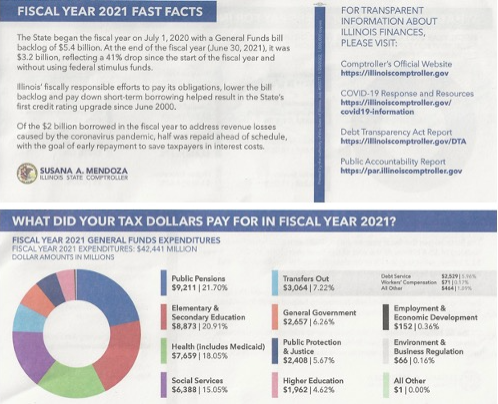
If you’ve received an Illinois income tax refund check lately from Illinois Comptroller Susana Mendoza, you probably got the insert reproduced below along with it.
It’s politicking that should not be done through official state communications.
And it’s deceitful.
It contains a version of Mendoza’s most often used political message, which is boasting that the reduction in the State of Illinois’ backlog of unpaid bills is an indication of fiscal prowess and that the state’s finances have turned around. Since that message is so often used by both Mendoza and Gov. JB Pritzker as well, let’s take a comprehensive look.
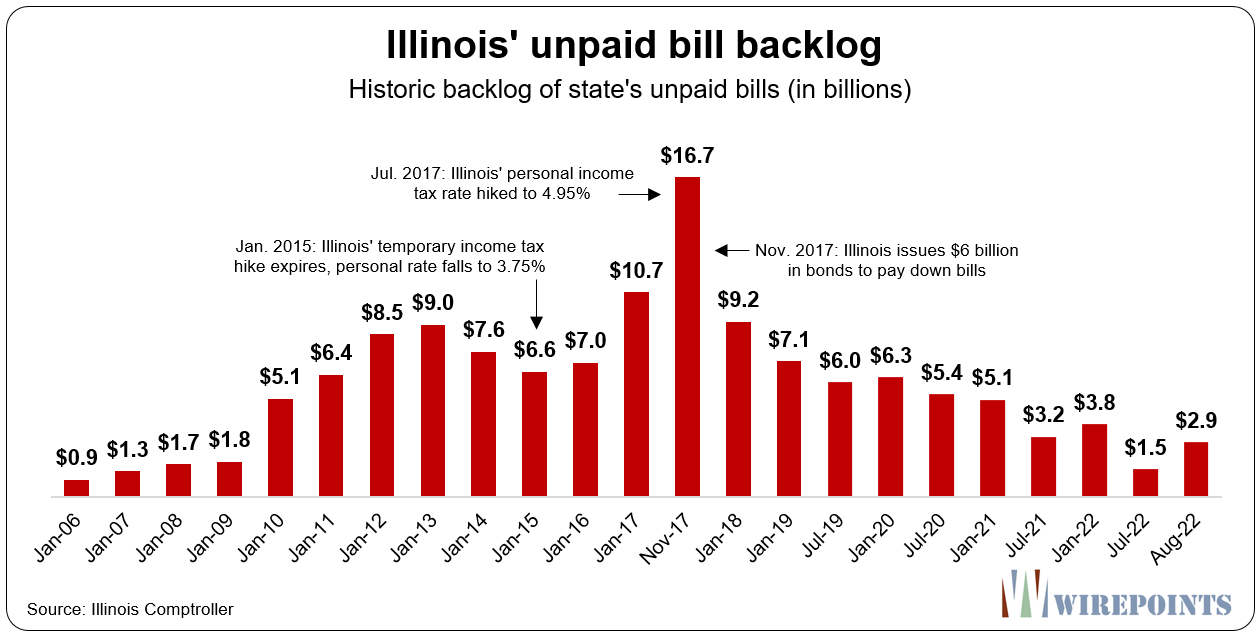
First, some background: Illinois had a backlog of unpaid, routine bills in its General Fund that peaked at $16.7 billion in 2017 and has now been reduced to $2.86 billion. That, Mendoza often says, indicates that “our state has made great progress with its finances, even in the face of the pandemic, as she wrote in the Chicago Sun-Times. “And the bill backlog has shrunk by about 80% since its historic high of $16.7 billion during the 2015-’17 budget impasse,” as she often says.
Mendoza has even claimed that “my office” is responsible for the backlog reduction.
Pritzker often makes much the same claim and did so again last week as part of his “Democrats Deliver” message at the Illinois State Fair.
The tax refund insert now being sent by Mendoza’s office contains only a slightly softened version of those claims, essentially saying the bill reduction is part of “Illinois’ fiscally responsible efforts to pay its obligations.” The insert also claims that federal cash bailouts had nothing to do with the backlog reduction, and it adds a boast about repayment of its loan under the Federal Reserve Municipal Liquidity Facility, though only Illinois is the only state that had to borrow under that program.
Here’s why those claims by Mendoza and Pritzker are deceitful:
The Backlog By Itself Means Almost Nothing:
The size of the bill backlog is just one part of the state’s financial picture and performance; it means nothing by itself. The backlog is just one of hundreds of accounts the state has. The state can ignore other payment obligations such as pensions or the federal loan for the unemployment trust fund — or simply borrow money — choosing instead to pay down the backlog. That’s exactly what the state has done, as explained below.
The proper way to look at what’s happening to state obligations in their entirety is exactly what Mendoza herself said in 2016, which is what we always say to look at.
Mendoza’s press release for the 2016 financial statements correctly said we should focus on the entire Net Position instead of just the General Fund. Net Position consolidates all gains and losses on all liabilities and assets for the whole state and is reported in audited financial statements. In 2016 she said,
With no relief in sight, Illinois’ finances deteriorated at an alarming rate in fiscal year 2016 as net deficit totals spiked to a staggering $126.7 billion…. The State’s [audited financial statement] paints a worsening outlook for the State’s financial future on this unsustainable path.
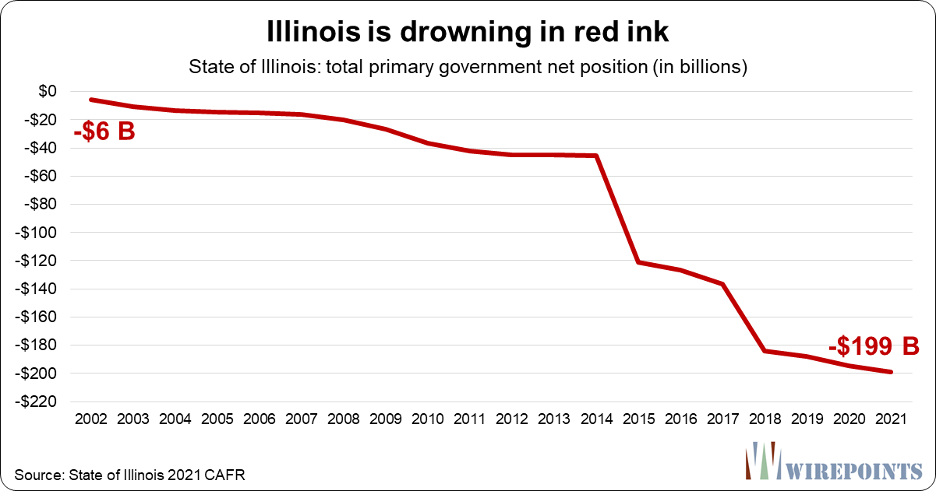
That “staggering” negative $126.7 billion Net Position is now negative $199 billion. She looked at things differently in 2016 because then we had a governor she didn’t like, Bruce Rauner.
This chart shows Illinois’ true performance, viewed the way Mendoza earlier and rightly said to view it. The Net Position is likely to have deteriorated much further in 2021 because of market losses in the pensions, though the number has not been reported yet.
One fundamental deceit is Mendoza’s focus on the state’s General Fund only.
At the heart of the matter discussed above is that the General Fund is only part of the state’s overall financial picture. Things like growing pension debts and borrowing from the federal government don’t show up in the General Fund, but they do show up in Net Position on the audited financial statements for the whole state.
Another example of why it’s misleading to focus only on the General Fund is Mendoza’s claim on her mail-out that the pension contribution was $9.11 billion.
No, the state is contributing about $10.8 billion to pensions this year. Mendoza’s number refers only to the General Fund contribution, which is misleading – presumably deliberately so — to understate the pension burden.
On her office’s website, Mendoza seems to present a thorough, transparent view of the bill backlog, that is now essentially gone. But it’s the same narrow view – the General Fund only, which ignores bonded debt, pensions and much more.
What else drove the reduction in the bill backlog? More debt and the biggest income tax increase in Illinois history:
Bond proceeds of $6 billion sold during the Pritzker Administration are reflected in the bill backlog reduction. In other words, the state borrowed to pay off debt. That’s a can-kick, moving debt from one credit card to another.
The bill backlog spiked up after what was called the “temporary income tax increase” expired in January 2015. Mendoza’s party had supermajority control over the General Assembly prior to that, and Mendoza herself was a member. She and her party neglect to tell you that they let it happen.
And how was the budget impasse with Gov. Bruce Rauner ended, an impasse which Mendoza and Pritzker blame for most every problem under the sun?
With an income tax increase that nets about $5.5 billion per year. It raised the personal income tax rate from 3.75% to 4.95%, a 32% increase. The corporate rate also rose by 33%.
The timing of those the bond borrowing and the tax changes are shown in this chart:
 Mendoza’s insert claims the backlog reduction was accomplished “without using federal surplus funds.” That’s preposterous:
The obscenely oversized federal “pandemic assistance” started in 2020 and continues to this day, with nearly $11 trillion already disbursed. Over $185 billion has come to Illinois, including $8 billion of direct assistance to the state and another $3 billion for the state to distribute to municipalities. The remainder swelled tax collections far beyond any prediction in Illinois and other states.
There may not have been a direct allocation federal money to the bill backlog, but money is fungible: Cash made available for any use makes more money available for other uses. And the unanticipated tax revenue that resulted from private sector pandemic assistance unquestionably helped pay down the bill backlog.
Across the nation, states are overflowing with money thanks to the federal cash, and they’ve acknowledged it. “The ultimate effect of the pandemic was a net positive,” said a city manager in California where sales tax revenues are soaring. “Isn’t that unbelievable? It’s just crazy to think of that.” Despite its problems, the State of California has a budget surplus of $45 billion, enough to send a check for $1,125 to every person in the state. “I just wish I could close my eyes and wake up back in the mansion and be [current Governor] Kathy Hochul,” said former New York Gov. David Paterson, referring to the cash windfall.
The only state officials who claim that federal cash has nothing to do with their improved finances that we can find are Mendoza and Pritzker, who claims he balanced the budget all on his own.
Early payment of Illinois’ loan from the Federal Reserve is nothing to brag about.
The insert says, “Of the $2 billion borrowed during the fiscal year to address revenue losses caused by the Coronoavirus pandemic, half was repaid ahead of schedule with the goal of early repayment to save taxpayers in interest cost.”
What it doesn’t say is that only Illinois was forced to borrow for that from the Federal Reserve. Taxpayers in other states therefor paid no interest on any such loan.
Finally, Mendoza’s insert claims that the state’s “fiscally responsible efforts” to pay down its bills resulted in the state’s first credit upgrades since 2000.
Credit upgrades got the state nothing because the same force that enabled the state to pay down bills means the state won’t benefit from those credit upgrades. Specifically, the federal money that enabled debt reduction contributed heavily to the highest inflation rate in 40 years, which in turn pushed up interest rates, as we explained here. The value of credit upgrades is normally lower interest rates, but Illinois can expect to see higher future borrowing costs thanks to federal overspending.
*************
This is not the first time Mendoza has used her official position to publish misleading political messages. In 2019 we criticized her for press announcements that she was “releasing funds for veterans homes.” She did that just ahead of Chicago’s mayoral election in which she was a candidate. The truth is that the Comptroller position is almost entirely administrative. She cuts checks to pay state bills. She had no basis for trying to claim credit for sending money to veterans’ homes.
The new insert she is sending with tax refunds, however, is far more serious. It’s a political misuse of her office and dishonest in multiple ways.
*Mark Glennon is founder of Wirepoints.
Insert from Mendoza:
Related articles by Wirepoints:
- Credit the near $200 billion federal bailout, not Pritzker’s actions, for Illinois’ “improved” 2023 budget
- What balanced budgets? Illinois Auditor General report debunks Pritzker claims
- New analysis projects big hit to public pensions in Illinois and the nation from recent market losses
- Nine things Gov. Pritzker didn’t tell you about Illinois’ 2023 budget
- What Illinois didn’t tell you about its celebrated early payment of federal loan
- Gov. Pritzker can’t take credit for Illinois’ improved budget projections when it’s the feds that bailed the state out
- Juiced Up Budgets In Other States Attributed To Federal Aid, But Pritzker Claims Credit In Illinois
 Audio and summary
  If this bill passes, say goodbye to local control over all Illinois parks and expect to see open drug and alcohol use, needles, no sanitation and fire hazards, but no ordinary park users.
Love to see what will be inserted into the token property tax rebates.
Susana, you’re ability to work fiscal miracles will evaporate the day the federal money spigot gets turned off.
WE HAVE ABSOLUTELY THE WORSE PEOPLE IN PUBLIC OFFICE……..I SAY THAT BECAUSE ALL THEY DO IS LIE ABOUT WHAT IS GOING ON……THEY DO NOT KNOW HOW TO BE TRUTHFUL ABOUT ANYTHING……..EVEN DENYING THE HORRIBLE CRIME GOING ON…….THE HOUSE NEEDS TO BE CLEANED!! OUR STATS ON EVERYTHING ARE HORRIBLE AND OFF THE CHARTS
Not sure I like “Public Pensions” called out separately like that. Maybe “Public Pension Debt” would be better. The normal costs (ie this year’s cost) for pensions should be included in their respective categories. For example, the normal cost for K-12 pensions should be under Elementary and Secondary Education, etc. This way makes it look like we don’t spend a lot on education, which they use as spin to increase taxes. If all teachers were SS/401(k), we wouldn’t have a separate category for “Retirement Costs,” it would be included under education. Paying retirement costs for educators is the cost of… Read more »
Great point.
Creative Accounting…
IL has always used creative accounting. Even though required to use GAAP, they’ve used “rulings” to exempt themselvs.
How is raising the personal income tax rate from 3.75 percent to 4.95 percent a 32 percent increase 🤔
4.95/3.75 = 1.32