
By: Ted Dabrowski and John Klingner
Questions are increasingly being asked about whether the end of cash bail in Illinois is resulting in more criminals roaming the streets and committing more crimes. The SAFE-T Act, which made Illinois the first state in the country to entirely eliminate cash bail, also reduced the number of crimes for which defendants could be detained pre-trial.
Opponents of the SAFE-T Act are concerned about an increased level of recidivism, more failures to appear in court, and the difficulty in detaining potentially violent defendants.
While it’s still too early to know if those concerns are warranted – data collection on the SAFE-T Act by the government is months behind schedule – there are three data points that are already a cause for concern. Jail populations are shrinking. The number of defendants on electronic monitoring are down. And appeals against detention orders have skyrocketed.
For those pushing decarceration, those data points show the SAFE-T Act is working as intended. But for those worried about the already-high levels of crime and an ever-softer approach to deterrence, that same data is troubling.
Shrinking jail populations
While there is no statewide info on jails yet available, data in counties including Peoria, Will and Cook show that jail populations are shrinking.
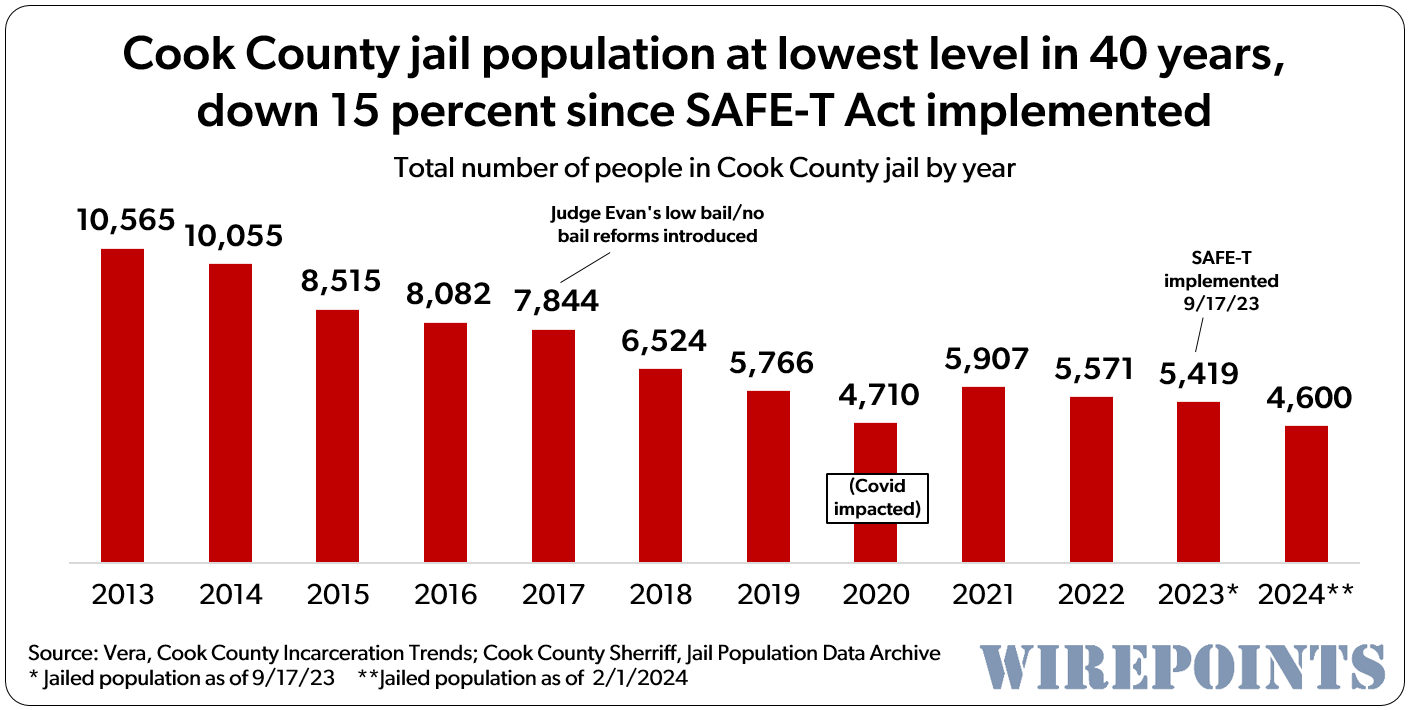
There were just 4,600 defendants in Cook County jail on February 1, the lowest number in more than 40 years.
That count is also a 15 percent drop compared to just five months prior when no-cash bail went into effect.
Reports from Peoria County show the jail population is down there as well. The county recently counted 265 inmates – down by more than 100 compared to pre-SAFE-T.
And in Will County, “the jail population has shrunk from 601 inmates to 478 since the law went into effect.”
Fewer defendants on electronic monitoring
Not only is the jail population in Cook County at a record low, but the number of defendants on electronic monitoring is also at its lowest levels in nine years.
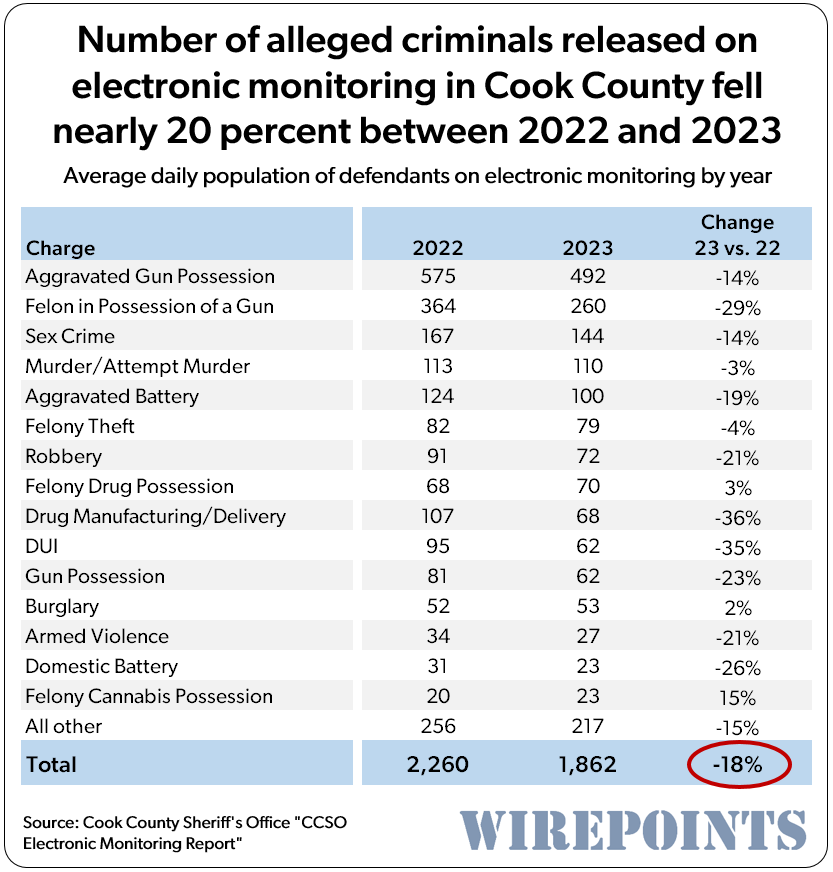
An average of just 1,860 defendants a day were on monitoring in 2023 compared to 2,260 in 2022 – a drop of 18 percent.
The drop has continued into this year. Just 1,683 defendants are now being monitored. That’s another 10 percent down.
 Some may look at the electronic monitoring data and interpret it positively. Everything else equal, fewer violent defendants out on ankle bracelets should be a good thing.
But if Cook County’s jail population is down and the number of defendants on electronic monitoring is also down – at the same time that violent crimes have just hit post-covid highs – then it’s not an unfair conclusion that more violent criminals are out on the street.
Chicago violent crimes in 2023 were up 14 percent over 2022, as we recently reported here.
Challenges to requests for detention have skyrocketed
In a further challenge to what little deterrence to crime remains, the Chicago Tribune reports that Illinois’ courts are facing a “skyrocketing” number of appeals to detention orders:
From Sept. 18, when the law took effect, through the end of the year, more than 1,300 pretrial appeals of detention decisions were filed in the state’s five appellate districts, an increase that comes on top of the normal caseload. In all of 2022, there were 1,981 criminal appeals filed across all five districts, according to data from the court.
Proponents of the SAFE-T Act claim that the appeals are a natural result of lawyers and judges figuring out the nuances of the new law. But such an overload of cases could result in prosecutors and judges simply avoiding detention orders in the future – unwilling to deal with the hassle of numerous appeals or the risk of being overturned. The result: more defendants out on the street than there should be.
In addition, there are concerns about defendants failing to appear in court. Officials in Effingham, for example, are experiencing high levels of “failures to appear:”
We’ve had a lot of people missing court dates, as we expected,” Effingham County State’s Attorney Aaron Jones said. Jones believes that some residents have been skipping their assigned court dates because they’ve discovered that they are able to, in some cases, skip multiple court dates before they are served with a summons and then, potentially, a warrant.
The backdrop worsens
Illinois courts are releasing more criminal defendants at a time when Chicago’s major crimes have hit a post-covid record, even though murders were down 13 percent. More than 77,500 major crimes were committed in 2023, up 55 percent compared to 2019 and up 18 percent vs. 2022.

As we said, none of the above data is conclusive as to the ongoing impact of the SAFE-T Act. But it’s certainly not comforting.
Read more from Wirepoints:
- Chicago led nation in homicides for 12th year in a row in 2023, murder rate still 5 times higher than NYC’s
- Gov. Pritzker’s dishonest spin on Chicago crime, Illinois jobs
- Criminals robbing with impunity: Time to care about who replaces Cook County prosecutor Kim Foxx
- Chicago: Where violence and dismal education intersect
 A mess of uncertainty and litigation is sure to follow.
 With $162 billion more from taxpayers, couldn’t you deliver a few bond upgrades, too
Heard this on the radio this morning. Just wanted to add that the policy of specifically reducing black incarceration is an ideological belief. Those who adhere to this ideology don’t care about crime, or victims, or public safety. As I’ve pointed out many times before, a majority of crimes are committed by black people and especially so on a per capita basis. This is not shocking or racist or even disputed. But on the flip side of these crimes, the criminals are also fathers, boyfriends, husbands, friends, neighbors, employees, caretakers, and so on in the community, and it’s very disruptive… Read more »
The decarceration myth was explained beautifully by our former Wirepoints guy, Matt Rosenberg: https://wirepoints.org/mass-incarceration-a-weaponized-myth-wirepoints/
Yes, and the other issue related to this is that large numbers of african-americans in urban areas are or have been caught up in the criminal justice system. They may not be incarcerated now, but they were in the past, or they have felony convictions. I can’t find the figures now but IIRC 1/3rd of Chicago’s African American men have felony convictions, and even large numbers have been arrested or have misdemeanor convictions. Convictions affect the ability of residents to get good paying jobs, secure apartments, and obtain business financing. Which again, goes back to the fact that there is… Read more »
The numbers will be twisted into a pretzel to justify liberal actions.
Hmm, the lowest numbers in 40 years. Gosh, the violent crime rate must have fallen off a cliff.
Everyone who had or has a BLM sign on their lawn or home should be required to house all of the criminals and illegals
another huge issue is the shortage of prosecutors & assistance prosecutors in Cook County as so many have quit under Foxx. Lots of articles from a year ago. Has anything changed? C. Harris is stating CC is down 200 assistance prosecutors from 900
The incarceration system is only too happy to place the burden upon society for violent offenders. They still rake in the tax dollars, yet are relieved of the responsibility of having to house, feed, clothe, entertain and monitor them. Will IL residents see a decrease in the money allotted to the penal system as a result of jails being half full? No, as people like Toni Preckwinkle have already decided that the money will go towards “ guaranteed incomes”, “ payments to those in stressed communities “ and other benignly termed grift.