
By: Matt Rosenberg
Bail reform has already come in various forms: to Cook County including Chicago, plus New York City, San Francisco, Los Angeles, and other U.S. cities. Now a souped-up version is coming statewide in Illinois. Other states should be on high-alert in coming months and years for bail reform initiatives because buyer’s remorse will be part of the package whether proponents want to admit it or not. This is a key takeaway from a new issue brief: “Bail Reform in Chicago: Un-Solving Problems in Public Safety and Court Financing” from the Manhattan Institute by University of Cincinnati professor John Paul Wright. He uses Cook County and Illinois as his primary example.
Wright argues that criminal justice reformers who backed bail changes in Cook County and the SAFE-T Act in Illinois callously ignore the harmful impacts on lower-income, crime-prone minority communities. Says Wright, “The costs of crime are borne on the backs of individuals, families, and businesses that all too often occupy the least privileged neighborhoods in society.”
Cook County is already paying the price due to bail reform enacted under Chief Judge Timothy Evans in late 2017. Up to November 19 this year, the crime website CWBChicago reports there have been 87 alleged victims of people facing trial in Chicago just for top-tier violent crime or weapons felonies – and who were out on bail under relaxed rules instituted in by Evans 2017. That includes 49 alleged victims of killings or shootings or attempts to kill or shoot them. More than 15,000 crimes of all sorts have been committed by Cook County pretrial defendants out on bail since bail reform was instituted in 2017, but that amount is lowballed dramatically because most crimes go unreported and arrest rates in Chicago are so low.
Wright in the issue brief says bail reform in Cook County is “unsolving” crime problems and that the SAFE-T Act’s end of cash bail and its sharp limitation of pretrial detention will worsen crime victimizations – particularly for at-risk communities that can stand it the least.
Wright does not in his paper address some of the broader causes of crime in Chicago: that four out of five black children are born to unmarried mothers; that K-12 public education fails to deliver proficiency in reading and math to about 90 percent of black students; and that sentencing in Cook County courts is weak and systemically immune from transparency and accountability. Wright does however accent the devastating marginalization by policy-makers of minority victims of crimes facilitated by bail reform.
Here are four key takeaways from Wright’s policy brief.
Takeaway #1: Bail reform is founded on a myth, and cash bail is an important deterrent.
Bail reform advocates in Cook County and nationwide contend many hundreds of thousands of defendants are held at length because of inability to make cash bail, but this is simply not true. Citing a study of New York City cash bail payment timeframes for defendants, Wright notes, “of those who were arrested by New York City police in 2018 and had bail set, 13% made bail on their first court appearance. Of the remaining 87%, 45% would make bail within two days, 70% would within seven days, and almost 90% would within 30 days.”
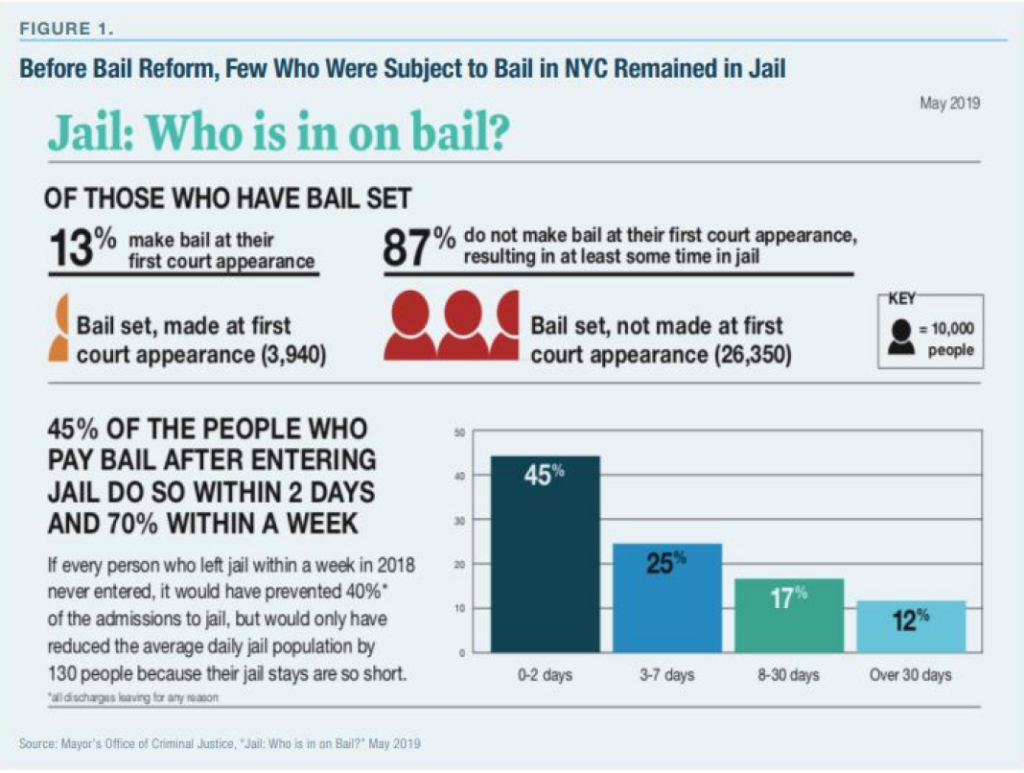 Wright also cites a federal Bureau of Justice Statistics report which found that in the 75 largest U.S. counties from 1990 to 2004, “only 6% of defendants were held without bail. Of those released on bail, 45% were released within one day, 76% were released within a week, and 92% within a month.” Wright concludes “contrary to the claims of reformers” pretrial detainees are not held “simply because they are poor and cannot make bail.”
Wright further notes that cash bail has always played an important deterrent role in the criminal justice process, something he believes is being swept aside now in Cook County and soon, Illinois. He writes, “Bail…protects witnesses and victims of crime from retaliation and intimidation, incentivizing cooperation with justice officials…Many arrestees never see a prison or jail cell, and even those who cannot immediately make bail are rarely held for long. The inconvenience that can accompany bail is the only real punishment many will experience…the bail process and the associated difficulties…serve as an important but overlooked deterrent…”
Takeaway #2: The trade-offs of bail reform in Cook County and the SAFE-T Act are not properly balanced. Victims of resulting additional crimes will pay too high a price.
Wright acknowledges that under bail reform crimes committed by pretrial defendants are relatively few in percentage terms but argues, “…it doesn’t take large-percentage changes in crime to have a dramatic impact on community safety in general, or to have a devastating impact on victims’ lives specifically. This is the trade-off that every policymaker must face: changing a crime policy like bail may benefit defendants, but it will also kill, maim, and harm others. Balancing this reality is not easy; but in the era of criminal justice reform, merely recognizing this reality has become politically challenging.”
The question is, which black lives matter? Just the ones taken by police? Because that is a tiny fraction of those lost to the criminal class.
Takeaway #3: The SAFE-T Act in Illinois is a next-level threat to public safety, far worse than Cook County bail reform.
Wright also notes that compared to Cook County bail reform, the SAFE-T Act is a next-level threat to public safety. It’s statewide and more sweeping. He writes, “The SAFE-T Act…goes well beyond Judge Evans’s comparatively modest reforms by freeing almost everyone immediately after arrest. Under Judge Evans’s reforms, defendants could still be held without bond — especially if they represented a threat to the community. The SAFE-T Act, however, is remarkable in that it more stringently limits the ability of prosecutors and judges to protect the community from dangerous individuals.”
Wirepoints has reported how the Act blocks judicial discretion to detain before trial either felony weapons defendants or those charged with forcible but probationable felonies such as aggravated batteries, burglaries, robberies and arsons.
Takeaway #4: The SAFE-T Act is both hypocritical and dismissive of impacts on minorities.
Addressing Cook County bail reform and particularly the effective end of pretrial detention under the SAFE-T Act, Wright attacks the dismissiveness and hypocrisy of criminal justice reform advocates who would never tolerate crime spikes in their own safer communities as a result of the reforms they enact but are ready to visit misfortune on communities of color.
“Before writing off marginal increases in crime and violence…consider that the devastating consequences of violent crime are almost never paid for by…reform advocates. The costs of crime are borne on the backs of individuals, families, and businesses that all too often occupy the least privileged neighborhoods in society. Fifty homicides in poor, crime-ridden neighborhoods is a travesty. Fifty in the neighborhoods populated by advocates, judges, and politicians would be untenable.”
A wake-up call for lawmakers in the Fall 2022 veto session
The issue brief by Professor Wright represents an outside and dispassionate analysis of the serious risks already borne by black communities in Cook County from bail reform and future risks which will fall unevenly on black communities statewide under the SAFE-T Act. It should serve as a wake-up call to lawmakers in Springfield who will still be able to amend the Act after Thanksgiving in the fall veto session.
Wright’s suggestions for fixing the act includes a call to identify certain serious felonies for which there is preliminary assumption that pretrial detention is the favored course – rather than something to be avoided except in rare circumstances. He argues, “To ameliorate public safety risks, legislators could, as they have done in New Jersey, include a list of offenses for which exists a presumption of pretrial remand. The presumption could be challenged by the defense at a hearing, but this tool alone could be sufficient to offset some of the problems currently experienced in Chicago.”
The report makes clear something that policymakers here have shamefully downplayed: all black lives and victims of crime matter. Not just those very, very few taken by police from an unarmed subject.
But the House Black Caucus of Illinois drove passage of the 764-page SAFE-T Act. Wright’s issue brief captures the shame that criminal justice reformers should feel – but don’t – for marginalizing black lives and black victims.
Read more from Wirepoints:
- Chicago’s progressive agenda has been destructive for black communities
- 50 years of failure: Norman Lear’s ‘Good Times’ first criticized Chicago’s policy of automatically passing students in 1974. It’s still happening today.
- Chicago’s Coming Mayoral Race Is Opportunity For Overdue, Focused Debate On Crises Strangling Major US Cities
- Chicago Transit Authority violent crime aims for five-year high in 2022; Red Line stuck in “Wild West”
- No police available for shootings, robberies, assaults, and more: Ongoing 911 response failures heighten risk for Chicagoans
 Audio and summary
  If this bill passes, say goodbye to local control over all Illinois parks and expect to see open drug and alcohol use, needles, no sanitation and fire hazards, but no ordinary park users.
I wish more people read this article. It has been the most accurate one I have read on the issue.
November 28, 2022…time is ticking.
If Illinois, and specifically Chicago, wish to avoid bloodshed and the resulting lawsuits that will result (one hopes) from the victims as they connect the “no-bail” policy to their victimizers, the Illinois Legislative Branch better move quickly.
They probably won’t. So, would you, the Judicial Branch, please come to save Illinois residents from harm and death?
One hopes.
It seems that a great deal of pain must be experienced before the light bulb illuminates for some people.
They won’t be happy until they turn the entire state into the cesspool once known as Chicago. If Pritzger and his cronies really care about Illinois and our minority citizens, they would start with reforming education. How many students graduate without basic math and literacy skills? How many graduate knowing about the history of our country and the Constitution? Are the schools imbuing our children with pride of country? Well educated citizens who respect their country and society are less likely to be out committing crimes.
I have been asking young people if they say the pledge of allegiance in school .the response is surprising.
It is always unfortunate to read about the tragic consequences of bail reform, occurring so prevalently across America’s major cities–Chicago, New York, San Francisco, LA, etc. It is even more troubling to learn that it can also spread like a virus statewide, negatively affecting places like Illinois. Setting high cash bails is a much needed deterrent against crime, preventing repeat-offenders from seeking out revenge against their enemies or committing wanton acts of violence on unsuspecting bystanders. This Manhattan Institute issue brief sheds light on many of the ways that bail reform is self-destructive and always seems to back-fire in the… Read more »
Wright argues that criminal justice reformers who backed bail changes in Cook County and the SAFE-T Act in Illinois callously ignore the harmful impacts on lower-income, crime-prone minority communities. Says Wright, “The costs of crime are borne on the backs of individuals, families, and businesses that all too often occupy the least privileged neighborhoods in society.” In other words, the poor are already being victimized by the leftist control of the “education” system and their sociopolitical systems designed to continue the cycle of poverty, and now their communities will be even further victimized by the “justice” system sending the worst… Read more »
I have seen the results of the “Bail Reform” in NYS. Teenagers in the cities and average people are now more likely to be victims, because when cops catch someone committing a crime they are out in minutes. Cops see their work as useless, because DAs do everything now to put criminals back on the streets.
Not being one prone to fringe elements and their ilk, it seems that something in the broader scope and context keeps repeating itself ….. all with the promise of a new and better day ….. and it never is. Basic elements of a civil society have been and continue to be abrogated with impunity (namely, a government accountable to its citizens, a government that protects its citizens and provides a solid foundation for a public education, and a judicial system that metes out justice, free of political interference). Education and children, the bedrock of every commencement speech, have been relegated… Read more »
If you cant do the time, dont do the crime. Thats the old saying, the new one is…Dont worry about jail, cause there aint no bail. The majority of the violent crimes in Chicago are committed by blacks..thats a fact. So by trying to force those poor criminals to pay to stay out of jail until trial, we are being racist. Hey..here’s a great solution, if you get caught for committing a crime, you just get to go home, but you have to promise to show up for court…yeah right!
It is so hard to understand how anyone could think this ‘act’ will do anything but punish the law abiding residents of this state with even more mayhem. The information presented in this article only confirms what any clear thinking person would assume about this piece of legislation, that it is horrendous. I will never understand how anybody involved in the writing or passing of this legislation can sleep at night.
I’ve dealt with all-about-not-paying people personally, but not in a criminal context. You can’t expect acceptable results from them or from those who sponsor initiatives of that type. In this case, the Safe-T Act requires more crime and more victims because not paying is more important. The criminal justice system hasn’t been unravelling for some time. It seems like there are more jails needed and more personnel to speed-up the timing of court appearances. In particular, limitations on judges to detain is awful policy and the judges shouldn’t put-up with that. It’s like an extension of what they’ve forced on… Read more »
I just cannot comprehend the mind set in our criminal justice system! It belies reason! What do they hope to accomplish?? I have witnessed such a breakdown in civil society and they blame society and not the criminal.
Well ya get what ya vote vote. Those people in those special communities continue to vote for the democrats that love the Crook and overlook the victims. Those democrats are from the same special communities as the future victims but don’t, for some reason, care about the innocents. So, in my humble opinion, screw them, let them suffer.
You have to ask the question – Who comes up with these laws and what is their end goal?
It brings to mind Professor Barbara Fried’s Boston Review article called Beyond Blame. Cash bail was once considered part of fixing the problem instead of fixating on fixing the problem.
IN DC, the city council just passed a bill, “it will eliminate most mandatory minimum sentences, allow for jury trials in almost all misdemeanor cases and reduce the maximum penalties for offenses such as burglaries, carjackings and robberies.” A major proponent of the changes was Kelvin Blowe. He was killed the day before the bill passed. He had a collision with another car and gunfire erupted killing him. Apparently Blowe himself was armed with a gun which was illegally possessed since he was a felon and not allowed to own or carry such a weapon. Many of the newspapers removed… Read more »
It’s clear that the Democrats know this will increase crime and that they know it will effect Blacks the most just as its clear they don’t care
So white liberals are making it easy for blacks to become victims. Who is the real racist here? And poor people are the victims of those wealthy office holders, lawyers, judges, prosecutors who really don’t care about creating poor victims. And yet they talk of compassion.
The Democrats want to “tweak” the SAFE-T Act because the people don’t understand how great it is. Tweaks won’t help. It needs to be repealed. Odds makers are siding with “no changes” will be made. It’s a shame because it will not make us safer. People want to live in safe neighborhoods.
No meaningful changes will be made
Cashless bail involves more government intrusion.
The Klan cheers the Democrats’ policies.
Matt,
Great article and great analysis, but the in the land of one party I doubt anything will be done before it turns into a disaster.
This story falls into the category of “Obvious” to those of a certain age who have watched the human race with any amount of discernment. People are fallible and will always take advantage. We should have seen this one coming a mile away.
So are we to believe that certain minority groups are more prone to commit crime
Hard facts confirm it.
Great points but it looks like not much will change in Illinois.
How many minority residents must be harmed or killed for this folly to be realized?
How many non-minority residents must be harmed or killed for this folly to be realized?
When you enact a policy whose consequences are predictable, Occam’s Razor suggests that those consequences are intentional. Otherwise, you’d reconsider the policy. So when a policy is likely to cause problems and the powers that be push it through anyway, explain to me how problems are not what these folks want to see?
Exactly correct.
Sorry but nothing will change because the root of the problem is education in the Black neighborhoods. The children need vouchers to go to school in the White neighborhoods and everyone will see the difference. Then maybe Illinois has a chance to stop the lawlessness.
OK, so when & how is this supposed tweaking of the Safe-T Act supposed to take place? Best move is to insist on certain felonies to require pre-trial detention, period. Any type of crime that involves person-on-person violence might be a good start. What dolts…
Another excellent article…
Just reading this article brings me much grief. It’s almost a textbook exercise in seeing injustice become a way of life. I hope and pray that the more egregious aspects of this legislation are extirpated during the veto session.
If only the low information voters, as well as the liberal elitists, would do some research. Once again, blind devotion to the same party will do more harm, to those they claim to support.
Great article, as usual. I’ve had the honor to chat with John Wright and I find him one of the only honest voices in criminology today. The damage done by reformers is very real, and totally obvious. The problem was: The measurement in which academics have said the systemically racist is simply the fact there are racial gaps in every area of criminal justice. What is almost never said is there are different behaviors. Until they changes — obviously — those gaps will remain.
A must-read supplement to this excellent article by Matt.
https://www.city-journal.org/html/what-criminologists-dont-say-and-why-15328.html
Excellent break down. Those who passed this know this and just don’t care. I must ask what is the bigger picture? Let them kill each other off? More babies blood flowing into the streets? Or is this a bad way of showing gun control is needed? It’s been the cry of some that no one needs or should have a fire arm. So to take the guns of law abiding citizens will somehow solve this is ludicrous. As with many who are tax payers they request they get their share of taxes from the criminal element. Thanks for a great… Read more »
Here’s the latest update to a recent national story in LA involving the release of a driver hitting 25 Sheriff recruits while running, adding yet another facet to the delay in criminal justice.
https://www.cnn.com/2022/11/18/us/la-police-recruits-run-over-friday/index.html
I wonder why the stakeholders-n-institutions that make the decisions which result in all of these negative consequences are so overwhelmingly supported at the polls by the voters who live in “poor crime ridden neighborhoods” who are also those policy’s most immediate victims. Negative opportunity costs. The decisions with “good consequences” that aren’t available to you because of a decision you’ve already made. Voters who live in these blighted neighborhoods keep overwhelmingly voting for elected officials who aren’t able to do anything different than what they’re doing now. More police, more deterrent punishment, a less Byzantine criminal justice system – those… Read more »
The Democrat Party is multifaceted.
It not only believes in the SAFE-t Act, it also believes in eugenics.
There is no Democrat party. In my opinion, it is the socialist/ communist party and has been for years while masquerading as the Democratic party.
I think they vote for Dems because they weigh the odds. 100% chance of more handouts with the Dems. Less than 100% chance of being a victim of the increased crime. Handouts win in a landslide.
That’s as good an explanation as any that I’ve read.