
By: Ted Dabrowski
I recently visited the owner of a large, successful business headquartered in Illinois. Among the issues we discussed were his frustrations with operating in Illinois and just how unfriendly the state has become to business. He then told me he was no longer expanding in Illinois and that 100% of his expansion was happening in other states. Some in the Midwest, but mostly in the South. That’s where the real growth was, he said.
Then he pointed to a map on the wall. Dots for expansions already done – and for those soon-to-be done – were pinned in many other states. Sadly, there were no new dots in Illinois. Investment and jobs are passing us by.
That’s an anecdote, but the data we’ve pulled up shows it’s anything but. Economic growth in Illinois’ metro areas has been sucking wind for a long time, but in this piece we focus on growth since 2019.
Start with the Bloomington metropolitan area. It suffered the worst economic performance of any metro area in the nation between 2019 and 2023, the most-recent data available. With a drop of 17% in real economic output, it’s dead last among the 384 metro areas the federal government tracks.
Rockford’s metro area is almost in the same predicament. It, too, shrank (down 3%) and is almost at the bottom of the list nationally.
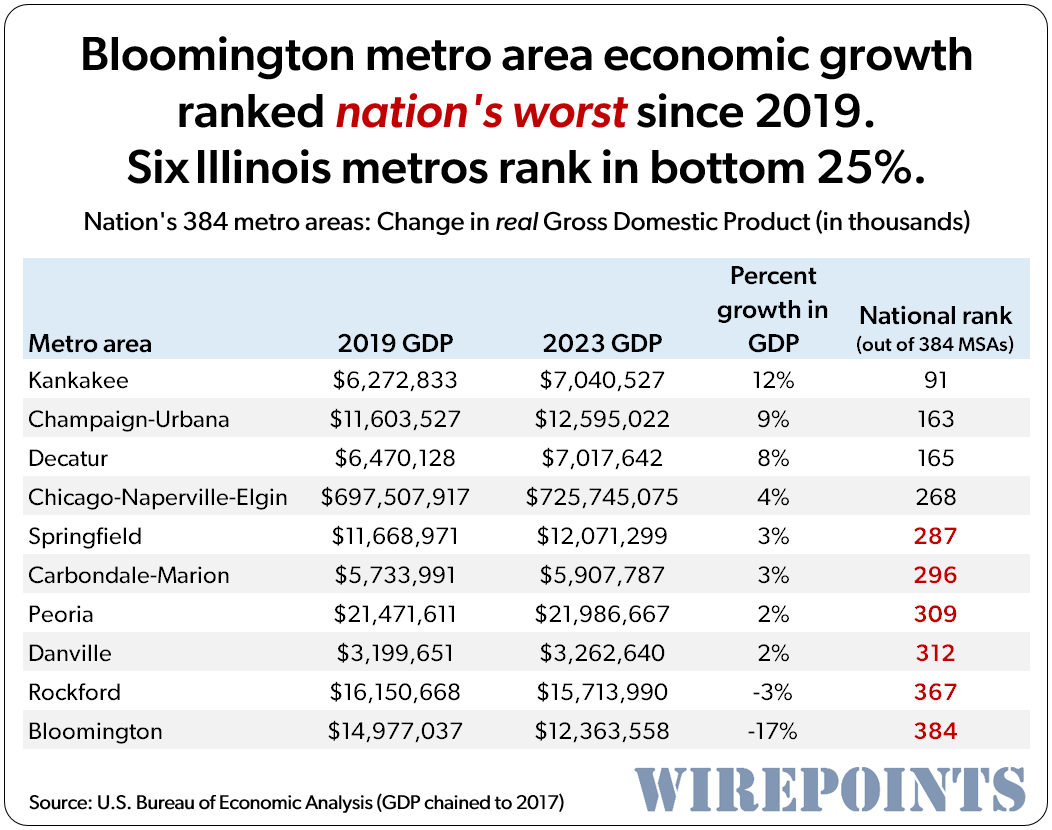
The Danville, Peoria, Carbondale and Springfield area economies have also stagnated, growing just 2% to 3% in total since 2019. By comparison, the national average across the nation’s 384 metro areas was 10%. The metro areas we’ve mentioned so far are all in the bottom 25% among metro areas nationwide.
The Chicago area isn’t much better, growing by just 4% since 2019. Illinois’ “economic engine” is ranked just 268th out of the 384 metro areas. It’s also the slowest growing among the nation’s 15 largest metros.

Only the Kankakee area managed to break the top 100 metros in terms of GDP growth, up 12% over the period. That’s likely due to the area’s strategic location along I-57; it’s a growing hub for warehousing, logistics and distribution in the online era.
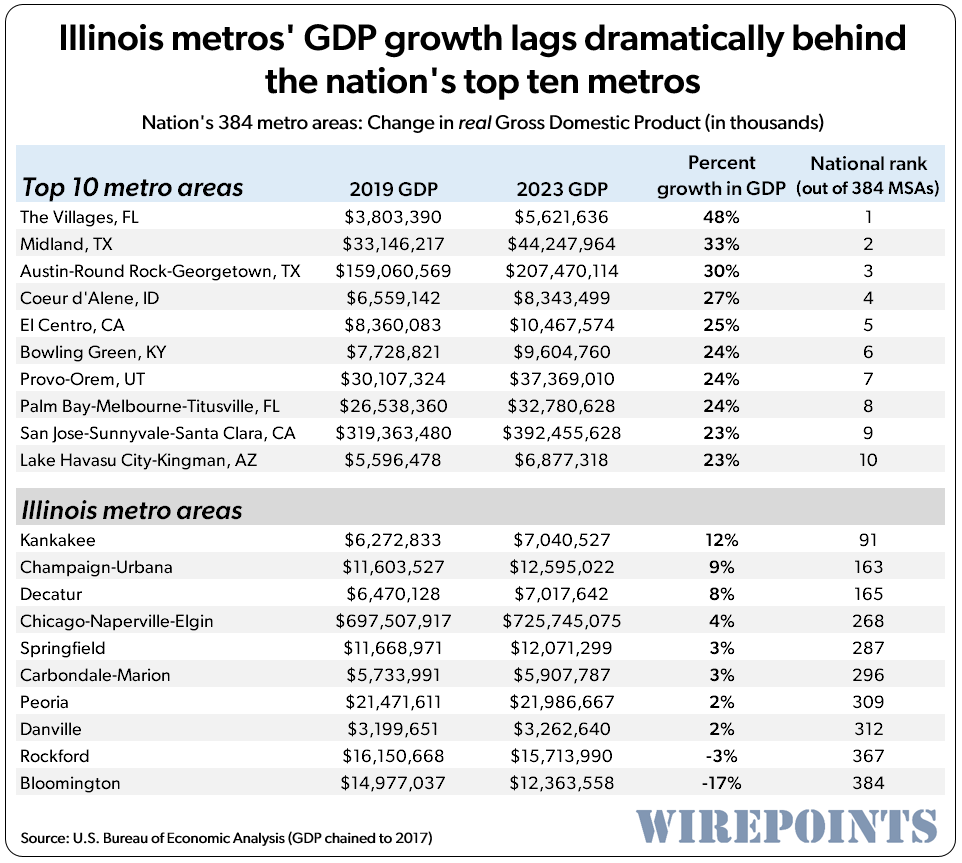
In contrast, the nation’s biggest metro winners are all areas experiencing a massive growth in either people, businesses and/or tech/energy. The Villages in Florida grew nearly 50% over the period. Midland, Texas’ economy grew by 33%. Other notable places include metros in Idaho, Kentucky, California and Utah.
*************
After securing safety for residents, the core need for a community is to have an economic environment where individuals and families can thrive.
Illinois’ state and local policies – from high taxes to overwhelming pension debts to strangling union powers to persistent overspending – have ruined that for Illinoisans. Overall, Illinois’ economic growth has ranked 4th-worst nationally over the last six years.
If those failed policies aren’t overturned soon, look for companies to not only continue their expansions elsewhere, but to leave entirely.
Read more from Wirepoints:
- Tax cuts, Gov. Pritzker?
- Wondering how Illinois’ projected $3.2 billion budget deficit disappeared?
- Beyond the Nazi accusations. What you should know about Gov. Pritzker’s budget address
- One big reason your Illinois property taxes are so high. And why you should get a big refund.
- Illinois shouldn’t dismiss Indiana’s overture to snap up “separatist” downstate counties
Appendix.

 Expect no retraction or apology. This what they do.
 The state’s existing buyout program for its own pensions is the precedent for Chicago, which should be a warning: Look out for similar exaggerated claims and shoddy analysis.
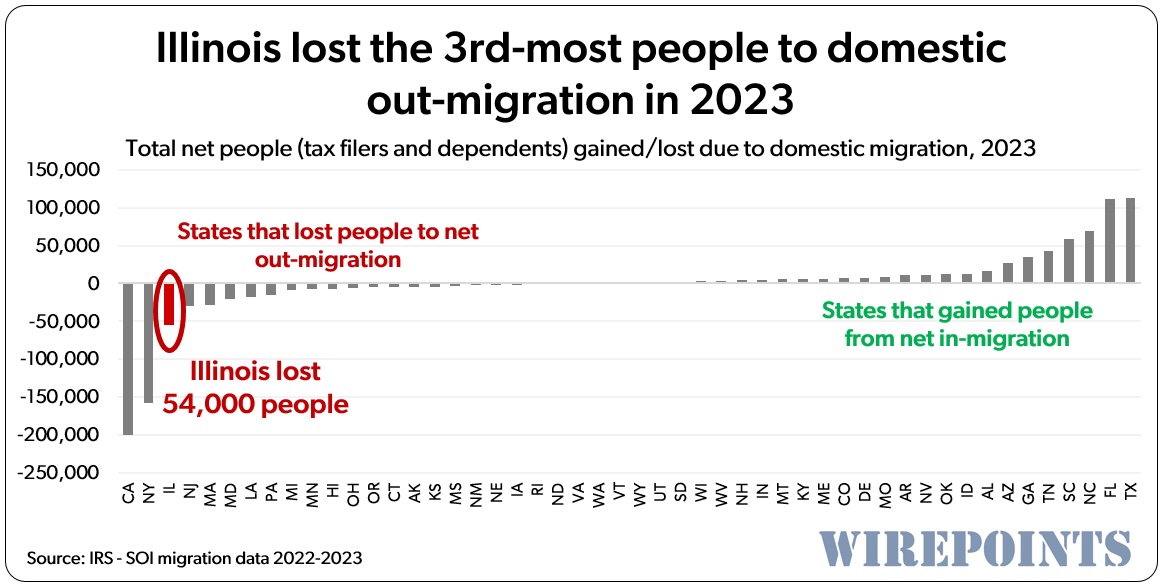 Illinois lost another 54,000 tax filers and dependents, net, according to the IRS. Since 2000, fleeing taxpayers have taken $94 billion of annual adjusted gross income with them.
The guy says it like it is.
Outstanding research by Wirepoints! Wow. Illinois is just in a death spiral. In a debate, I would love to see JB address this story.
Indiana posted a 15% increase. Most could be attributed to outmigration from Illinois. I know the Indy area is growing but so is Lake/Portage County in Indiana.
Why is there no statistical information on Aurora Il, it is the second largest cityin the state ?
It’s part of the Chicago MSA.
If I were younger I’d move my company to another state, Indiana would be easy and reconstitute my work in a climate that enjoys business and doesn’t persecute it.
2019 to 2023 are basically the COVID years. Where would Chicago/Illinois GDP be without all that ARPA-COVID fed funding? Ditto for all the other cities & states nationally?
Central Illinois has effectively been in economic depression for decades – no elected Democrat locally or at the state level seems to care much as their behavoir hasn’t changed one bit. Many small companies have been hanging on by fighting for the crumbs of low bid government and quasi-government (like healthcare) projects – the private investment here is meager. And it shows. Do not see anything that suggests the current negative trends will change. If your goal is prosperity, you must leave.
Totally true. Other than the perverse grip the universities have on communities both in government and construction related growth we’ve not really had decent business minded leaders in Illinois for the last 100 years. Everyone likes to take from Illinois. No one builds or puts back.
A very simple and effective acid test for the Democrats was the incredibly meager ‘Invest in Kids Act’ renewal, which was 100% funded with tax credits on private donations. They couldn’t even muster up the ‘courage’ to do that – no way to go against their preferred status quo. How can you expect Democrat cowards to improve a private economy? They can’t, and they won’t.
Remember employers look at the skill set i.e. education of the labor pool. If only 5% of the graduates from high school can read at grade level that’s not much incentive to relocate to IL.