
By: Ted Dabrowski and John Klingner
Mayors and managers in Illinois towns and cities have long complained about what’s not well understood by most Illinoisans: officials have little control over their budgets because of the many unfunded mandates imposed by the state. Most of their budgets are on automatic pilot thanks to Springfield, and that’s pushing Illinois communities toward a fiscal cliff.
Now they face another threat from the state.
The state is angling to swipe $150 million in funds from state tax revenue that has been traditionally shared with municipalities. That’s sparked a strong pushback from local officials. As reported by Crain’s, “mayors representing hundreds of municipalities in metropolitan Chicago today launched a campaign to get lawmakers to stop dipping into the share of state income tax receipts meant for cities and villages…”

The mayors are right. The money at issue is the Local Government Distributive Fund, or “LGDF” that’s often served as a political football. This time, Pritzker is using it as a bargaining chip against local governments in an attempt to force a statewide tax increase under the guise of “closing loopholes.” The governor’s office says the taxes will help city budgets and that local governments will come out ahead, on net, if officials back his proposal.
But if Pritzker were really serious about helping Illinois towns and cities, he wouldn’t be threatening to take funding from local governments at all. He would be focused, instead, on eliminating the state’s costly unfunded mandates.
Handcuffed by state mandates
Pritzker plans to shore up the state’s 2022 budget by taking $150 million, or 10 percent, from the $1.5 billion-plus local governments expect next year from the Local Government Distributive Fund.
“The math doesn’t add up with this.” Highland Park Mayor Nancy Rotering told Wirepoints. “We’ve cut what we’ve needed to, we’ve continued to balance our budgets. That should not be an opportunity to find more money off the backs of Illinois municipalities.”
Local governments are soaked two ways by the state. Not only do communities often lose out on LGDF money, but many of the costs they deal with are foisted upon them by state laws.
Today, mayors and city councils are handcuffed by the one-size-fits-all mandates that make the term “local control” a fantasy in Illinois. Pension rules are set entirely by the state, and so are collective bargaining laws. Other costs like prevailing wages and workers’ comp laws are also controlled by the state legislature.
Take collective bargaining laws. Illinois has some of the most union-friendly labor laws in the nation. Cities are forced to negotiate with their local public sector unions – collective bargaining is compulsory in Illinois – whereas that’s not the case in our neighboring states. Far more items are subject to collective bargaining in Illinois, too. Only Kentucky is as broad with its negotiation items.
And when it comes to resolving differences, Illinois favors its government unions far more than its neighbors do. Teachers and other workers can strike in Illinois, while public safety workers can demand binding arbitration. In the other states, strikes are prohibited, while only two require arbitration for police and fire disputes.
 Those union powers contribute to why Illinoisans pay the highest property taxes in the country.
And then there are pensions. For decades, it’s been a bipartisan effort to dole out ever-increasing benefits to government workers, never mind whether city residents could ever afford the increases. Improved benefit formulas. Three percent compounded colas. Retirement in their 50s for Tier 1 workers, often with full benefits. City officials had no say in those increases, they just had to make their residents shoulder the costs.
In 2017, Danville’s then-mayor David Eisenhauer described to Wirepoints why Illinois cities are in such a mess. “When we say pensions are impactful, they’re not just impactful because they cost us more and it costs the taxpayer more, but we also have to divert so much of our financial resources to that problem…My level of frustration is we’ve not been able to grow because we’re putting so much resources into pensions.”
Danville’s pension numbers bear that out. Despite a tripling of taxpayer contributions to public safety pensions since 2005, the total shortfall in the city’s police and firefighter plans has more than doubled since then. Even worse, retirement security for those workers has collapsed as the combined funded ratio for those plans is now just barely 20 percent. The plans are effectively insolvent.
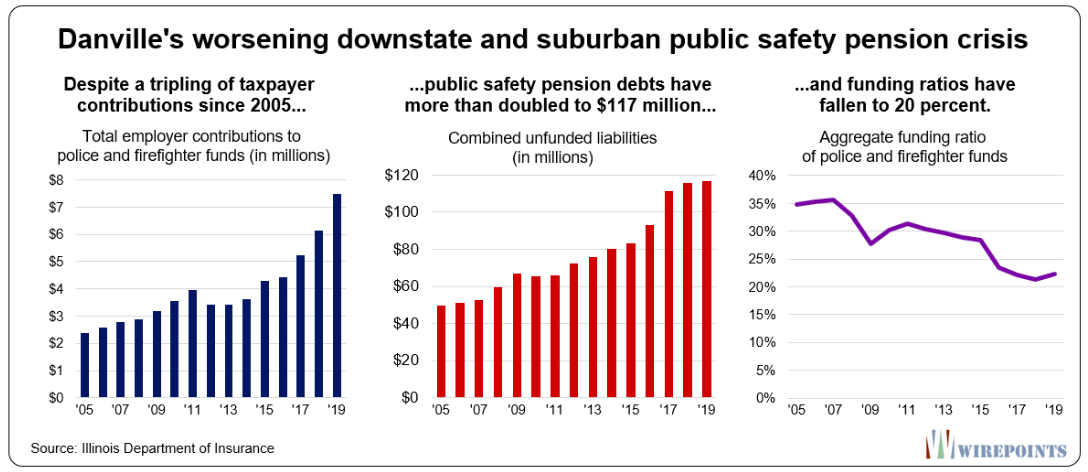 Controlling local costs becomes even more difficult when pension laws overlap with collective bargaining laws. Here’s how Eisenhauer described his limited power:
Of the five major components that impact an employee pension – (1) the number of actives, (2) the number of inactives and beneficiaries, (3) salaries, (4) rate of returns and (5) benefit levels – Eisenhauer argued he had control over maybe just one: the number of active workers employed by the city.
But even then, minimum-manning laws for firefighters prevented the mayor from having full control over headcounts.
Of the other four, binding arbitration overrode his control over salaries. He had zero control over the funds’ investment rates of return. He had little-to-no influence over the number of inactives and beneficiaries in the pension funds. And in the end, state lawmakers set workers’ pension benefit levels, not the city council.
Illinois’ cities are being damaged, in large part due to state mandates. Pritzker and the legislature can continue to ignore that fact, but it’s only a matter of time before Illinois’ broken math makes the roll back of those costly state mandates inevitable.
“There are a number of unfunded mandates that really need to be addressed.” Highland Park’s Nancy Rotering told us. “We can’t keep assuming that municipalities can continue to tax their residents. We all serve the same constituencies, and everybody’s hurting.”
Read more about Illinois cities and Springfield’s neglect:
 Audio and summary
  If this bill passes, say goodbye to local control over all Illinois parks and expect to see open drug and alcohol use, needles, no sanitation and fire hazards, but no ordinary park users.
I think all municipalities should lay off 100% of their workforce, then hire a 3rd party to do those jobs. Whoever hires those employees can set the wages & benefits, including pensions, if at all. The taxpayers simply canNOT afford to do the same thing yearly as the state & municipalities are broke, bankrupt, tapped out. IL gets what it deserves based upon how it votes. Shame on the people! And teachers, teachers’ unions, CTU, CPS, Mayor Lightfoot, shame on them as they are NEVER out for the children, only themselves. If their lips are moving, they’re lying.
Should I suppose, then, you and yours are doing your work because it serves humanity for its benefit rather than being in it for more personal reasons such as your own monetary benefit? I don’t think so, and “If their lips are moving, they’re lying.” In short, you are criticizing others for traits that are not theirs alone but are universally human traits.
You’re a teacher, right? People do go into teaching for altruistic reasons & getting $100k/year from CPS is not one of the reasons. I expressly didn’t go into teaching as I wanted to earn what I produced, which is not how teachers are paid & shouldn’t be. Thieves is what they are in Chiraq.
Sure, people do any given career for various reason, and we can agree that some make their choice for altruistic reasons. But, surely you’d agree that people also make such choices for more personal reasons as well. People are free to choose or reject employment based upon a myriad of reasons, and long may it be so!
James is right. People do behave for their own economic benefit…except when forced not to do so as in Illinois. Illinois Political class has a unique set of privileges not available to most Illinois taxpayers and workers.
But one way people might behave to their own (survival level) economic benefit in Illinois is to refuse to serve Illinois political class who receive specific unique privileges under Illinois law (it goes without saying, only to the extent allowed by law).
Replace them with cheap foreign workers OR just outsource the work to Asia or Mexico like the government does to us. After all cheaper is better
Mayors were all for higher taxes when they got a cut of the action via revenue sharing, grants so on and so forth to fund assorted vote buying schemes. Now when they can’t get the goodies that are taken from the workers via taxes they get upset. Cry me a river…
Back to pensions again. I feel like I’ve written ad nauseum about public employee unions and their power. We all know what the problem is. But I always ask: “why am I responsible for the retirement of these people, when I can’t even fund my own?” Pensions were originally put in place as a tradeoff for government employees not making nearly as much money as the private sector. I get that, and for what teachers used to be paid, I wholeheartedly agree. But now, public employees make far more than their private sector counterparts, work less hours, have far greater… Read more »
Very well put, to fight or flee that is the magic question is it better elsewhere maybe so I’m 63 retired (not public sector) private, built my home 20 years ago my 3 kids long gone just me and the wife we argue about this almost weekly, and yes it would be hard to start over since everything is to are ways starting over could be a real rough road. Share one thing I don’t know we’re you reside in Illinois if at all but my current property tax bill is 7,623.45 just went up again this has tipped the… Read more »
Look out IE, Pensions Paid First is walking up your driveway with his hand out!
Thanks for a good laugh
I will keep my eye peeled for a “robust” looking government employee with a clipboard and a bad haircut. Although the Cadillac double-parked might give it away before I even see him.
(we have to be allowed to have a little fun here)
Even though I could still afford the Illinois taxes, I left anyway. For me the move was largely based on my core beliefs. In Illinois my taxes were supporting corruption and a liberal (or socialist) agenda which I couldn’t stomach. You mention in your comment, “the question is to fight or flee”. I think the best way to fight is to flee. There is no meaningful organized opposition to the Dems. The GOP is a joke in Illinois. Wirepoints has made little if any difference in effecting change. What chance do you have?
OK so don’t bite my head off here, but once you get out of the Chicago/suburb area into downstate most Illinois teachers are not making a ton of money. The health benefits are also not so great. We pay $15,500 a year for family insurance. The school district only pays $300 a month towards the premium. So for teachers, fireman/paramedics, etc. down here I think the pension is an incentive for them to work those jobs because they know they will get a nice retirement. Plus, I know in our case by the time we pay the health insurance premium,… Read more »
Wages almost anywhere reflect prices in the local economy, and an individual public employee pension is a direct result of one’s wages. Its short-sighted to think pensions for the same type of job should be equal no matter where one chose to work. Sometimes the disparity is great, of course. You can often buy two houses in downstate IL for what it costs to buy a similar one in suburban Chicago. The cost of buying anything using local labor as well as the cost of real estate, its maintenance and the taxes due on it each year are likely the… Read more »
I’m not going to bite your head off at all. I appreciate your thoughtful response. It is proof that as much as we see the problems up north, there are much different situations in central and southern Illinois. I would also bet that many teachers and people in rural areas of Illinois are not hell bent on using my government and tax dollars to implement social justice warfare, destroy the foundation of our country and state, and double dip while preaching (screeching) communism to everyone. I would imagine that people downstate are generally good people who are well adjusted and… Read more »