
By: Ted Dabrowski and John Klingner
Wirepoints is continuously asked by parents and educational groups for long-term student outcome data for their districts and schools. They are looking for trends to understand how badly outcomes have stagnated or worsened.
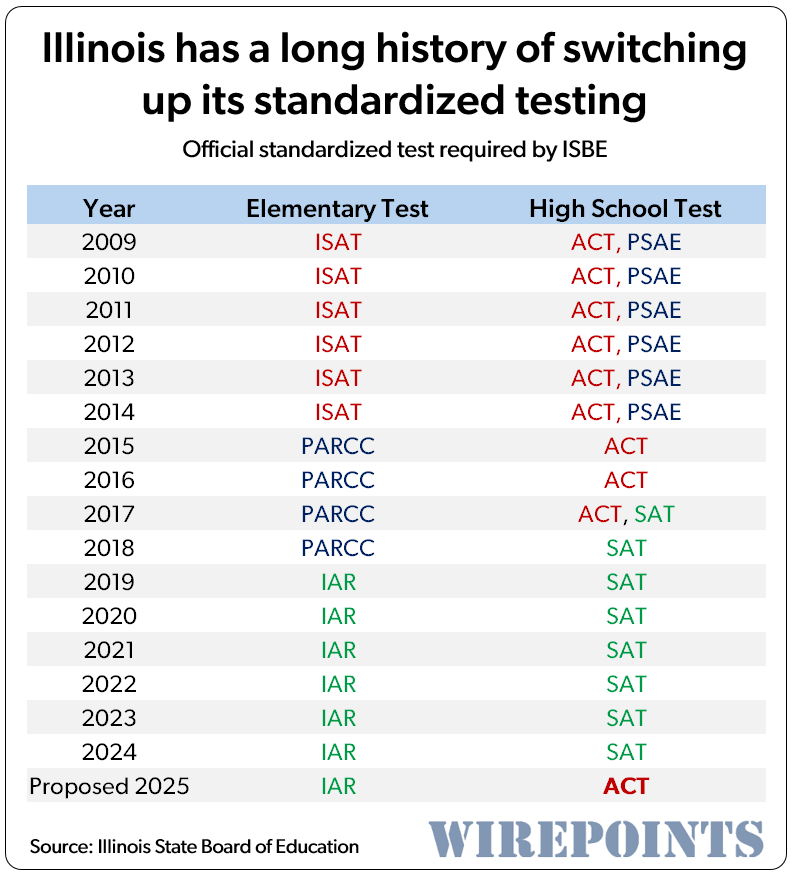
The problem is, we can’t provide good long-term trends. The Illinois State Board of Education has a history of switching up its standardized tests every half-decade or so, making it impossible for us to track long-term outcomes at the school and district level. And national tests, which do provide long-term data, only cover top-level state and Chicago data.
Unsurprisingly, ISBE is about to make another change. They’ve announced a switch to the ACT from the SAT. Whether by chance or design, they’re making it more difficult to hold individual schools and districts accountable. And given the dismal student outcomes and spiking education costs in Illinois, one can’t be blamed for thinking they’re switching it up on purpose.
The ACT was the test of choice from 2009 to 2017. Then ISBE switched to the SAT from 2018 through 2024. Now it’s apparently going to switch back to the ACT.
“Next year, Illinois high school juniors could take the ACT instead of the SAT as the federally-mandated state test. The Illinois State Board of Education has started the process of awarding a three-year, $53 million contract to ACT Inc.
The College Board’s contract to administer the SAT for 11th graders and PSAT for ninth and 10 graders is set to expire June 30.
Illinois education officials are essentially resetting the baseline for student performance by changing the test high schoolers take. Results in 2025 and beyond won’t be directly comparable to the 2017-2024 period because the ACT and SAT are different tests.
Ditto for elementary testing. From 2009-2014 the state used the Illinois Standards Achievement Test (SAT). Then it switched to the Partnership for Assessment of Readiness for College and Careers (PARCC) tests from 2015 through 2018. Since 2019, it’s been the Illinois Assessment of Readiness.
Fortunately, what’s dubbed as the Nation’s Report Card – the National Assessment of Educational Progress – continues to provide evidence of Illinois’ long-term failure to educate students. It provides reading and math scores at both the state level and for Chicago Public Schools.
But the NAEP only provides partial data:
- The test only occurs every two years
- It covers only 4th grade and 8th grade
- It provides only results for the state as a whole and CPS – not any of Illinois’ other 850 districts
Because of that, state testing matters.
**********
Changing tests may not sound like a big deal. But it’s effectively another way for districts to pull the wool over the eyes of parents and avoid accountability. If you want the full story, read here: Poor student achievement and near-zero accountability: An indictment of Illinois’ public education system – A Wirepoints Special Report
Read more from Wirepoints:
- Illinois per student spending jumps to nearly $24K, CPS at nearly $30K.
- Privilege, affinity and equity: How DEI is playing out in Illinois schools
- Illinois lawmakers’ killing of school choice looking more absurd as Alabama, Tennessee, Texas set up choice expansions
- What literacy crisis at Chicago Public Schools? Illinois State Rep. Buckner says he can read ‘very well.’
 Audio and summary
  If this bill passes, say goodbye to local control over all Illinois parks and expect to see open drug and alcohol use, needles, no sanitation and fire hazards, but no ordinary park users.
This is what happens when you have the inmates run the prison
Very reminiscent of the way that the CTU kept changing standards in a desperate attempt to keep children out of classrooms for as long as possible. We’ve all seen this movie before.
Well, of course they do, it is harder to hit a moving target and even more difficult to evaluate. Keep moving the goal post and changing the field markers…no one knows what is happening and that’s why its being done.