
By: Mark Glennon*
This week, Chicagoans will get what the city says is a special chance to invest in their own city, and to do social justice while they are at it.
They’re called Chicago’s Social Bonds, but Chicagoans would be surprised if they understood how these bonds really work: Part of their city’s future — its future sales tax revenue — was already sold off by the city. The bonds will offer Chicagoans a chance to claw back a tiny part of what was sold, provided they will lend money to the city.
I’ll try to explain in plain language below how the that works. Criticism and some snark are unavoidable, but please understand that nothing is meant to imply whether the bonds are good or bad investments. That’s a different matter, and my criticisms do not mean the bonds are unsafe. I dislike the bonds for different reasons, namely, how they are structured, which is not in the city’s long term interest. And while I don’t like the social justice marketing, that’s for buyers to judge.
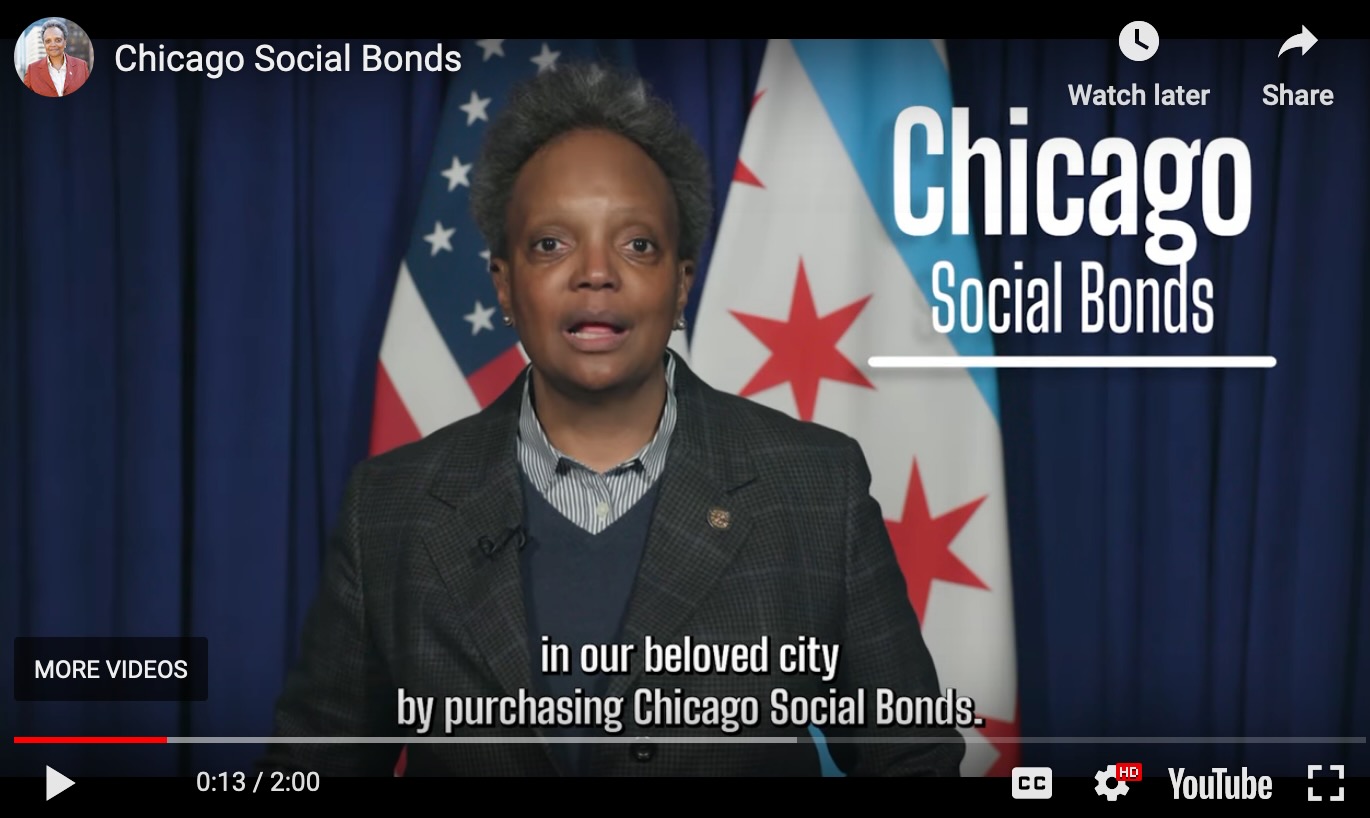
Mayor Lori Lightfoot personally kicked off a media campaign last week to sell the bonds, which includes radio spots, a city webpage and her video linked here.
It’s “your opportunity to fight climate change, create affordable housing and strengthen our neighborhoods,” says the website.
The initial batch of Social Bonds are being offered to residents and individual investors “before large banks and institutional investors have a chance to purchase” through January 18. About $150 million of the Social Justice Bonds are to be sold.
How the bond structure works:
To understand how these bonds work, you must first know that the city already transferred full ownership of current and future sales tax revenue to a specially created, separate entity called the Sales Tax Securitization Corporation. It’s that corporation that is actually selling the bonds, though the proceeds are for the city to use.
Why did the city do that? To create a form of super-duper mortgage on sales tax revenue to secure repayment of certain bonds, including the new Social Bonds – a mortgage that hopefully will be bulletproof even if Chicago goes bankrupt.
Lightfoot says it was done to lower the city’s interest cost. That’s true, but it’s because lower rates are accomplished by creating what’s known in the industry as a “bankruptcy-remote entity,” like Chicago’s issuer. It was lenders’ fear of city bankruptcy that mattered.
We’ve long criticized that form of borrowing, as in the articles linked below. It’s like selling off body parts to pay current bills. It means the city has hocked not just its current assets but its future revenue to keep new lenders happy. Legislation authorizing Chicago and other municipalities to engage in this kind of borrowing was slipped through the Illinois General Assembly in 2017 in a particularly sleazy way.
Bloomberg echoed our criticisms in a 2017 column headlined “Bondholders Fret as Alchemy Turns Chicago’s Junk to Gold.”
Now Chicagoans are being offered a chance to share in the proceeds of that alchemy. Their future sales tax payments were mortgaged off, but they will get a bit of the benefit, as long as they’ll lend the city some money. That’s the essence of how the Social Bonds are structured.
Equity and social justice:
What makes the bonds “equitable, transformational investments” that will “produce positive social outcomes,” as the city says?
Here’s where the money will go: Construction of more than 2,000 units of affordable housing; emergency shelter for the homeless; cleanup and sale of more than 5,000 vacant city lots; planting of 15,000 trees citywide; and replacing nearly 200 of the city’s gas-powered vehicles with electric vehicles and charging stations.
But hold on. Such things are already at the center of everything the city is doing, as Lightfoot has often said. The city’s budget is a means to put “equity and inclusion at the center of all our work,” she said in a budget address. Her bigger agenda, she said, is to right the “historic wrongs” of systemic racism, which she says is “intentional and must be changed,” to address the fault lines that date “back to our earliest days as a union.” The city has already been spending heavily on affordable housing, vacant lot programs, vehicle electrification and the like. Lightfoot’s “tree equity” program was announced long go, not contingent on any bond sale.
Furthermore, all money is fungible. The bond proceeds, like most city revenue, effectively go into one pot, so pretending that some source is earmarked for a particular purpose is artificial.
The bond documents nevertheless go to great length to make the “social” designation look scientific and empirical. They include a special opinion letter supposedly validating the social bond designation. It’s issued by a firm called Kestral Verifiers (POS, page 199) that apparently has a regular racket providing such designations.
Their opinion includes material like this about compliance with “UN SDGs,” which are the United Nations’ social development goals. Decide for yourself if this is science or snow job:
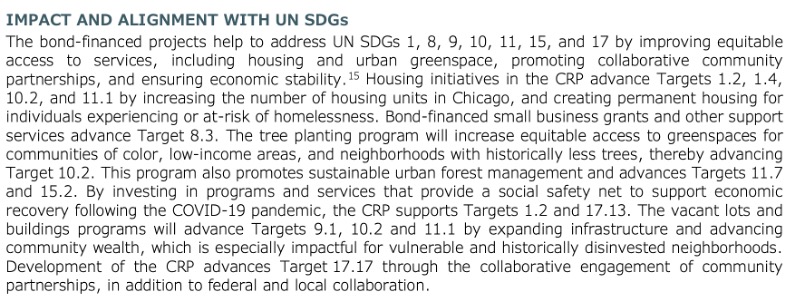
Reporting on city compliance with all that is voluntary, as the opinion points out, and we don’t yet know how much Kestrel is getting paid.
Social bonds are part of what’s commonly called ESG (environmental, social, governance) investing, against which a major backlash is underway, as we wrote earlier. It’s “a concept that was born in sanctimony, nurtured with hypocrisy, and sold with sophistry all the way,” as a critic we agree with put it, Prof. Aswath Damodaran at New York University’s Stern School of Business.
But that’s a matter to be left to investors to judge. Let them decide. For that reason, it’s perhaps okay that part of Chicago’s borrowing be labeled as Social Bonds. ESG remains popular in a large part of the investment world and much of the city’s money is indeed going to its view of social justice.
Some of us view it as a marketing gimmick, but if it makes people feel good about where their money is going, hurray, let’s hope it works for the city.
In fact, if it makes investors feel good, wouldn’t yard signs make a sensible addition to the city’s marketing campaign? “I bought Chicago Social Bonds,” the signs should proudly announce. Every buyer should get one. They’d blend nicely with other yard signs that I suspect are popular with likely buyers.
Bond critics might also say that Lightfoot’s ads look more like campaign spots for the February 28 mayoral election, paid at city expense.
Anybody interested in buying Chicago’s social bonds should contact their broker and investment advisor and review the POS (which stands for preliminary offering statement, not what you were thinking) and its supplement, both of which are linked on the city’s site.
*Mark Glennon is founder of Wirepoints
This column was updated to correct the definition of ESG from equity, social and governance to environmental, social and governance.
Earlier pertinent articles from Wirepoints:
- City of Chicago 2022 budget up nearly 60 percent over pre-COVID 2019 as Lightfoot set to implement ‘equity’ agenda
- Woke Capitalism Or Smart Marketing? Chicago To Issue ESG Bonds.
- Backlash Against ESG Investment Of Taxpayer Money Grows, But Illinois And Chicago Carry On
- Outrageous Giveaway to Muni Bond Buyers Hidden in Massive Budget Bill
- Bloomberg article echoes our warnings about Chicago’s cash-for-body-parts financing
- Illinois Bill to Prioritize Bondholders Over the Public Must Be Stopped
 A mess of uncertainty and litigation is sure to follow.
 With $162 billion more from taxpayers, couldn’t you deliver a few bond upgrades, too
The bonds will be issued in the form of crypto.
In response, we issued the first-ever social bond by a foundation to ensure organizations could not only carry on their important work but also their invaluable . https://realestatebees.com/profile/psg-lending/
Bankruptcy is an excellent option for Chicago. Not under the current administration but under competent leadership and it really may be the only answer. Casinos, taxes upon taxes, endless waste (Red Line to Roseland) and of course a great deal of corruption. What could possibly go wrong? 🤣 This nonsense gives you a peek behind the curtain, its a joke to even think that Chicago is remotely on solid financial footing. The business community will be leaving and they will do it quietly. They may move outside of Cook or over the border to a more competitive state. This was… Read more »
Everything the Dems do or propose is a secret! Hmmm Wonder Why? Lori’s always got secret plans that are working just fine and exceeding expectations. Asking questions or anything beyond blind acceptance is considered implicit racism; whatever that is.
Taxpayers should learn about ‘workarounds’ of Statutory public debt limits (13.8% of EAV for schools) for capital spending…this is just for buildings and is not including or addressing pension and OPEB obligatory debt.
Was going through old files, discovered that in 2015 Illinois property taxpayer was in debt $10,000 per pupil. What might that amount be now?
https://www.chicagotribune.com/news/breaking/ct-illinois-school-debt-met-20160416-story.html
(Workarounds of the law ( law requiring referendums for increased public debt, or limiting debt-as-percentage-of-property-value) include Capital Appreciation Bonds (CABs) and enabling a for-profit entity to build a new school building and lease it back at huge private-profit).
I would ask each of the mayoral candidates how much they have personally invested in this scheme, er, program.
What are the bonds’ coupons? I couldn’t find any information on these. 10% or more?
Luckily, my broker, Schwab/TD Ameritrade wasn’t in the brokers list.
It’s a secret – didn’t read the full 254 pages, so it might be there … somewhere … but I didn’t happen upon it with my quick review.
Decided long ago to avoid government investment opportunities in Illinois – paying my taxes is enough of an ‘investment.’
emma.msrb.org is the municipal bond look-up website. you can find bonds by district, or CUSIP number
Yeah that would be key! Lol. Bait n switch probably.
Stew, the pricing of the bonds was not yet firmly set at the time this was written, but that should be available very soon, if not already.
More incompetent and corrupt actions by Il politicians. Unless they-we attack public union Tier 1 pensions, and Il’s rampant political corruption, and Il political incompetence, they have done nothing.
They won’t even talk about tier 1 pensions. On top of that, they supported another constitutional provision (Amendment 1) to protect those benefits and anything else the public unions want.
Continued selling out of Il non public union law abiding tax payers continue to be the path of least resistance to Il pols. We need to change that calculus.
Due to supply chain issues, buy now; avoid future regret and disappointment. Will the governor peddle these when he goes to Davos? Why isn’t Lori going?
Didn’t Johnny Rogers advise CTU pension fund to load up on Chicago ‘Social Bonds’ now that they’re divested from fossil fuel??
Biden is vomiting all over himself! Lori will not be out done. These are the golden years of political comedy. Don get mad, just enjoy the irony!. Garland wonders.? Wtf is next? Buggery!
I imagine Chicago Social Bonds are a lot like Green Bay Packer stock – you earn nothing, your vote gets you nothing, and the benefactor gets all the benefits. Lightweight should at least send you one of those yard signs or a little plastic city flag you can tape to your front window.
Let’s not forget the CPAs, bond lawyers, consultants, rating agencies who will take a large slice off the top before the city gets the money. Then the city and its bureaucrats will consume most of the bond proceeds by hiring family and cronies to oversee the distribution of funds to the beneficiaries. Calling this “pork” is an insult to boars, sows and butchers.
The Chitty of Chicago Bonds are nothing but Schmitt.
DO NOT PUT YOUR HARD-EARNED MONEY IN THIS BOND.
Let the Cops, Teachers, and Firemen pension funds buy them.
Spot on. When NYC went bankrupt in the 70s NYC pension funds were backed by NYC bonds!
How is cities credit rating effected by selling (sugar coated esg bs bonds) debt thru Sales Tax Securitization Corporation?
Where were these social justice warriors when trees were destroyed in Jackson Park? In spite of Obama’s promise they wouldn’t be. But, then again, he stated quite specifically: “If you like your doctor you can keep your doctor,” too. That didn’t work out so well either. https://southsideweekly.com/remembering-the-jackson-park-trees-a-photo-essay/ Now they claim these bonds, among other things, will facilitate planting trees? Is that over and above the city’s efforts last year? Yes, trees were planted, but the unplanted (and paid for) inventory is languishing in pots on vacant lots and may or may not survive winter. The whole bond offering is a… Read more »
Forget “social Justice!” I want to see some real Justice!
“””—Kestral Verifiers—“”” (are they like fact checkers?)
Why not use “Zambonis Verifiers”…?
I’ll just hang my shingle to advertise…
I can “verify” with the best of them…
Chicago people have got to be some of the greediest individuals there are as they continue to demand services and programs that the City can not afford creating the need for silly programs like these. The politicians I assume know the ramifications but rely on the old axiom of knowing they wont be in office when the eventual outcome happens but these moves buy votes; votes that Chicago types apparently love to sell. Greed once again prevails in Chicago Illinois.
The Tribune will buy all available bonds.
Chortle, Clear the streets, blow the sirens. A bourbon induced dream. Next she’ll partner with Cupich to exchange votes for indulgences.