
By: Ted Dabrowski and John Klingner
Illinois’ AFSCME and Gov. J.B. Pritzker recently agreed to a new 4-year contract that will reportedly increase state costs by $625 million over the next four years. The contract guarantees the union’s 35,000 workers raises of at least 19 percent over the four years; provides “paygrade upgrades” for thousands of workers; keeps healthcare costs at a near 20-year low; extends paid parental leave to 12 weeks; relaxes drug testing and disciplinary rules; and more.
All those benefits are on top of constitutionally guaranteed pensions and free retiree health insurance for career state workers.
The contract, outlined in an AFSCME factsheet for its members, is a perfect example of the divide between Illinois’ two-classes of workers: government employees with their guaranteed multi-year benefits vs. ordinary Illinoisans, who get no such guarantees, but are forced to pay for said benefits. It’s one of the reasons why Illinois is facing so many challenges.
Based on the union’s factsheet, here are the contract details we know so far:
Pay and salaries
- Workers will get five separate automatic raises, starting with a 4 percent retroactive increase for July, 2023, with the total compounded increase equaling 19.3 percent. Keep in mind that’s the bare minimum increase. The “step and lane” structure of the AFSCME contract means all workers will get additional boosts for working each year and some will receive additional longevity/paygrade raises. None of those increases will be due to performance or merit.
- Workers will also receive a $1,200 bonus stipend in 2023.
- The contract calls for “thousands” of workers to receive additional and immediate paygrade increases, in some cases up to two or more. Those paygrade jumps represent raises worth thousands of dollars.
 Health benefits
- Workers’ out-of-pocket maximum for health insurance will not increase during the contract.
- Workers will not pay more for health insurance in 2023, and out-of-pocket increases in the following years will be “limited.”
- Premiums will grow by $10 a year or less during the contract.
- State retirees over 65 on Medicare advantage will have no cost increases at all.
Other provisions
- Paid parental leave for workers will be extended to 12 weeks.
- Workers in DHS will finally have their covid vaccine mandate lifted.
- Workers in agencies where the vaccine mandate has been lifted will have any “mandate-related discipline” expunged from their records.
- The state will “cease random drug testing for THC except as required by law” and detection of “legal substances” shall only be cause for discipline under certain circumstances.
The class divide
Usually, we’d largely ignore the commentary in a document like this – it’s essentially a marketing document to union members, after all – but the union’s language on health benefits is particularly telling.
“The Employer’s initial proposal on health insurance sought large increases in employee premiums as well as alarmingly high increases in the out-of-pocket maximums that could have left employees in financial ruin. Virtually every employee would have had to pay thousands more in healthcare related expenses over the term of the agreement.”
Does AFSCME’s leadership really expect people to believe that some additional health cost increases would impose “financial ruin” on state workers?
The most-recent AFSCME health insurance cost data Wirepoints has dates back to before the previous contract – but it’s still useful as a look into just how much taxpayers subsidize state worker health care. Back then, AFSCME members were only required to pay 23 percent of their total healthcare costs – around $4,500 a year. Taxpayers were stuck paying the other 77 percent – nearly $15,000 for every worker. Nothing in AFSCME or Gov. Pritzker’s language regarding health costs says that subsidy is any less generous today.
On the contrary, the union brags that healthcare costs for members “are amongst the lowest when compared to other settlements within the last 20 years.”
The union document also cries poor regarding salaries, complaining “employees have had to cope with a very volatile economy which has created considerable challenges for family budgets.” The economic turmoil is true – and was suffered by both the public and private sector alike. But only government workers received guaranteed multi-year raises regardless of that turmoil – raises that buttressed their already-generous salaries.
Illinois state workers – comprising varied administrators, university employees and union workers, including those in AFSCME – received the 9th-highest average salary of any state worker in 2021: $66,000, after adjusting for cost-of-living, according to the Bureau of Economic Analysis. Illinois state worker salaries have consistently ranked among the nation’s top ten since at least 2015.
 Contrast that with the private sector, where only now are wages finally starting to catch up with inflation. As reported in the WSJ, “While improved for the past two years, inflation-adjusted wage growth remains below the trend in the five years before the pandemic.”
********
Unfortunately, it’s impossible for us to calculate just how well-compensated AFSCME workers are today. The current administration is not nearly as transparent about state worker costs as the previous one. But what we do know comes from our previous in-depth analysis of state worker costs: Six facts Pritzker can’t ignore when negotiating AFSCME’s contract.
On top of the nationally-outlying salaries and health benefits described above, there are also retirement benefits to include. Average lifetime pension benefits for career state workers total about $1.8 million with Social Security benefits on top of that. And the free retiree health benefits for career workers are worth some $200,000 to $500,000 in present value terms, depending on tier and age.
That resulted in an average all-in cost for an AFSCME worker in 2016 at about $110,000 a year (Again, including salaries, overtime, healthcare, and pension and retiree health insurance normal costs.)
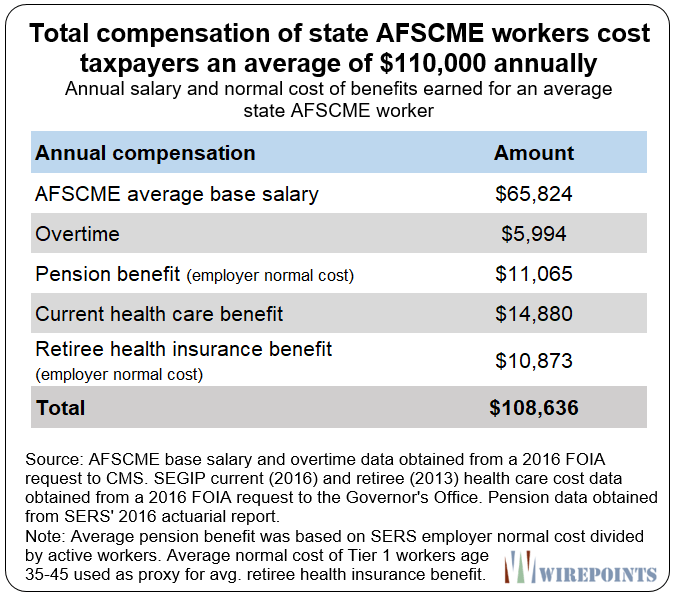 We’ll update what we know if and when we receive more details via FOIA. But suffice it to say that Illinois will never be fixed as long as the divide between Illinois’ two classes of workers continues to grow. Which is something this contract definitely does.
Read more from Wirepoints:
 Audio and summary
  If this bill passes, say goodbye to local control over all Illinois parks and expect to see open drug and alcohol use, needles, no sanitation and fire hazards, but no ordinary park users.
Here y’all Republicans go again. The cost of living has gone up, way up! And yes state employees are paid a lot! But dang, why shouldn’t those workers be compensated accordingly. No one lives in a cave or in a commune. So, please stop your assault on unions and how much it’s costing the state because the Republicans alternative is NOT to have unions which created the middle class.
AFSCME are the second rank of Illinois vermin right after the grifters at CTU. Bust these unions now.
I’d like to remind those of you who read this that over the last 8 years, while inflation went up 28% according to https://www.in2013dollars.com/us/inflation/2014?amount=1, AFSCME represented state workers received a whopping 1.4% raise per year. The average rate of inflation was 2.86%. State workers lost a ton of purchasing power because the last contract had an 11.5% pay increase for the span of the contract, and the first four years were the Rauner years, who refused to negotiate with AFSCME. This contract that was ratified makes up for what was lost, but doesn’t keep up with inflation. Did I mention… Read more »
and we can’t forget the outstanding heroic bang-up job IDES– AFSCME employees performed during COVID!!! Was anyone ever fired or disciplined??
work.illinois.gov or idoc.illinois.gov Come apply.
I agree with you. We can’t forget the outstanding jobs the heroes at the VA hospitals, correctional facilities, developmentally disabled facilities, and all those who kept the state running during the once-in-a-lifetime pandemic.
A lot of heroics performed in public and private sectors during COVID once-in-a-lifetime pandemic, I’m sure even at IDES. But are you implying that state AFSCME employees are MORE deserving of some kind of COVID heroics compensation pay raise than private sector employees?
I’m not implying AFSCME members are more deserving than private sector employees. But see what happens with a strong union? Workers get the pay they deserve. Why shouldn’t private sector workers get better pay also? It’s ironic. The salary of the office of Governor is $177,412. The average salary for an AFSCME represented state worker in Illinois is $37,186/yr, according to ZipRecruiter. The salary for the Walmart CEO is $24,100,000. The average salary for a Walmart worker is $36,796. See what happens with a strong union? I want the private sector to get the pay they deserve, which they haven’t… Read more »
No but we were understaffed.
Interestingly enough while things were so bad there was not a wholesale resignation from State jobs to work elsewhere during your mentioned time frame. Why is this?
Resignation, maybe not, retirement yes, and it takes about a year for a position to be filled right now. There are 8,000 open positions within state government. Come apply. work.illinois.gov idoc.illinois.gov
Another win for the” Illinois is utopia!” crowd. Another loss for everyone else.
And the other gigantic $payday$ AFSCME- TIER II are going to get is whatever the machine includes in and passes behind closed doors in HB4098 coming up in fall. You can bet it will be more than just meeting “safe harbor” requirements.
If the state doesn’t sweeten the tier 2 benefit, the benefit will not keep pace with social security, required by federal law. Per https://illinoisanswers.org/2023/05/10/a-pension-fix-could-blow-a-hole-in-city-budgets-heres-why-supporters-say-its-worth-it/ workers can sue the state for the difference between their pension benefit and social security.
are you saying any benifits included in HB4098 beyond meeting ‘safe harbor’ requirements are unwarranted? I believe HB4098 is pretty much an open book at this point with taxpayers only finding out what they’ll be on the hook for only until after it’s past as usual.
I’m saying the tier 2 benefit has to be improved because otherwise, the state would be in violation of federal law.
“I’m saying the tier 2 benefit has to be improved because otherwise, the state would be in violation of federal law.” Yep. Everyone was warned about this occurring when the whole crazy “Tier II solves the pension crisis” scheme was working its’ way through toward approval. AFSCME knew what they’d get – what the Dem’s in charge promised they’d do for the Union. They’d get the same pension deal Illinois admitted it couldn’t afford – hence Tier II – for everyone in the end. And ‘backdated’ benefits for this-that-n-the-other thing, and raises, and more paid time off. I worked 40+… Read more »
work.illinois.gov idoc.illinois.gov Come apply.
Read it again sport. Pay attention this time. I was a state employee. For six years. In fact, let’s talk about the god-awful, torturous and tardy Work.Illinois process, I’d be interested in reading what you have to say about it, since we’ve both apparently been through it. Let’s talk about Central Management Services notoriously poor ability to recruit and hire for vacant state jobs. I’ve participated in composing and filing grievances via AFSCME over Illinois’ unwillingness to properly staff state agencies. What I learned is that AFSCME wasn’t really interested in compelling the state to properly staff its offices. Any… Read more »
Answer me a question. Why shouldn’t the private sector get the same or similar benefits state employees get? CEOs make millions of dollars a year, yet their employees live paycheck to paycheck. Yet you blame state workers for that.
Well, how much are you willing to pay for a burger, A? During all the (long) years I spent in hospitality management, I often wished I could charge $20 for a hamburger, or $40 for my Old Country Buffet’s all you can eat (or waste) dinner. Double my employee’s wages, cut my turnover in half. Not have to sit in my restaurants and do what I could to help hard working staff figure out how to decide whether they were going to buy food and clothes for their kids, or put unaffordable gas in their car so they could drive… Read more »
I want to ask you a serious question. Would the cost of a burger increase, regardless of whether or not an employee’s wages increase? Btw, Lee Saunders’ salary is $363,253, which is far less than the CEO of Walmart, McDonald’s and I’d wager all of the Fortune 500 companies CEO salaries. You said Lee Saunders’ salary comes from dues out of my paycheck, which is funded by taxpayers who wished they weren’t taxed so much. Do you know what the biggest spending for Illinois government is? It’s not state employee salaries and benefits. There’s 38,000 of me. There’s 12.7 million… Read more »
Would the cost of a hamburger increase if an employee’s wages were raised. Hmmmm….. Well, in a very meaningful sense, that’s not even a ‘serious’ question. Anyone asking such a question illuminates themselves as having little idea how business works. That said, wages-n-benefits-n-payroll taxes take just over a third of a typical restaurant’s revenue. What you pay to buy the food you sell is just over another third of your sales. If you really pay attention to your vendors. Your building expenses – lease or mortgage, maintenance, utility costs – and your licenses, fees, taxes, liability insurance and marketing –… Read more »
You have it totally backwards: The question should be WHY are state employees receiving more than the private sector? State employees salaries and pensions and health care costs are driving the state into insolvency…
Look what happened to Yellow, the trucking company that paid high wages, pensions and health care costs for its workers….
The union drove Yellow into bankruptcy…Now 30,000+ employees are unemployed…
Because you have it all backwards…
So what you’re saying is that state workers should be paid what the private sector makes. Ok. If that’s the case, should those who are in government make more than $1 million per year? Because What you’re arguing is a ratio of employer to manager payscale so one sided, employees have to have more than one job just to make ends meet. You referenced Yellow Trucking and blamed their woes on their Teamsters union. So a truck driver that’s been on the job for more than 10 years is to blame, but the board of directors, which according to https://simplywall.st/stocks/us/transportation/nasdaq-yell/yellow/management… Read more »
The decision Illinois residents face is to ether stay and fight the system or simply move and leave it all behind. There are many reasons to leave, of which the above article is an example, and typically only two reasons to stay, either a good job and/or family ties. Those were also my reasons for staying as long as I did, which I now regret. Staying due to a job is a tough call. You have to calculate the cost of remaining versus the savings of leaving. It’s not too difficult, but I expect it may be beyond the capabilities… Read more »
In this economy the stay for a job excuse doesn’t fly. We have near record low unemployment and widespread worker shortages. Your laziness & inability to look for a different job outside Illinois is 100% your fault.
This isn’t 2009.
Tend to agree Indy, but there are exceptions.
Even if you are a city worker with a residency requirement there are comparable positions in other better run cities.
No one is hiring me. White, male, age 62. Just hoping to hang on to current job for as long as I can
Our three kids – born, raised and educated in IL all left with their spouses and kids in the past few years. The grandkids deserved a better education than offered by Illinois schools and with work from home the new reality, only two of the six parents had to find new positions.
WE encouraged them to leave Illinois… and they did.
Illinois’ loss; neighboring state’s gain.
Glad they escaped. Illinois simply has nothing to offer but misery. Now they can build their future free of socialism.
Democrats using taxpayer dollars to buy votes. What else is new. Get out of Illinois. The state is hopeless and will crumble. Don’t be the last one paying the freight.
One word – RACKET!!
Glad I voted with my feet over 20 years ago.
My bank account is smiling as I figured I’ve saved $200K+ in various taxes since leaving Taxistan.
Collective bargaining by government employees is legalized extortion
I like how Pritzker’s bargaining team opened with health benefits so wretched that everyone cried bloody murder then backed off completely. Psychological torture for no reason. Doubt they’ll remember that during JB’s presidential campaign.
Just posturing for politics’ sake.
AFSCME knew that Pritzker was going to pull some frivolous “lookin’ out for the taxpayer” showmanship, but that in the end they’d get what they wanted.
Knew it like they know that the sun’s going to rise in the East tomorrow.
SEIU has more pull with Pritzker than AFSCME does, and that’s another 30K plus public employee union members involving who-knows-how-many billions of tax dollars.
I’ve noticed a common practice in AFSCME contracts over the years: two increases within the first six months. Why is that?
Sets the baseline higher for the next contract.
We try to do that when we negotiate leases with tenants. The larger increase in the beginning makes all the later increases larger.
Fast forward 10 years and there’ll hardly be a private sector in Illiannoy. Just public employees, illegals and gang bangers. Good luck with that to anybody who didn’t leave.
That’s a depressing scenario you describe. It may be time for another “Escape from …” movie. Let’s see, can we still get Kurt Russell as the action hero in “Escape from Illinois”? He’s 72, but if he were in Congress, he’d be young enough to be the son of a couple Members of Congress.
This remains to be seen. The biggest driver of our regional economy, by far, is the Big 10 to Chicago pipeline of college grads that essentially run the biggest corporations, financial institutions and other most important sectors of our economy. (No, it’s not the illegal Venezuelans). For sure, there are definitely troubling dark clouds on the horizon with the Big 10 pipeline drying up, as other midwestern cities attract up and coming grads. But the pipeline hasn’t dried up completely, as these same people are realizing that housing in the nicer Chicago suburbs are 1/2 to 1/3rd (even with real… Read more »
$987,000 in Denver, CO, a reliably Blue State buys you this, a normal 1979 house:
https://www.redfin.com/CO/Englewood/11293-E-Berry-Dr-80111/home/34858823
A million bucks to live outside of Denver!