
By: Ted Dabrowski and John Klingner
The recent election has ensured that most of Illinois’ failed policies will continue for years to come, whether on education, budgets, taxes, energy or countless other issues.
Illinois’ poor jobs climate is one of those failures.
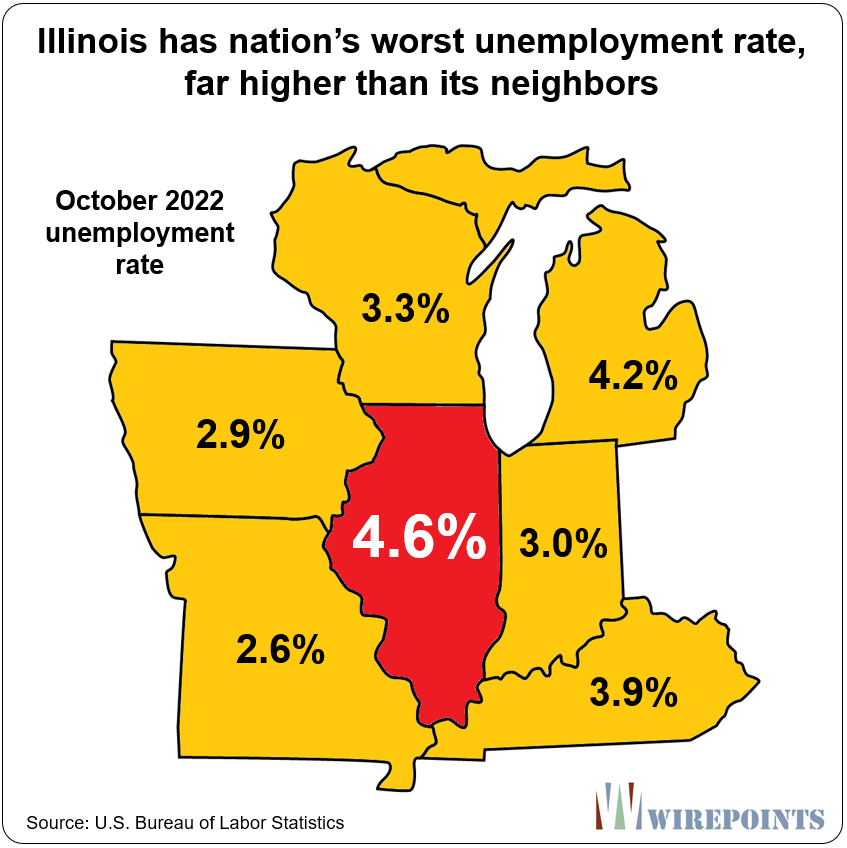
At 4.6 percent in October, no other state has a higher unemployment rate than Illinois, according to the latest U.S. Bureau of Labor Statistics data release. That’s a 0.1 percent increase from September’s 4.5 percent rate.
Illinoisans have long been suffering in one the worst five states for unemployment, but October marks the second month in a row that Illinois has held the nation’s worst jobless rate.
 A jobless rate of 4.6 percent is low compared to Illinois’ historical average – but that doesn’t change the fact that every other state is better than Illinois at keeping their citizens employed.
Nor does it change the fact that Illinoisans are poised to suffer the most during the next economic downturn. Bloomberg says there’s a 100% probability of a recession within the next 12 months and Illinois’ jobs climate remains the worst-positioned to deal with the impact.
All of Illinois’ neighboring states are in far better shape. Their unemployment are significantly below those in Illinois, most notably in Wisconsin, Indiana, Iowa and Missouri, where unemployment rates are 1 to 2 percentage points lower.
 That difference in jobless rates represent a big difference in Illinoisans’ lives. Catching up with states like Missouri would mean 130,000 residents back at work – equivalent to the entire population of Springfield and then some.
Illinois’ worst-in-nation jobs climate isn’t preordained. With its central location, abundant resources and hard-working residents, it should be leading the nation in jobs and growth.
But that’s not going to happen with the current crop of lawmakers that have just been reelected.
They’re unlikely to tackle the many problems that hold back Illinois’s jobs climate: from rising crime to the nation’s biggest pension crisis to the state’s financial problems to public-union dominated labor laws to rampant corruption, and more.
Until those policy failures are finally addressed, expect both businesses and Illinoisans to continue to leave for better prospects. Which, as of September, means every other state in the nation.
Read more from Wirepoints:
- Chicago’s progressive agenda has been destructive for black communities
- A 36th-straight Illinois Covid Emergency Declaration. 979 days under Pritzker’s Executive Orders. Does it even matter?
- 50 years of failure: Norman Lear’s ‘Good Times’ first criticized Chicago’s policy of automatically passing students in 1974. It’s still happening today.
 Audio and summary
  If this bill passes, say goodbye to local control over all Illinois parks and expect to see open drug and alcohol use, needles, no sanitation and fire hazards, but no ordinary park users.
In any given time a 5% unemployment rate is normal, because of people just quitting jobs, changing jobs or simply getting fired. So it’s not useful to talk about rates lower than that.
The surprising thing is it is not higher than that. Illinois is doing its very best to chase away businesses.
Contrary to this article, Illinois does a better than average job at keeping its residents employed. The employment to population ratio (E/P) is the percent of residents who are employed. It is a better measure of employment.
Nationally this ratio was 60.0% in October. It was 61.4% in Illinois, i.e. better than average.
Our neighboring states: Michigan = 57.1%; Wisconsin = 63.1%; Iowa = 65.8%; Missouri = 60.8%; Kentucky = 55.6%; and Indiana = 61.4%. Illinois and Indiana are in the middle of the pack of these states.
Companies want to do business here.
I’m just going to make up some different metric, completely different from the metric economists have used for generations, to explain, ACKSHULLY, it’s not as bad as you think it is…
HAHAHAHAHAA
You cannot use the employment to population ratio without also considering the % of population 65 and older. Florida has one of the worst E/P ratios but it also has one of the highest % of residents 65+. Strangely, WI and IA are also older than IL yet they manage to have much better ratios.
Most employers, especially middle market and small business,view the Chicago area as way too expensive to set up shop; and no offense, but the rest of the state is just a dump because of the anti-business environment arising out of Springfield. Recruitment to areas outside of Chicago is extraordinarily difficult – ask Cat that left Peoria, and ADM left Decatur a decade ago, and so on. Big companies like Google can afford to expand in Chicago because they want access to white collar talent. But outside of a handful of large corporate employers, the job market is Chicago is bleak,… Read more »
Funny how the “most labor-friendly state” can’t get anyone to work.
why work when the never ending jb emergency covid declaration orders–“free stuff” giveaways never end. particularly if your low to moderate income. jb just announced another $1 billion new round of housing “free stuff” giveaway yesterday…..If anything i feel like a chump for not getting my little pile of covid $bucks$, maybe i still gots time
We are already in a recession. Every indicator has been showing that we’ve been in a recession for two quarters. It’s not just the GDP growth, it’s inflation, housing sales, housing prices, retail sales, interest rate inversions, shipping rates, cargo freight, layoffs, payrolls, it’s all been showing mild recession. Then the midterm talking points came out: THIS IS NOT A RECESSION. And the media acted like we’re not in a recession, and every important person in the government began saying WE ARE NOT IN A RECESSION while business leaders from Griffin to Bezos and beyond were publicly and privately saying… Read more »
The National Bureau of Economic Research is the group that determines when we are in recessions. https://www.nber.org/research/business-cycle-dating/business-cycle-dating-procedure-frequently-asked-questions “Q: What indicators does the committee use to determine peak and trough dates? A: The determination of the months of peaks and troughs is based on a range of monthly measures of aggregate real economic activity published by the federal statistical agencies. These include real personal income less transfers (PILT), nonfarm payroll employment, real personal consumption expenditures, wholesale-retail sales adjusted for price changes, employment as measured by the household survey, and industrial production. There is no fixed rule about what measures contribute information… Read more »
Biden says ‘we’re not anywhere near a recession’ right now
https://www.msn.com/en-us/money/markets/biden-says-we-re-not-anywhere-near-a-recession-right-now/ar-AA13VGu6
Nov 9, 2022
U.S. President Joe Biden on Wednesday said he believed the U.S. economy would have a soft landing and avert recession.
Biden told a news conference at the White House that he was also confident his administration could reduce inflation, but could not guarantee it.
Recession another victim of Democrats’ rewriting of the English language When is a recession not a recession? When a Democrat is in the White House, apparently.The traditional rule of thumb for when an economy is in a recession is a decline in gross domestic product for two consecutive quarters — a shrinking economy for half a year. Under previous presidents, that was not a controversial definition. In 2008, Joe Biden’s National Economic Council director, Brian Deese, wrote, “Economists have a technical definition of recession, which is two consecutive quarters of negative growth.” But here’s Deese Wednesday: “Two negative quarters of… Read more »
Elections have consequences. The residents here are going to learn the hard way. Wait until this recession decimates Il finances and the codified Unions demand tax increases to pay for their largesse.
Relatives in Chicago for a wedding recently, who had left many years ago, commented how much more ‘gritty’ Chicago looked. I was somewhat taken aback. But then I remembered – that’s the boiling frog scenario.
The Midwest’s version of Gotham City.