
By: Ted Dabrowski and John Klingner
Illinois’ K-12 school districts are set to receive $5 billion in federal dollars as part of President Biden’s $1.9 trillion American Rescue Plan package. That’s equivalent to a whopping 60 percent of the $8 billion-plus the state appropriated to its classrooms for all of 2019.
Nevertheless, Gov. J.B. Pritzker is ignoring the windfall and wants Illinois taxpayers to put even more money into K-12 education next year. Pritzker recently announced his intention to add $350 million to the state’s 2022 education budget.
That spending increase is part of the “evidence-based” funding formula passed in 2017 by Gov. Bruce Rauner that demands the state spend $350 million more in education each year (for as many years as it takes to add $7.2 billion in total new dollars to the state education budget) regardless of whether taxpayers can afford it or not. The formula also ignores the fact that Illinois already spends 50 percent more than Indiana and 30 percent than Wisconsin on a per student basis when considering all federal, state and local sources.
 The Biden ARP package is the third, and largest, federal stimulus granted so far. In all, Illinois school districts will have received over $7.5 billion in total aid during the pandemic, made up of the following:
- $511 million from the Coronavirus Aid, Relief, and Economic Security Act or, CARES Act
- $2.0 billion from the Coronavirus Response and Relief Supplemental Appropriations Act
- $5.1 billion from the American Rescue Plan Act
Combined, that’s nearly four times the $2.1 billion in federal revenues Illinois districts received from the federal government in 2019. School districts don’t have to spend the money all at once, though. The ARP, which is the bulk of the stimulus money, requires districts spend the funds by September 2024.
 Given the massive windfall in education funds from the feds, Pritzker shouldn’t be increasing the budget for education in 2022.
That’s especially true since the $7.6 billion in federal stimulus is already earmarked for the Illinois school districts most in need. Chalkbeat reports: “Like the prior relief bills, the money is distributed in a way that closely tracks poverty, which will lead to large differences in what school districts get.”
For example, Cairo USD 1, one of the poorest districts in the state, is set to receive more than $7 million from the combined aid packages – or more than $25,000 per student. East St. Louis, another of Illinois’ poorest districts, will get more than $18,800 per student.
On the other end of the list, low-poverty rate Deerfield SD 109 will receive $265 per student.
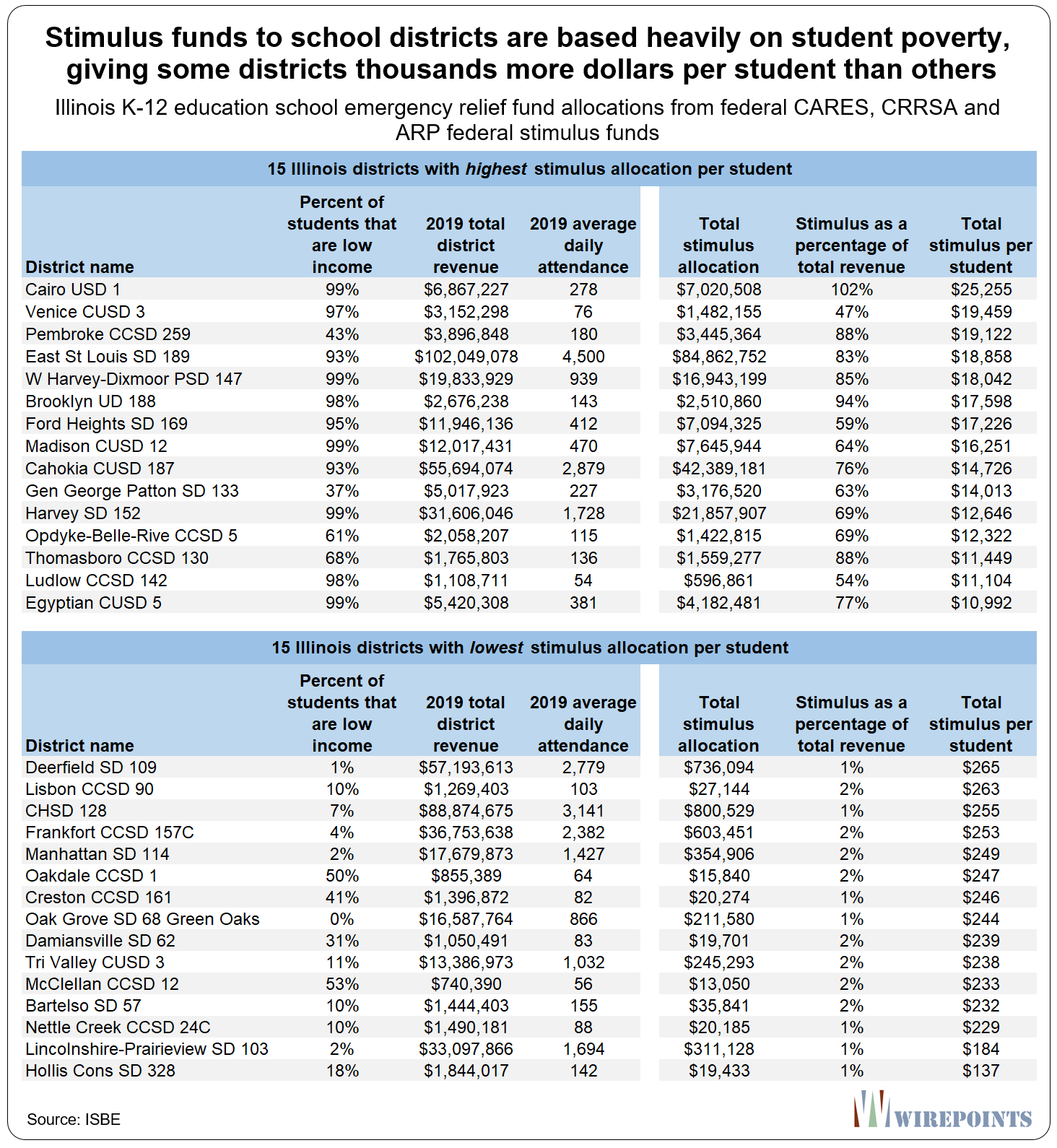 To see how much federal money your local district will receive, check out the interactive database below. The table is based on the most recent data from the Illinois State Board of Education and is still subject to change.
Wirepoints included several other metrics, student average daily attendance, district spending per student and 2019 district revenues to help readers compare stimulus allocations between different school districts.
To see stimulus totals, scroll to the right in the table.

Illinois already spends far more than its neighbors on education and yet its politicians are committed to spending hundreds of millions of dollars more every year. All to achieve student outcomes that haven’t improved in a decade and are, in most cases, worse than in neighboring states.
Wirepoints will soon release a new report that tackles the myth of Illinois’ low education spending.
 Summary and audio
  Much of the routine trade and investment between China and America is entirely appropriate and in America’s interest. But inserting the Chinese Communist Party into America’s pay-to-play system and its economic development strategy isn’t just crossing a line. It’s a leap into an abyss of stupidity.
 Illinois paid the price for embracing Fauci’s “science.” Here’s the retrospective.
Just goes to show no matter what is given to the Education System they always want more and certain politicians are always willing to succumb to their wants in Illinois.
Jb’s funding the $350b seems especially irresponsible with news stories just breaking (like centersquare articale posted below–“Pritzker’s plan to use federal tax money to pay debt hits snag”) that puts big time restrictions on using fed bailout bucks for paying off pre-pandemic debt.
OEPP is a good metric for comparisons of expenditures per pupil between variable school districts. For example, McHenry County has 2 Unit Districts: Huntley 158 and Woodstock 200 OEPP (operating expense per pupil) for latest year 2020: Woodstock 200 $13,817 (9-month average daily attendance 6058); Huntley 158 $11,841 (9-month ADA 8528). A staggeringly horrifying comparison is obtained by comparing individual Illinois school districts to national “Peers” (similar districts chosen by federal government agency). https://nces.ed.gov/edfin/index.asp MENU: “Data&Tools SUBSECTION: “Comparison Tools” SUBSECTION: “Public School District Finance Peer Search” Comparing Woodstock CUSD 200 to national peers at https://nces.ed.gov/edfin/index.asp (National Center for Education Statistics)… Read more »
ISBE is deliberately making it very difficult to access school financial data. It used to be possible to look up OEPP (‘operating expense per pupil’) comparisons: Go to https://www.isbe.net/Pages/School-Finance-Historical-Reports.aspx Select link to Annual Financial Reports (1996–2020) Then you could look up your school district, click link for desired fiscal year, and download an excel spreadsheet. On the Excel spreadsheet, you go to the tabs at bottom of page and select PCTC-OEPP 27-28 There you could find “Per Capita Tuition Charge per pupil, and OEPP. You could compare to other similarly situated districts. NOW, ISBE has deliberately obfuscated access to School Financial… Read more »
I use ISBE’s ILEARN page. You can download excel files that have financial data for every district going back to 1997.
https://apps.isbe.net/ilearn
THANK YOU for great resource! Just looked at it
Funny thing, whenever I hear “investment” in education, it always seems to mean teacher compensation raises. And hiring of Diversity and Inclusion “executives.” And then assistants to the “executives” and the Administration. They all get in on the action. It does not mean facility upgrades, better technology, more instructional hours and days, more diverse curricula, sports facilities or even rebuilding old and grossly outdated schools, which many of them are. They don’t seem to budget for long-term depreciation of capital assets and the need to replace. They expect us to pay for all that additionally with the constant referendums they… Read more »
Ted, Mark and John all need to say the obvious about this, which they haven’t. This will be impossible to follow through on, period.
This article is confusing. 350 million more per year for how many years?
As many years as it takes to add $7.2 billion in total new dollars to the state education budget.
https://wirepoints.org/illinois-state-super-wants-to-spend-7-2-billion-on-a-failed-education-model-bloated-education-bureaucracy/
Things will crash before that happens. That pesky math will get in the way again. It simply will not happen.
John, with rising pension costs, that will not be possible. I also read they may only go for 3.5 billion total, and not 7.2 7.2 will never occur. I doubt even 3.5 will as the state declines every year. Do you agree? The state, simply put, has no where near the money to pay for this.
I think the original commitment is $300 million per year for 10 years. If the $350M commitment is met, then $50M of that amount is appropriated for the Property Tax Relief Grant to give back to a few select school districts, hence the $300M.
It won’t be met – not even close, just like the pensions. 🙂
It’s a bribe to get the teachers union to better support his next run at the unfair tax amendment
The Fail Tax failed miserably, and has zero chance of passing without the pensions being fixed first. Non-starter at this point.