
By: Ed Bachrach, founder of the Center for Pension Integrity, and Ted Dabrowski
In the dark of night during the recent state budget negotiations, Illinois’ General Assembly passed legislation to sweeten the Tier 2 pensions of Chicago police and firemen. If Gov. Pritzker signs the bill, the obligations of Chicago’s public safety pension funds, already nearly insolvent, will get bigger. For police and firemen, it will be another blow to their retirement security. For taxpayers, it will mean even higher property taxes.
The governor should veto this reckless and unnecessary measure.
This is just the latest piece of sweetener legislation that’s arisen due to Tier 2 pensions. Tier 2 government employees across Illinois, those hired after January 1, 2011, were originally given reduced, but still handsome pension benefits by the General Assembly. But recently, some lawmakers and unions have claimed that the benefits for some Tier 2 workers are too low, violating arcane IRS regulations tied to Social Security.
Several proposals subsequently arose to sweeten the Tier 2 pensions of state-level employees, with potential costs rising as high as $80 billion, even though no real proof of any violation was ever provided.
Fortunately, lawmakers avoided increasing pension benefits by wisely inserting a new reserve fund into the budget to ensure the state will comply with Social Security requirements if any violations are ever proven. That should have been enough to head-off any future issues with the IRS.
But the unions wanted more. And so lawmakers passed a dedicated bill providing sweeteners for Chicago’s public safety pensions anyway.
Civic and policy groups have been studying the Tier 2 problem for over a year and have counseled repeatedly against any sweetening beyond simple compliance. Because this proposed legislation does more than that, there will be several negative consequences if it becomes law.
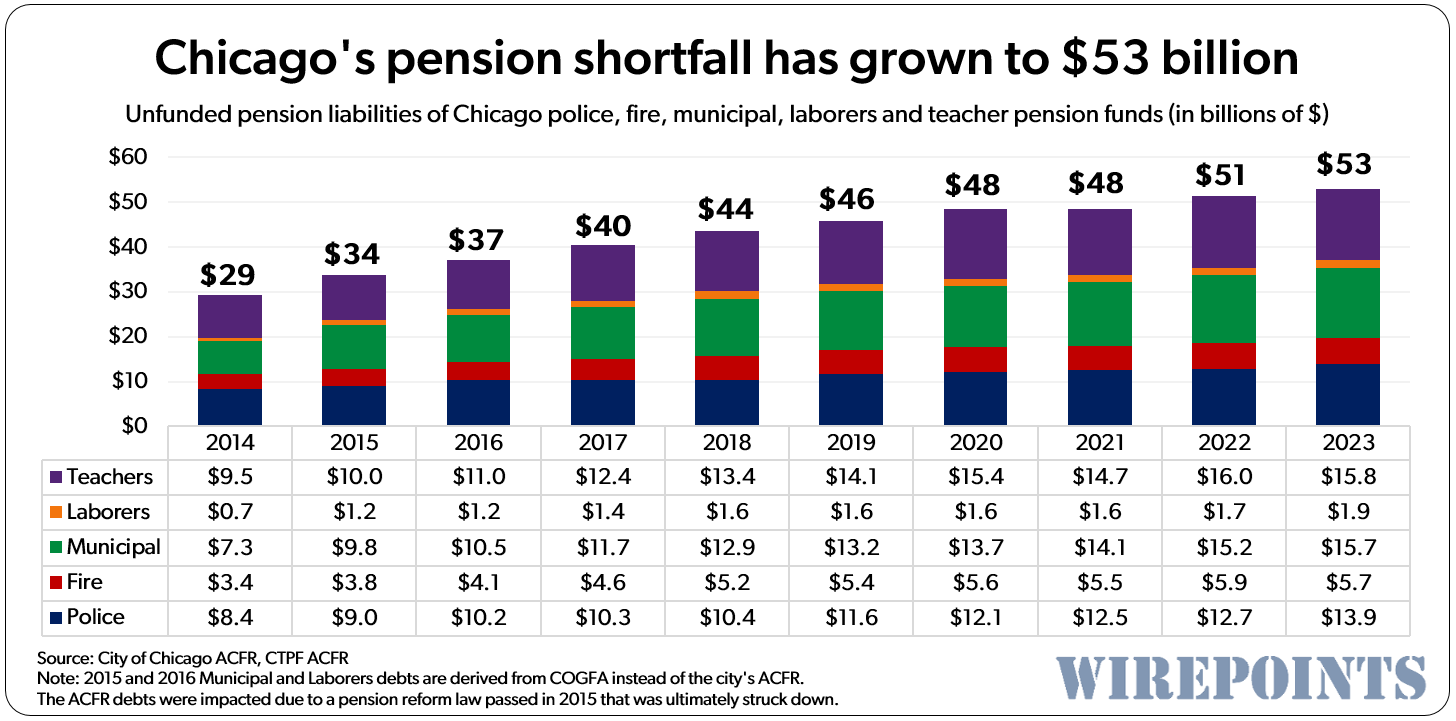
First, the sweeteners were never actually scored, so no one knows just how big the costs will be. Chicago’s police and fire pension plans are just 23% funded and are two of the most insolvent funds in the country. Pushing even more costs onto them amounts to political malpractice.
Second, this law is yet another unfunded mandate on Chicagoans. The state, and not the city council, is telling city residents that they have no choice but to fork over more money to public workers.
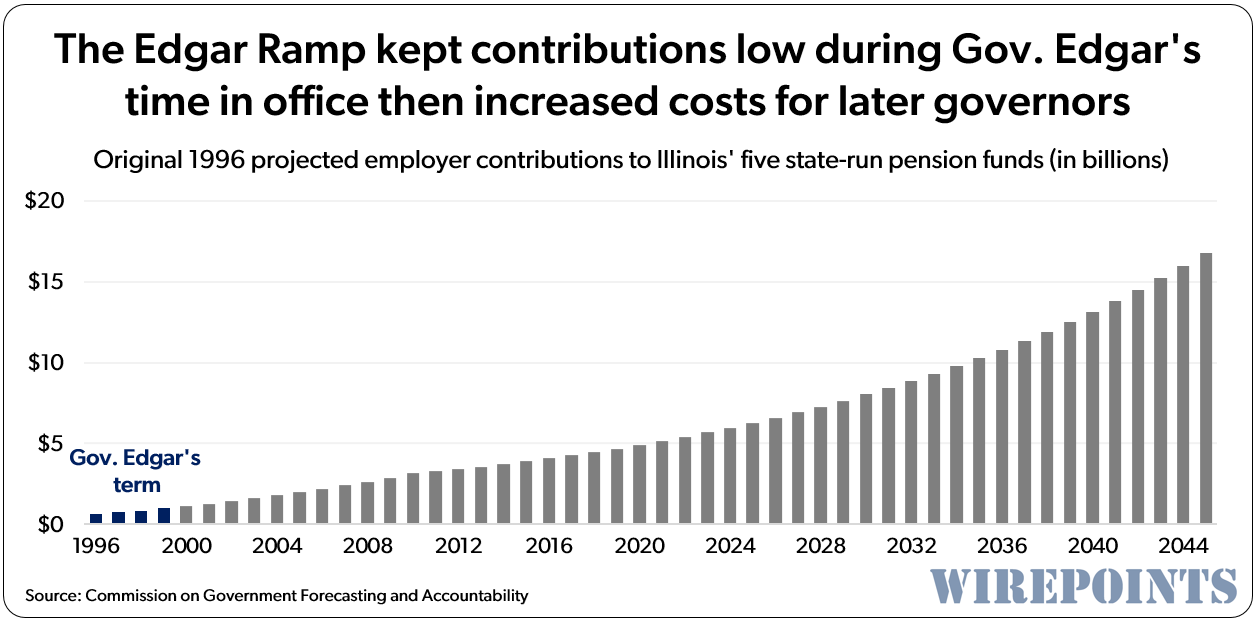
Third, the proposed law continues the egregious practice of doling out benefits and pushing out the costs decades into the future. In 1995, Gov. Jim Edgar created a rising pension repayment schedule nicknamed the “Edgar Ramp” (see Appendix). It was supposed to be a one-time re-amortization of debt, but every pension change since then has thrown its costs onto the ramp. If Gov. Pritzker signs this legislation, he’ll continue this actuarial malpractice of shoving costs into the future – call it the Pritzker ramp.
What all this boils down to is that lawmakers don’t take seriously the negative consequences of Illinois’ worst-in-the-nation pension problem. The back-loaded ramps push punitive fiscal burdens onto future generations and governments. If these were private sector plans, the 1974 Employee Retirement Income Security Act (ERISA) would require that the plans maintain 100% funding with added strict rules for distressed plans whose funding falls below 80%. As it is, every state-level and Chicago-run pension fund is already below the 50% funded level (see Appendix).
Lawmakers’ pension malpractice is just half of the story. The other half is the political culture in Illinois.
Gone is the ability for lawmakers to govern themselves through what the dictionary defines as prudence: the use of reason, wisdom, caution, and discretion in practical affairs. Missing are sound judgments, the avoidance of unnecessary risks and the consideration of potential consequences. They even ignore the wise counsel of reputable policy organizations that caution prudence and keep a watchful eye on the statehouse.
In the end, the unions and the state’s lawmakers couldn’t defend the Chicago sweeteners as prudent, so they pulled a fast one in the middle of the night.
Expect similar changes for state-level and other Chicago pensions sometime in the near future. How long until lawmakers give in to union demands and sweeten those pensions, too? Citizens in Illinois see these machinations and use the only word they know to describe them: corruption.
Gov. Pritzker, veto this bill. If you don’t, you will own the pension woes and the resultant property tax hikes across our fair state. And you will perpetuate the institution of pension malpractice and the political culture of stealth and underhandedness.
Read more from Wirepoints:
- PRIMER: Illinois lawmakers shouldn’t burden taxpayers with Tier 2 pension “fixes” until they know what they’re doing
- Common sense prevails for once in the Illinois statehouse
- More than $1 billion in market losses is a reminder of how close Chicago pensions are to the brink
- Illinois taxpayers deserve answers before state pension costs rise – Sun-Times oped
- Do Illinois and Chicago really need to sweeten Tier 2 pension benefits? – Chicago Tribune oped
- Video: Here come more pension sweeteners…(aka tax hikes) – Wirepoints, AFP and IPI
- Chicago’s black hole: Pension debts jump even though taxpayers pour billions into city funds
Appendix.

 Expect no retraction or apology. This what they do.
 The state’s existing buyout program for its own pensions is the precedent for Chicago, which should be a warning: Look out for similar exaggerated claims and shoddy analysis.
JB and fiscal responsibility don’t belong in the same sentence.
Because the State or City cannot afford it. It should live within its means like the rest of us.
Voters . He won’t