
By: Ted Dabrowski and John Klingner
Illinois lawmakers have a lot of explaining to do regarding K-12 education spending and their continuous demands for billions more in state funding.
How is it that Illinois spends nearly 70 percent more per student (in federal, state and local dollars) than Florida does – a state with an even larger concentration of minority students than Illinois – and yet the Sunshine state largely performs the same or better?
And how is it that Illinois spends $6,000 more per student on education than Indiana – a state with the same share of low-income students as Illinois – and yet that state performs better on national testing than Illinois does?
And how is it that Illinois has been the biggest spender on education in the entire Midwest every year since 2010, and yet we’ve seen no real improvement in student achievement since then?
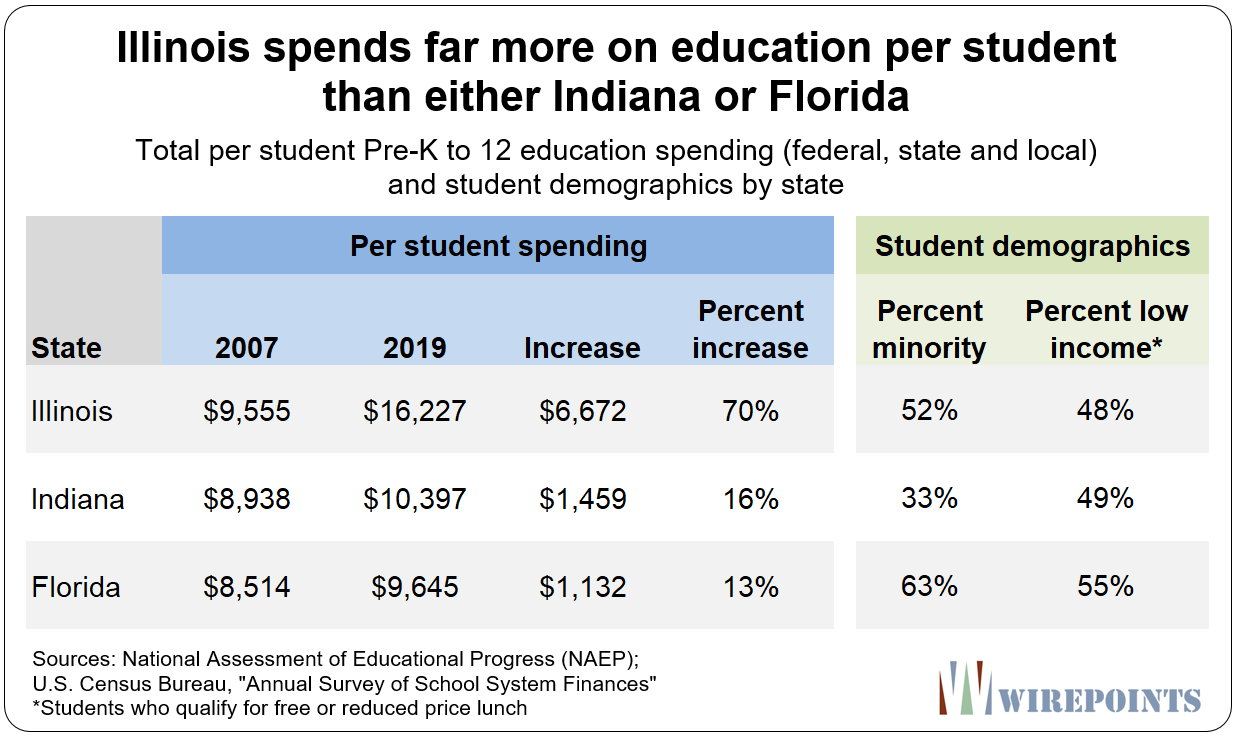 Those questions matter because Illinoisans are struggling under the nation’s 2nd-highest property taxes, nearly two-thirds of which goes to education; the state has hundreds of overlapping and duplicative districts with thousands of redundant administrators; teacher pensions are among the nation’s most generous; and overall per student spending in Illinois has increased by 70 percent since 2007 – the nation’s biggest increase.
Most importantly, Illinois has continually failed to improve on student achievement. Results from the National Assessment of Educational Progress (NAEP), often called The Nation’s Report Card, show Illinois has basically flatlined since 2007.
Reducing Illinois’ $16,200 per student spending to Florida-like levels of $9,600, would mean a reduction of $12.8 billion in education spending per year, which would be the equivalent of a 40 percent property tax cut. (Total property taxes in Illinois totaled $31.8 billion in 2019).
Illinois lawmakers and the state’s education officials have gotten a free pass year after year when they’ve pushed for more K-12 dollars. More recently, former Gov. Bruce Rauner declared the state’s education spending inadequate in 2017 and worked with the educational establishment to pass a new “evidence-based” funding model that demands billions more in state spending over a decade. Gov. J.B. Pritzker has embraced that same “underfunded” narrative and has continued to push for additional funding every year.
Few, though, have asked just what that money is doing and where it’s going.
The details: Illinois spends far more on education than Florida or Indiana
We focused this piece on Florida and Indiana because they have had the slowest growth in per student spending in the nation since 2007, 13 percent and 16 percent, respectively.
In contrast, as Wirepoints documented in its recent report: Illinois education spending soars while outcomes flatline, Illinois education spending per student grew by 70 percent. That’s according to 2007 and 2019 education spending data collected by the U.S. Census Bureau.*
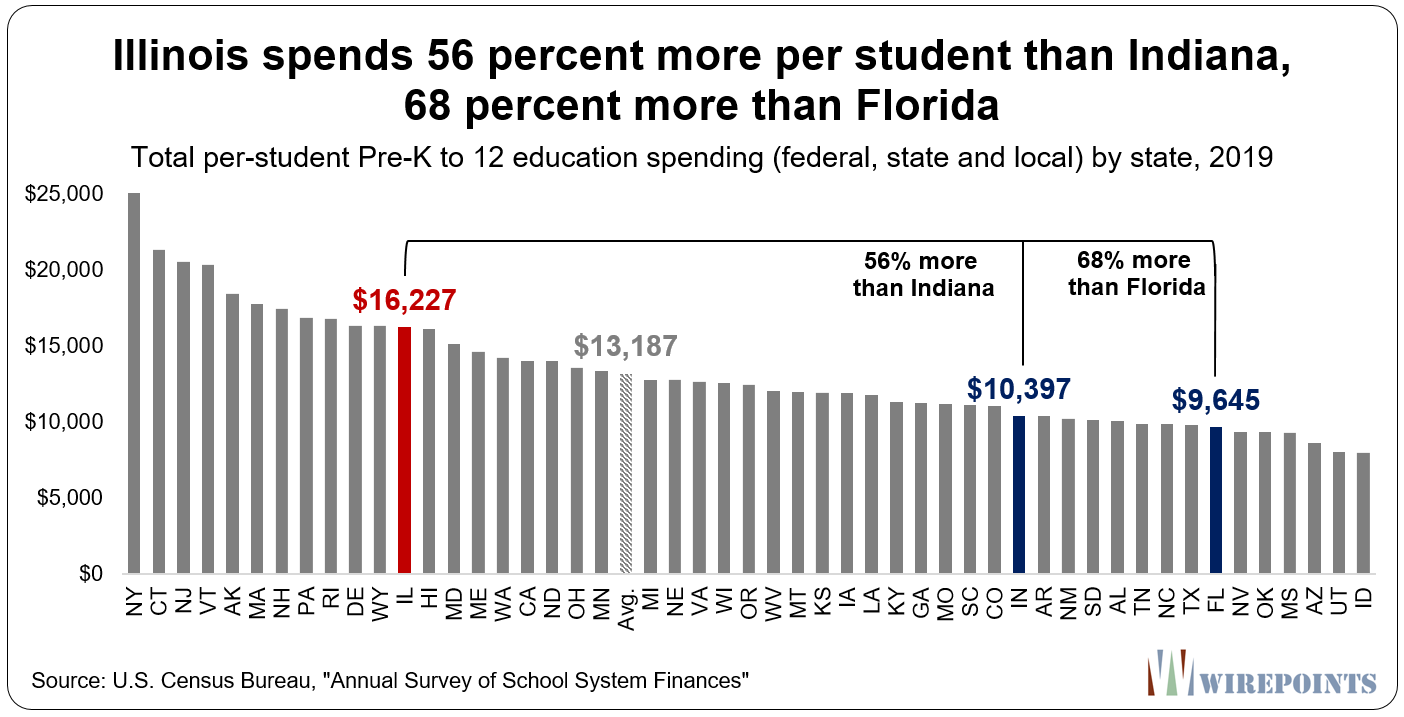
 In 2019, the most recent year available from the U.S. Census, Illinois spent $16,227 per student. That’s the 12th-most of any state and 8th-most when adjusted for cost-of-living.
In contrast, Indiana spent just $10,397, the nation’s 37th-most. Florida spent just $9,645 per student, the 45th-most in the nation.
In all, Illinois spent 56 percent more than Indiana and a whopping 68 percent more than Florida in 2019.
 For all its spending, Illinois does no better
With Illinois spending so much on education and Indiana and Florida spending far less, one might expect Illinois’ student achievement to significantly surpass both states. An examination of National Assessment of Educational Progress (NAEP) test scores shows that’s not the case.
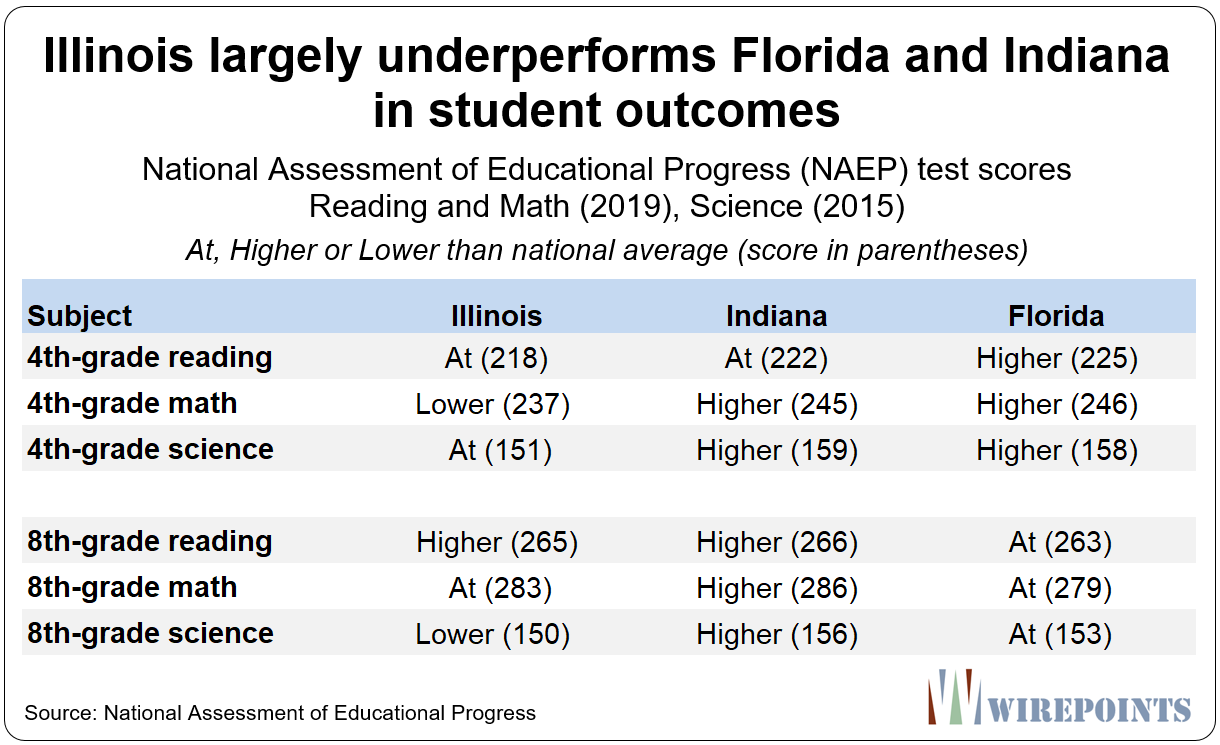
Illinois’ results were largely worse than Indiana and Florida’s over the entire 2007-2019 period.
Take for example, 4th-grade math. Illinois students have always scored below the national average, while students in Indiana and Florida have scored at or above the average.
In 2019 alone, Illinois’ average math score was 237, significantly lower than the nationwide score of 240. In contrast, Indiana and Florida scored 245 and 246 respectively, significantly higher than the national average.
Or look at 8th-grade reading scores. Illinois students consistently scored a few points above Florida and a few below Indiana, though by 2019 each state’s scores had largely converged.
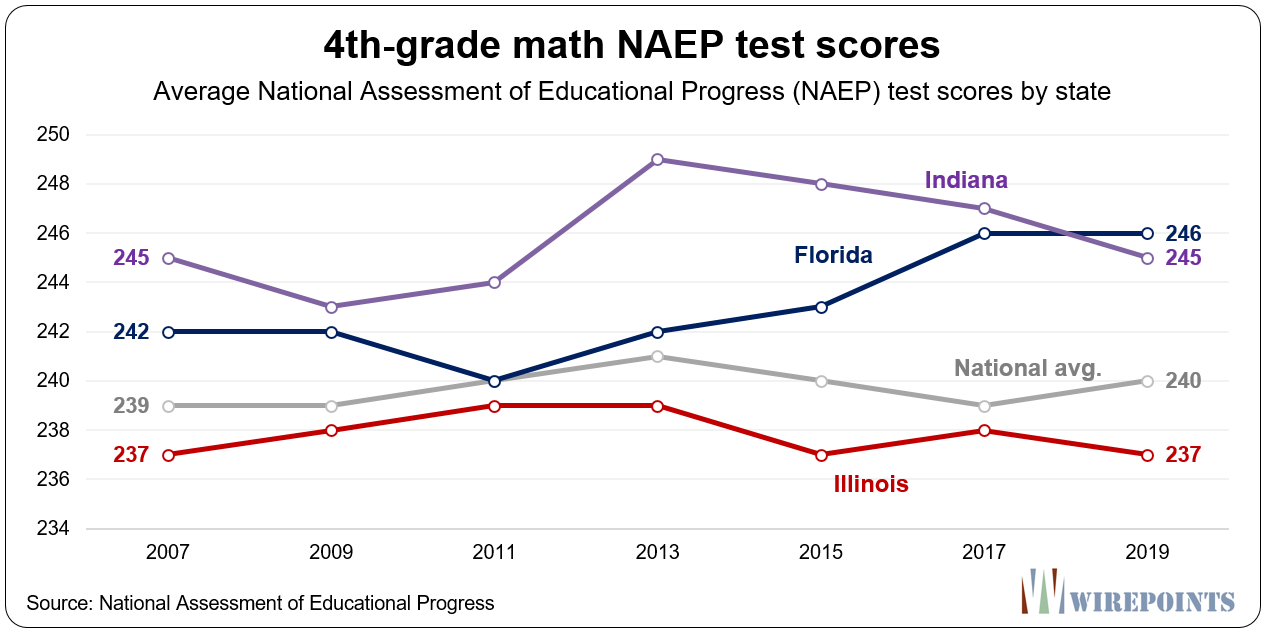
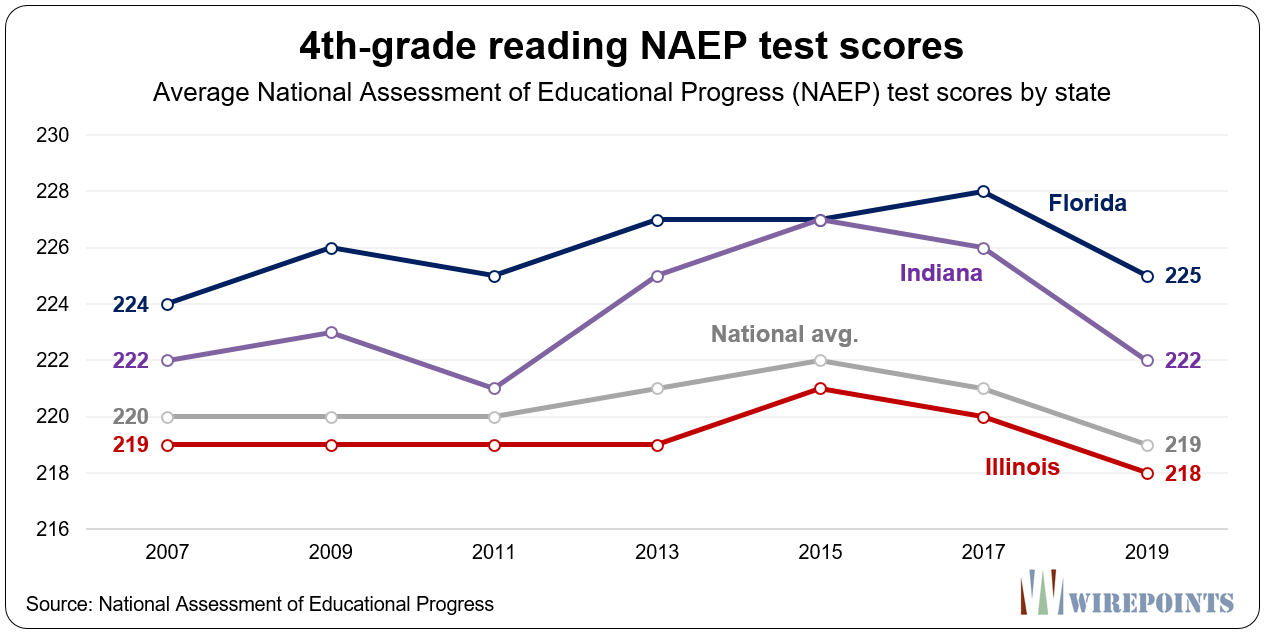

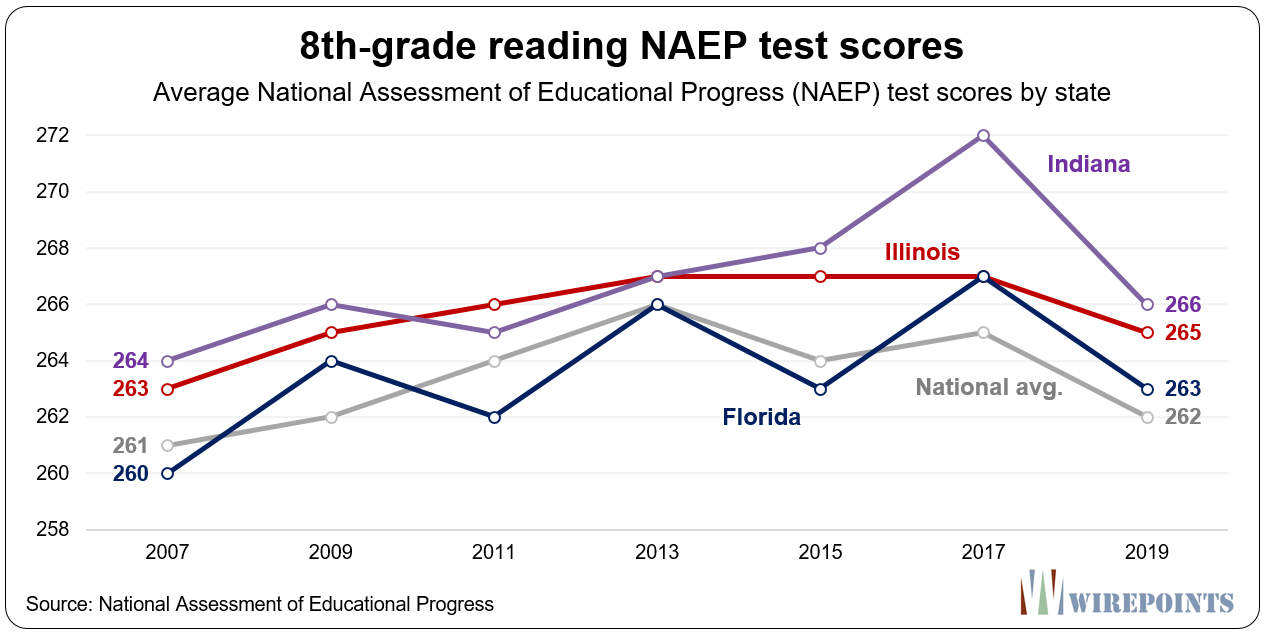 The point remains that, for all of its spending over the 2007-2019 period, Illinois’ student achievement is often worse than two of the lowest spending states in the country.
State officials may try to argue that Illinois’ situation is different due its concentration of poor and minority students – but Indiana has the same share of low income students as Illinois. And Florida actually has an even greater share of minority and low income students than Illinois does.
 If higher spending was so necessary to boost student achievement of low-income and minority students, then Illinois’ scores should be far better than Florida’s – not similar or worse.
Of course, there are many factors that go into understanding student outcomes – far more than just per student spending. And Florida and Indiana are just two states out of 49 to compare to. But the fact that both states have grown their spending so little, and spend so much less than Illinois overall, warrants the comparison.
A forthcoming deeper look at Illinois education spending will reveal that too much of Illinoisans’ money is funding hundreds of overlapping, duplicative school districts, a bloated, growing administrative bureaucracy, overgenerous retirement perks, a regressive pension funding system and multimillion-dollar lifetime pensions.
Those are the many reasons why Illinois spends such a premium on education and yet gets nothing for it.
*Wirepoints chose 2007 as the base year to avoid the volatility in education funding during the Great Recession.
Appendix.
 Audio and summary
  A largely unasked question is becoming glaring: Is Illinois doing all it should to use artificial intelligence to make government cost less and work better? So far, the evidence says no.
 Audio and summary
Many Chicago-area teachers’ contracts average around 3 percent raises per year. Add prorated step increases of around 2 percent per year, and the average salary increase for a Chicago-area teacher is around 5 percent per year. Since the school districts’ line items comprise the biggest percentage of your PT bill, you should now understand why your PT bill increases always outpace inflation. This situation won’t change until: 1) the salary structures for teachers, especially for starting salaries, are lowered for a few reasons, one of which is teachers don’t work full years; and 2) teachers’ salary percent increases are lowered… Read more »
I’d like to know how different parts of IL compare in both scores and amount spent per student. While in college, classmates of mine agreed to work a number of years in inner city schools in exchange for their college tuition being repaid. If most of the failing schools are filled with new teachers doing their time to pay off loans, what motivation is there for improvement?
Ted, John—your comparison of Illinois vrs Florida education cost includes pension/ benifits costs?
Does FL allow the same people to collect multiple pensions too?
These costs EXCLUDES summer school, capital projects and pensions
No, iL cost per student cost EXCLUDES summer school, multi-million dollar capital projects and pensions.
Or, in other words, if the true accural accounting (moody’s #s) teachers benifit/pension costs were added into comparison illinois cost per mediocre student results would be in outerspace compared to Florida? YES?
Yes it does. That’s included in the Census data. To see what Illinois looks like vs. its neighboring states when pensions are stripped from Illinois’ per-student spend, go to our 50-state review linked here: https://wirepoints.org/new-u-s-census-data-illinois-education-spending-soars-while-outcomes-flatline-wirepoints-special-report/.
https://nces.ed.gov/edfin/search/search_intro.asp
Is a peer comparison tool which offers breakdown of many categories of expenditure.
Try it, see how your local district spends your money.
Illinois schools need to be subject to RAC audits.
Doctors who accept Medicare and Medicaid (that is, public funds) must subject themselves to RAC audits.
That is, for-profit agencies invested with supralegal powers to go through all financial records and declare that fraudulent billings occurred. The burden of proof is on the doctor that fraudulent billing did NOT occur.
You see, the RAC auditor has the incentive of compensation as a portion of whatever “fraud” is “found”, according to the unsubstantiated claims made by the auditor.
Why are Illinois schools uniquely protected from the public service performed by RAC audits?
This may be of interest to you but not if you have high blood pressure.
https://www.chicagotribune.com/investigations/ct-school-pension-spikes-met-20150522-story.html
https://www.chicagotribune.com/investigations/ct-municipal-pension-padding-met-20150816-story.htmlhttps://www.chicagotribune.com/opinion/editorials/ct-edit-illinois-pension-spiking-career-hikes-20190610-story.html
I can’t seem to find the Tribune article called Pensions and Penalties-Taxpayers Socked Twice.
It had a breakdown of school districts and the amount of penalties they paid for exceeding the 6% cap. So far Rockford dist 205 is #1 at $3M since 2010 when the 6% was enacted. Why do they care how much the penalty is when the taxpayers end up paying for it. I contacted my local media but nothing was done.
Yes, there is no action on impeding corruption unless initiated by individual citizens.
Citizens could insist school boards conduct thorough forensic audits, or elect school boards who will do so.
All the more reason for bankrupt Illinois to push the crt bs to serve as a giant smokescreen coverup of the massively overpriced inefficienct education fraud machine
It would be an interesting study to compare what states spend per student that are all in on the crt hustle vrs those have ban or limited crt.
It’s only bad news if you live in Illinois. It’s good news for Florida and Indiana. Live in Florida or Indiana. Problem solved. This isn’t rocket science people!
The schools will improve once the police officer, a symbol of oppression is removed! This means, no more crimes will be reported once the CTU gets control of the reporting! Robberies? Assaults? Molestations? Shootings? Here in our school? No way! Got to be “outsiders”! We need more money for safe passage workers!
yea,its those damn guns walking into our state from Indiana,huh Lori,only problem with that is crime in Indiana is way lower than here.
There is another aspect of education costs that should be addressed and that is retirement costs for educators and administrators. The $16K per student is paid approx 60% by local taxpayers/30% state/10% federal. The 60% share is paid directly by property owners which includes here in Rockford total pension pickup for teachers. That state portion is paid by all who pay state taxes in the state. Now add in the pension payout costs which should be coming from the funds assets and yearly returns which are rarely met and the difference is again made up from taxpayers. Now in addition… Read more »
Yes. Now, people can flee/be forced out of homes in high p-tax rate areas, and property ownership can revert to lenders. Lenders will choose to pay p-taxes or abandon titles based upon a profit algorithm. The key factor determining ‘ghost town’ fate is whether the plates can be kept spinning by REITs buying dirt-cheap rental investment properties, and getting public-funds subsidies (like Section 8) for the <5 years it takes to payout the investment in each property. There is an inflection point which triggers death spiral of non-TIF residential real estate. This inflection point has been breached in many Illinois… Read more »
Now the one saving grace is Ptell which limits the increases to 5% or 1/2 of inflation whichever is less. This year taxing bodies will ask for the max since inflation will be more than 5%. If I’m not mistaken under Ptell if your home value doubles they are limited to 5% but if they decline by half the tax rate doubles to compensate. There are 38 counties under ptell including Cook but not Chicago. Home rule communities within ptell can raise additional revenues luckily home rule was voted down in Rockford but not Belvidere. Home values at least in… Read more »
Illinois is truly an extreme outlier, and not in a good way. WP shows in their gap analysis that the citizens of Illinois are being forced to pay drastically higher taxes for mediocre education outcomes. Under normal circumstances, action would be taken to correct this upside down situation. However, Pritzker and the supermajority Democrats have basically hard wired the education dysfunction into the state by giving teachers unions an extreme amount of authority. So like other major problems in Illinois, it’s unfixable.
That’s the way most politicians like it: never fix anything, always blame somebody else, and have, waiting in the wings, sobbing violins and clickbait accusations.
Taxpayers need a mechanism to uncover school district fraud and embezzlement, and spending in violation of law. https://www.nbcchicago.com/news/local/former-cps-principal-indicted-on-fraud-charges-in-alleged-scheme-to-get-overtime-pay/2554634/ The principal recently charged with fraud required co-conspirators to be paid overtime for hours not worked. This (phantom) overtime would go toward their creditable earnings and result in significant retirement benefits boosts. It is also unlikely her co-conspirators paid the taxes on their phantom incomes out of their own pockets, so their complicity cannot be labeled as innocent or coerced. Many individuals had to participate for this scheme to work. These Individuals were willing to defraud their community—essentially stealing money from children… Read more »
Let’s play a game. Please add a progressive response or vote for one here, and then let’s see if we can get any of the CTU communists to actually regurgitate one of them. Ok, I’ll start: “Systemic Racism!” Us: “But isn’t this state run entirely by Democrats from top to bottom? Isn’t every major political position or appointment in Chicago and Cook County filled by a black person? How in the heck is a “system” racist when it’s run by the very same minorities who claim to be oppressed by it? (scratches head) “Shut up Racist! You don’t even understand… Read more »
Centuries of oppression are built into the system!
The system itself was designed by white people, ergo, it must be oppressive!
So,a black guy and a white guy walk into a small store at the same time.If the shop owner helps the white guy first,the owner MUST be a racist for helping whitey first.If he helps the black guy first ,the shop owner is racist cuz he wants the black guy out of his store sooner.-Its a no win situation with leftists.