
By: Ted Dabrowski and John Klingner
We recently wrote about how Illinoisans are burdened by the nation’s highest effective property taxes. New research by ATTOM ranked Illinois residential property tax rates as number one in 2021, just ahead of New Jersey.
Residents aren’t alone. Illinois businesses are subject to the same level of overbearing taxes. A 2021 Lincoln Institute of Land Policy study measuring effective property taxes in the largest city in each state found that Chicago imposes the 2nd-highest commercial property taxes in the nation.
The study also calculated that Aurora, Illinois, the state’s second largest city, imposes the nation’s 6th-highest tax rate. (Illinois and New York had two cities in the study because the tax systems in Chicago and New York City are significantly different from what exists in their respective states.)
Combined, the two cities serve as a proxy for Illinois’ overall property tax burden on businesses.
Chicago’s effective tax rate in 2020 on commercial properties valued at $1 million was 4.03 percent, while Aurora’s was 2.94 percent. The average tax rate of the cities analyzed by the study was 1.95 percent.
 Chicago and Aurora’s high national rankings remained almost constant regardless of whether the commercial properties analyzed were worth $100,000 (2nd and 5th), $1 million (2nd and 6th) or $25 million (2nd and 6th).
Illinois can’t hope to attract many businesses here, or even keep the ones it has, as long as the property taxes remain a national outlier.
Not only do the sky-high taxes hurt companies’ bottom lines, but they also drive away residents – the customers businesses need to thrive. What company wants to be in a high tax state that’s losing people?
The Lincoln Institute study also found that Chicago and Aurora’s residential property taxes are, unsurprisingly, also high. Aurora hits its residents with an effective tax rate of 3.25 percent – the highest of the 53 big cities measured.
Chicago taxes are lower, but still high compared to most states. The Windy City hits its homeowners with a 1.54 percent rate, the 15th-highest of the cities measured. The average tax rate among all the cities was 1.34 percent.
 Of course, there are many things that help determine the overall effective tax rate for a given city or state: a government’s overall reliance on property taxes versus other taxes; the overall value of home and commercial properties; whether a government spends a lot or a little relative to its peers; and how much of the property tax burden falls on commercial properties compared to homes.
Illinois politicians often claim property taxes are high because Illinois relies more heavily on property tax revenues compared to other states, but that defense doesn’t hold up. Illinois is a high-tax state, period.
Illinoisans now pay the nation’s 7th-highest combined state and local taxes, according to the latest state-by-state data released by the nonpartisan Tax Foundation. Other groups say the burden is even higher. Kiplinger says Illinois is the nation’s least tax friendly state for the middle class, and Wallethub calculates that Illinoisans pay the highest overall state and local tax burden in the country.
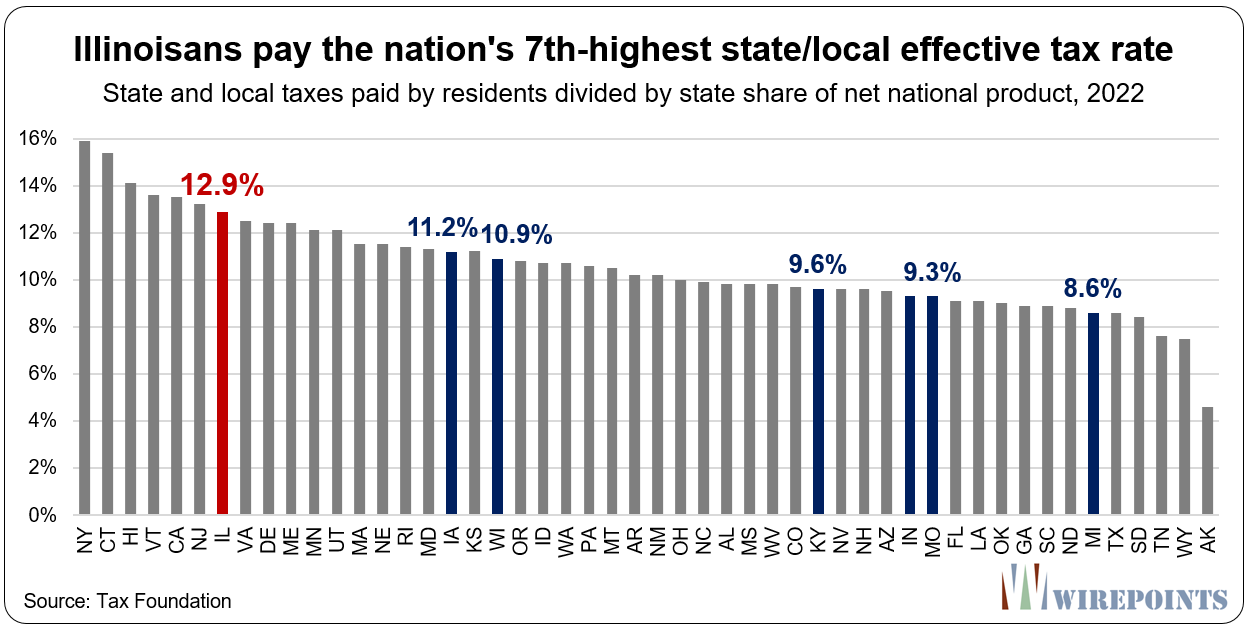 Taxes are high because Illinois is a high-spending state. A few of those higher costs include:
- Paying state workers the 2nd-highest average government salaries in the nation.
- Providing government pensioners, especially teachers, with some of the nation’s most generous retirement benefits.
- Paying for nearly 7,000 units of local government, the nation’s most, and the bureaucracies that go with them.
- Offering free retiree health insurance to state workers.
- Spending the 8th-most per student – and the most in the Midwest – on K-12 education.
- Granting government retirees 3 percent compounded COLAs, one of the nation’s most generous post-retirement benefits.
- Increased operating costs for local governments driven by some of the nation’s most union-friendly collective bargaining laws.
Bringing taxes down
Some Illinois politicians say they want to bring property taxes down by capping property taxes or implementing spending freezes. But those ideas don’t actually address the cost drivers behind Illinois’ rising property taxes: skyrocketing pension costs, generous public sector benefits and too many units of local government.
There won’t be any significant drop in property taxes until pensions are reformed and public sector unions are stripped of their extreme bargaining powers.
If candidates on both sides of the aisle aren’t openly pushing for an amendment to the pension protection clause and subsequent pension reforms; if they’re not pushing for a roll back in the public sector union’s collective bargaining laws; and, if they’re not pushing to get rid of overlapping, duplicative local governments and the bloat that comes with them, then they’re not serious about bringing down your property taxes.
Read more from Wirepoints:
- Chicago car thefts spike sharply in 2022, up 100% along lakefront compared to 2019
- Close the revolving door for high-risk offenders in Cook County
- Two ‘Compelled Speech’ Matters Beg For Litigation In Illinois
- Secret union contract negotiations trample on Illinois taxpayers and parents’ rights
- Nine things Gov. Pritzker didn’t tell you about Illinois’ 2023 budget
- Current Progressive Agenda Is Relieving Harm From Past Progressive Agendas
- Illinois needs a multiyear restructuring plan to stop residents from fleeing
 Expect no retraction or apology. This what they do.
 The state’s existing buyout program for its own pensions is the precedent for Chicago, which should be a warning: Look out for similar exaggerated claims and shoddy analysis.
Illinois is unfixable – Democrats, Public Unions, and Madigan have worked hard over many years to make it this way.
Your choices are:
a) Leave and forget it all.
b) Accept the abuse with the understanding it will continue to get worse.
Relatively easy to incorporate a territory of Illinois into a Village or City which could rival Chicago in terms of entitlement to State funds. (65 ILCS 5/Art. 2 Div. 2 heading)DIVISION 2. INCORPORATION OF CITIES (65 ILCS 5/Art. 2 Div. 3 heading)DIVISION 3. INCORPORATION OF VILLAGES TIF designation is obscenely easy: Illinois High Courts have ruled that blight designation is at the whim of Mayor or municipal President. Also, the doling out of TIF money is at the whim of the political rulers and citizen taxpayers can do little to circumvent corrupt distribution of TIF funds...so WHY NOT have a municipality which… Read more »
I like it. Whoever goes broke faster gets more money. A competition of sorts. Move over Illinois, California, and New York! Villages and towns now in a race to go broke first. First one that can’t pay the bills gets everyone else’s cash. Yep, get woke, go broke.
And now we have the mayor of Aurora, Richard Irvin running for governor when he has failed as mayor of Aurora. hell no
I would love to live in a state where we could elect a Republican Ron Desantis. But I live in the reality that is IL. We don’t live in a state that could elect a Republican Ron Desantis. We don’t live in a state that can elect a Bailey, or Rabine, or a Sullivan. We do however, in a Red Tsunami year like we have now, have a chance, just like we did in 2014, of electing a RINO like Irvin, and in IL, almost anyone with an R next to their name is better than JB Pritzker. I know,… Read more »
You say that after we elect a RINO there would be positive changes. I don’t think we could count on that. However, almost anyone would be better than JB Pritzker. What a vile excuse for a human being.
We need some elected officials who actually want to make things better rather than enrich themselves. There is absolutely no reason to vote for any Democrat, or Republican incumbent as they’ve both neglected their responsibilities to lead.
Here’s an article from WIFR in Rockford about a couple moving from California TO Illinois because cost of living is less here. This should be under a Ripley’s Believe or Not article. How bad is it that this made headline news? Wait till they get their tax bills and see if they feel the same way in a few years. I’m thinking of sending them a sympathy card and a note for the nearest mental health/suicide prevention facility.
https://www.wifr.com/2022/04/28/california-couple-makes-2000-mile-move-rockford-area/
Maybe their next move is New Jersey.
Suburban Rockford (loves park, Cherry Valley) might actually be better than a handful of third world hellholes in CA: all of the inland empire, South LA, San Fran. proper.
Suppose all of unincorporated Illinois (mostly farmland and low density residential) incorporated as a Municipality, let’s call it Libertaria. Municipalities in Illinois are allocated State income tax distribution based on population. Obviously Chicago gets the lions share. Libertaria’s new allocation would dilute that distribution ratio. Next, Libertaria could declare every square inch within its borders as blighted, thus TIF-eligible. That means that property value assessments would be frozen for 23 years. The “incremental” tax generated by inflation of property values would be distributed back to each landowner to cure his own blight. Finally, Libertaria could give every citizen within a… Read more »
I’ve read your idea on previous postings. Maybe it has legal merit, but I doubt it. That might well partly depend upon the legal definition of “municipality.” I don’t see how any stretch of that word would apply as you seem to want.
Businesses don’t pay taxes. Never have, never will. That expense is just passed on to the consumer (all of us) as part of the cost of doing business. It’s part of why everything is so expensive in Illinois, and why so many of us are leaving.
Sort of. Businesses operating/competing within the same state are on a level playing field with regard to state taxes and can pass them on to the consumer. When a business in Illinois is competing against a business from another state (or internationally), the Illinois business may not be able to pass the cost along to the consumer.
Perfect example is there’s no gas stations (amongst many other businesses) in Illinois near the border.
Not true. East Dubuque gas station just before the bridge crossing the river to Dubuque. I wave both ways – going to and coming from the Iowa Hy-Vee pumps. Ha!
This is how cities die — when you can’t park your car on your own street, that city no longer works for you, and you move somewhere else. Ask Detroit how that worked out for them.
Can’t wait to see what taxes are after Illinois has burned thru the Fed covid money. Oh well, think positive. Maybe there will be a new pandemic.
na, it’s gonna be war and famine.
Covid money? I thought Pritzker was responsible for the balanced budget and paying bills on time.