
By: Ted Dabrowski and John Klingner
Illinois lawmakers have passed a budget for fiscal year 2022 that does nothing to improve the fiscal and economic trajectory of this state. Missing were the many spending reforms Illinois needs to bring down its pension debts and high property tax rates.
The budget reportedly spends $42.2 billion of $42.3 billion in expected revenues and relies on some $655 million in business tax hikes to make the budget “balance.”
Each year Illinois lawmakers find a new way to kick the can and this year billions in federal aid made that possible. The state’s tax revenues have boomed recently as a result of consumer spending spurred by stimulus checks, while the state government also received a direct $8.1 billion windfall from the federal government.
All that extra money – not to mention the $13 billion-plus that local governments will receive – has let lawmakers off the hook from making any tough decisions, allowing them to paper over Illinois’ many fiscal cracks that widened at the onset of the pandemic.
But the state’s financial cliff will be waiting after the federal largesse runs out. Here are the biggest takeaways from the 2022 budget:
1. The 2022 budget hikes taxes by $655 million. The budget adds $655 million in revenues by implementing several of Gov. Pritzker’s suggested tax hikes on businesses, what he calls “closing corporate tax loopholes.”

2. The budget spends $2.5 billion of the $8.1 billion in federal American Rescue Plan Act money. $1.5 billion will go toward violence prevention, business relief, and affordable housing. The other $1 billion will go toward infrastructure projects. Legislators say they’ll spend the summer months planning how to spend the remaining billions.
3. Official retirement costs will total over $11 billion in 2022.

Wirepoints calculates that retirement costs will consume 26 percent of the 2022 budget. The state is set to contribute $9.4 billion in General Funds to pensions, pay $777 million in pension bond costs, and pay an estimated $1 billion in retiree health costs.
In total, that’s $11.2 billion of the $42.3 billion budget consumed by retirement expenditures.
On top of the payments from the General Fund, another $1.2 billion in pension payments will come from other budget funds, meaning the state’s total retirement costs will be an estimated $12.4 billion in 2022.
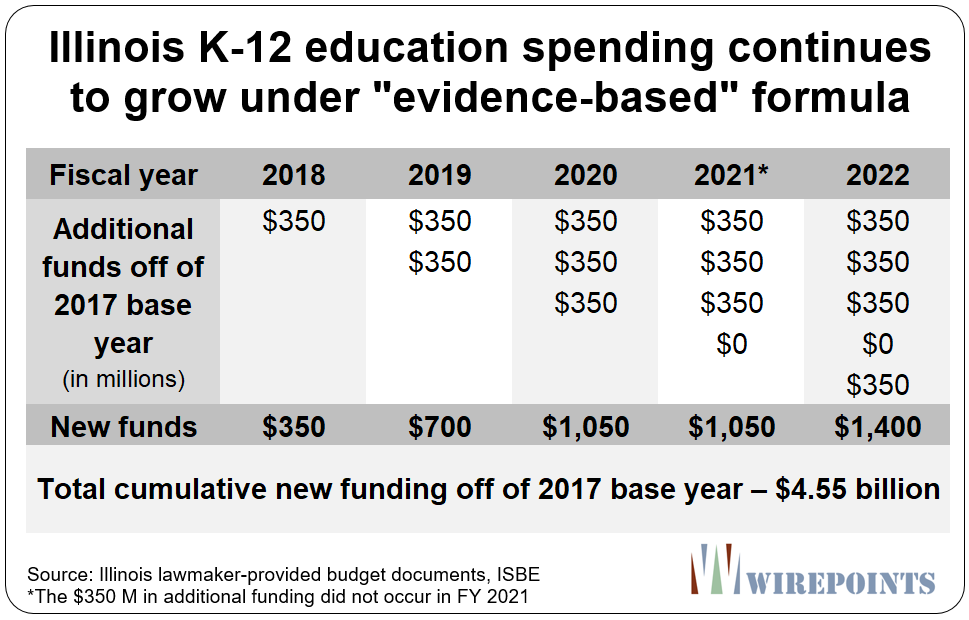
4. Education spending increases by another $360 million
The budget adds another $360 million to K-12 education – part of the state’s decade-long goal to grow Illinois’ education budget as required by the 2017 “evidence-based” funding formula. In total, the state will spend $9.2 billion on education in 2022.
What lawmakers continue to ignore is how much Illinois already spends on education. The latest data from the U.S. Census bureau shows Illinois in total spent over $16,200 per student (including local, state and federal dollars) in 2019 – far more than any of its neighbors. Illinois spends 23 percent more than the national average ($13,187), 27 percent more than Michigan ($12,756), and 56 percent more than Indiana ($10,397).
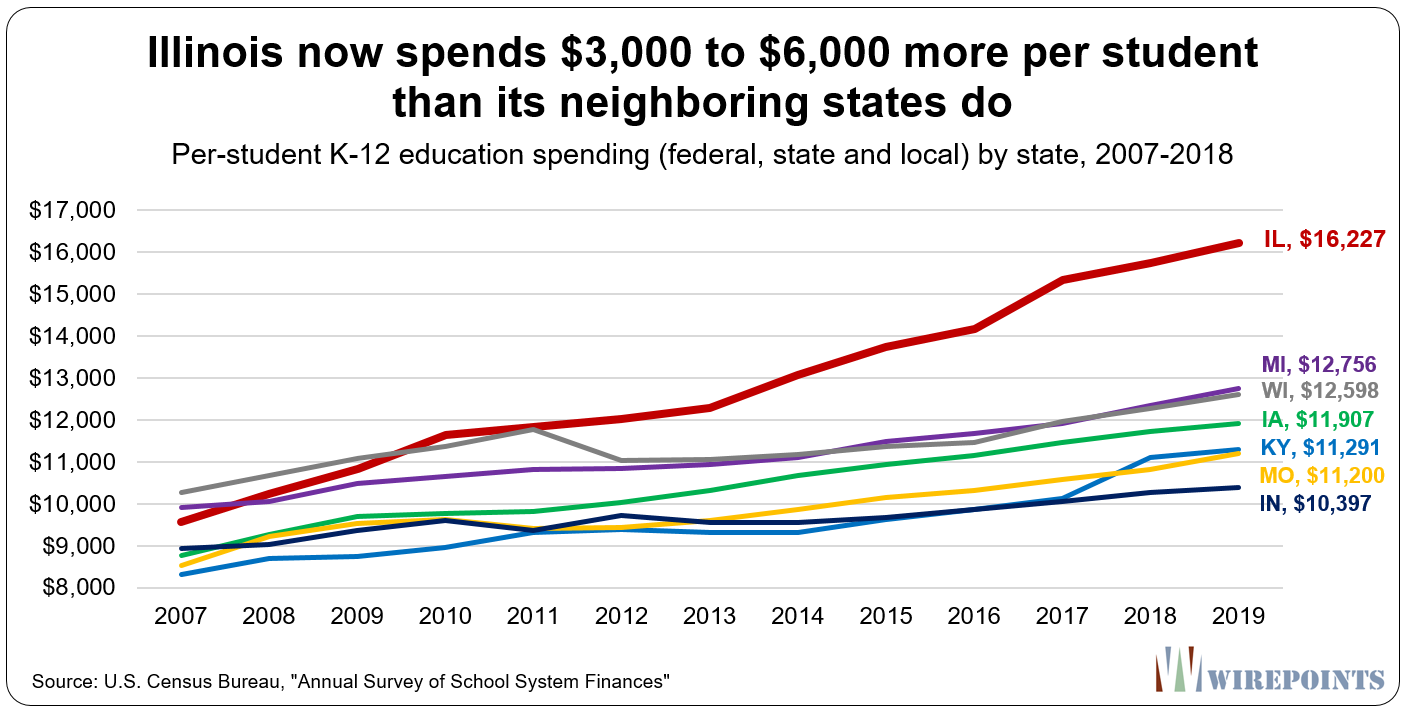 Education policy needs to move from discussions on how much more money K-12 needs to how to better spend the money Illinois already has invested in education. That will be the focus of an upcoming Wirepoints report.
5. The budget pays off $2 billion in debt to the Federal Reserve
The 2022 budget will pay down the $2 billion remaining from the $3.2 billion the state originally borrowed from the Federal Reserve’s Municipal Liquidity Fund (MLF) program in the midst of the pandemic.
Lawmakers are taking credit for the move, saying paying down the debt early will save Illinoisans $100 million in interest savings. But no praise is warranted. Lawmakers are simply removing a cost Illinois should not have been saddled with in the first place.
Illinois was the only state to borrow from the MLF – largely due to lawmakers’ insistence on passing a 2021 budget that was $6 billion in the red. If lawmakers had simply passed a budget that was affordable to Illinoisans in the first place, none of the MLF borrowing or subsequent interest costs would have occurred.
6. No matter what politicians claim, the budget is not balanced.
Lawmakers will claim the 2022 budget is balanced, but that’s just not true. Correct pension costs – based on the pension funds’ actuarial reports – would add another $4 billion in expenses to the budget, while retiree health insurance costs would add about $2 billion more. It’s this kind of failed accounting that’s led to the massive retirement debt build up over the past three decades.
We haven’t yet seen the precise shortfalls for 2022, but given no pension reform or change in the statutory payment requirements, the shortfall should be similar to amounts in recent years (see 2020 numbers below).
 7. Hopes for a credit upgrade.
State Comptroller Mendoza has expressed hope Illinois bonds will get a credit upgrade soon based largely on the state’s falling unpaid bill backlog. Illinois’ credit rating has hovered just one notch above junk for several years.
A credit upgrade could happen, but if it does, chalk it up to the billions in federal dollars that have flowed into the state. Since bondholders have first-dibs over money, their situation may have improved for a few years.
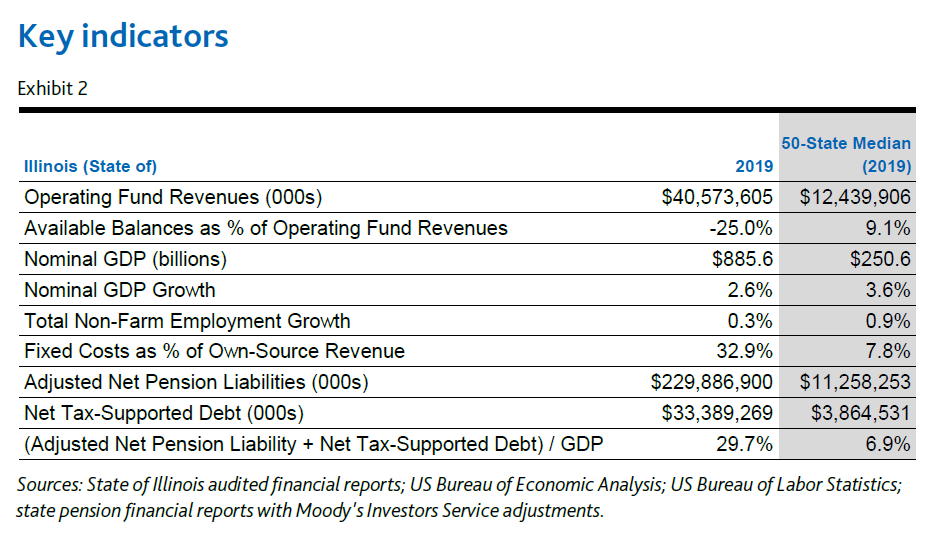
But make no mistake, any upgrade will have nothing to do with what legislators have done. They’ve passed none of the structural reforms that could have a major impact on Moody’s “key indicators” listed below.
 **************
Pritzker’s administration has been quoted as saying Illinois is on the “cusp of being in the best shape it’s been in 30 years.” That’s nonsense.
Illinois has the nation’s largest pension crisis; the country’s second-highest property tax rates; a credit rating that is by far the lowest in the nation; the country’s 48th-worst business environment; record outmigration; and a shrinking population – one of just three states in the country.
Illinois needs to forget these one-year budget deals, they are a waste of time for everybody. It would have been far better to pursue a multi-year budget – an emergency reform plan – and use those one-time billions of federal dollars to cushion the pains of real structural reform. Now that would have been something for Pritzker to truly brag about.
 Audio and summary
  If this bill passes, say goodbye to local control over all Illinois parks and expect to see open drug and alcohol use, needles, no sanitation and fire hazards, but no ordinary park users.
We should include pension costs with their associated services. In other words, TRS payments should be lumped in with K-12 spending, SURS with higher ed spending, etc. That would show everyone how much we really spend on these services. Separating pension costs make current spending look stagnant while pension costs keep eating larger chunks of the budget. Some folks will argue we shouldn’t include pension debt in determining yearly costs, but I disagree. Illinois is using cash-basis accounting. That means the value the state places on K-12 education, for example, is whatever the state spends that year on education funding… Read more »
“That more and more of that cash goes to pensions isn’t the taxpayers’ fault.” I beg to disagree in that every time political pressure is put on legislators to spend more for line items of a discretionary nature there is an equal subtraction or more borrowing for non-discretionary expenditures. That’s on both the legislators voting for it and the taxpayers who succesfully make such demands.
This is why we’re leaving.
I honestly think along with yourself a lot more people are going to be following and leaving Illinois, reason, taxes and Springfield legislators.
It will be interesting to see how inflation is going to affect fiscal expenditures of state government.
This federal largesse is not going to be free. When the cost of borrowing goes up, due to high inflation, where will the state be, then?
There is no such thing as a free lunch.
It is such a shame that the Illinois Democrats with their super majority lack any kind of fiscal stewardship. The Red State bailout should be viewed as a gift to be used to set Illinois on a sustainable fiscal path that supports economic growth, much like a debtor working their way back to solvency. Instead the Red State bailout will be wasted on the same reckless spending policies that got Illinois into a fiscal hole. Such a shame – people of Illinois deserve so much better. It’s not hard, just takes political will. Oh well.
They could care less, they’ll show Joe pictures of children crying and expect an immediate windfall. Money is just some rasiss nonsense. How many of our leaders have been quoted ‘hoping for improvement’ children hoping their problems away. That’s Chicago Leadership!
Easy data tool for Peer Comparisons of your public school district with peers nationally is at nces.ed.gov ( Noone should be able to complain this .gov site which has gathered educational financial data throughout several presidencies is partisan or fake news). EXAMPLE: Woodstock CUSD 200 compared to peer districts across America spends $16,796 per pupil per year. Peer average spending per pupil is $10,787. The next highest Peer to Woodstock expenditure per pupil is $11,651 https://nces.ed.gov/edfin/search/search_intro.asp Illinois Report Cards can confirm Woodstock CUSD 200 low level of college readiness or 5th grade reading and math comprehension, for example, as evidence… Read more »
Not sure why anyone cares, those in the state of Illinois are not going anywhere. They are not fighting back, it’s all going exactly the way they want it to. So why make a change, if anything take this to the logical conclusion, hurry up and pass the progressive tax, and let those who run the state do what they think is best for the state. After all the citizens of the state put them there to do just that.
It’s election fraud
Indeed. and if 2020 is not dealt with, they will continue stealing elections. And with it America’s prosperity.
Illinois limps from year to year. The gap between Illinois and it’s healthy neighbors will simply widen until they can no longer see each other.